

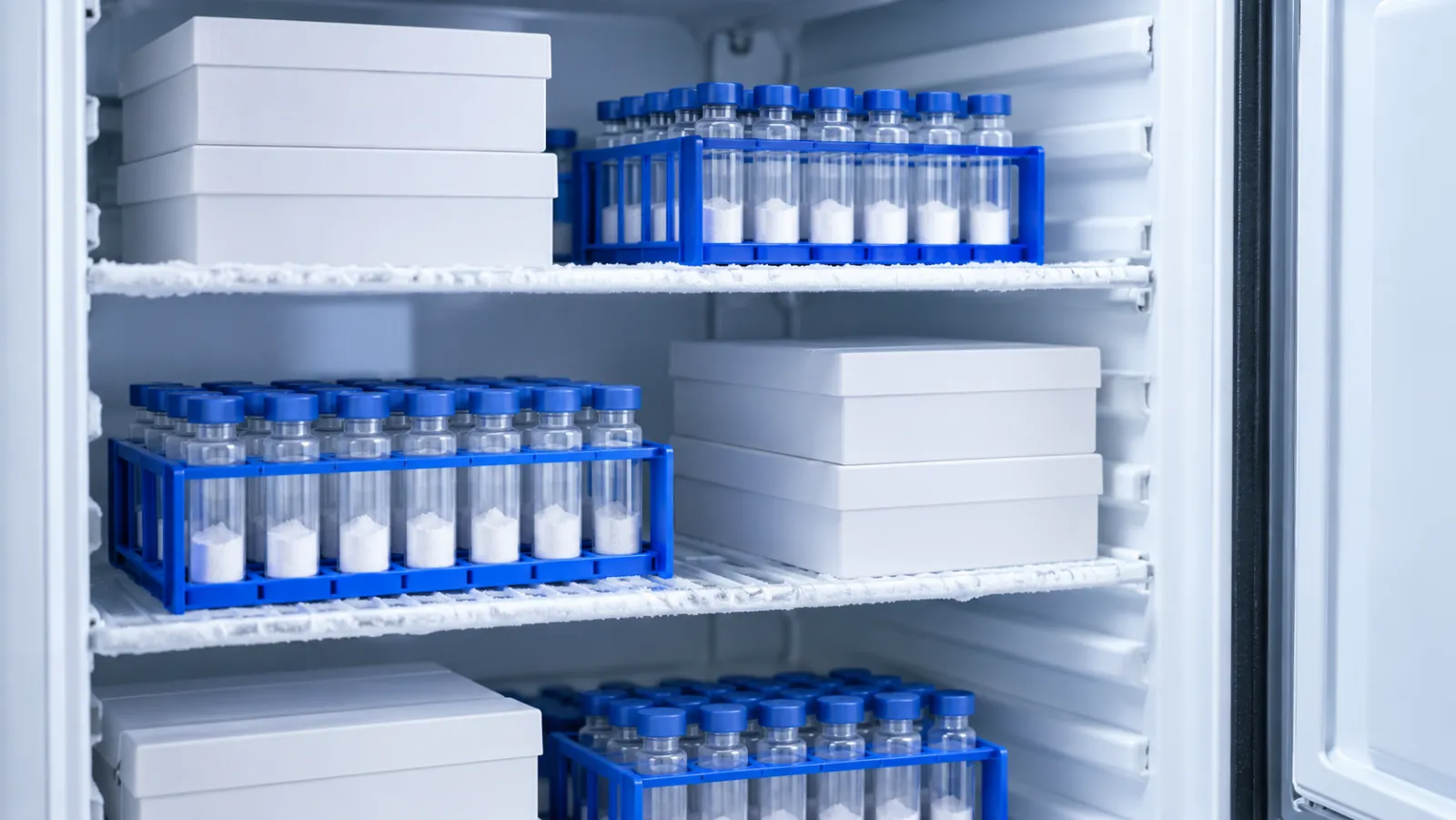
In short: Sealed lyophilised peptides are usually stored cold, dry and dark. WHO recommendations for freeze-dried reference standards give -20 °C as the usual storage temperature, with containers protected from light, and published studies link higher temperature, moisture, light and oxygen to faster degradation of dry peptides and proteins.
Synthetic research peptides usually arrive as a lyophilised solid, the dry powder or cake left by freeze-drying. Our explainer on why research peptides are lyophilised covers how that solid is made. This guide covers what happens next: how temperature, moisture, light and oxygen affect sealed, dry material in storage, and what guidance and published studies say about each. For the chemistry behind it, start with our primer what is a peptide?.
Why does storage matter for a lyophilised peptide?
Chemical degradation continues slowly in the dry state, and storage conditions set its pace. Lai and Topp’s review of solid-state chemistry named temperature, moisture content, additives and the physical state of the solid as the main factors influencing reactions such as deamidation, backbone cleavage, oxidation and aggregation in dry peptides and proteins 1.
| Factor | What the sources report | Usual control |
|---|---|---|
| Temperature | Degradation of dried material speeds up as temperature rises; WHO estimates losses with the Arrhenius equation 2, 3 | A freezer, usually at -20 °C or colder 2 |
| Moisture | Lyophilised material is hygroscopic, and higher residual moisture reduced chemical stability in a lyophilised antibody 2, 3 | Sealed containers, a desiccant, and warming vials before opening |
| Light | Tryptophan, tyrosine, phenylalanine and cysteine undergo photo-oxidation in proteins 4 | Dark storage or amber glass 2 |
| Oxygen | Methionine, cysteine, histidine, tryptophan and tyrosine are the residues most prone to oxidation 5 | Sealing under vacuum or dry nitrogen 2 |
What temperature are sealed lyophilised peptides stored at?
Usually frozen. The World Health Organization (WHO), in its recommendations for freeze-dried biological reference standards (materials used as agreed benchmarks for measurement), states that sealed containers should be stored at an appropriate temperature and protected from light, and that the storage temperature is usually -20 °C but may be lower 2.
Temperature matters because reaction rates rise with it. WHO describes estimating how fast a freeze-dried standard loses activity by holding samples at several higher temperatures and applying the Arrhenius equation, which links reaction rate to temperature, while cautioning that the relationship is approximate over wide temperature ranges 2. In a study of a lyophilised monoclonal antibody, Breen et al. reported that degradation followed Arrhenius kinetics during storage in the glassy state and that all formulations were stable at 5 °C over the 6 or 12 months of the study 3.
For a peptide example, Srinivasan et al. (2015) stored a lyophilised formulation of the peptide hormone secretin, labelled for storage at -20 °C, at -20 °C, 4 °C, 25 °C, and 25 °C with 60% relative humidity for up to 8 weeks 6. They reported decreases in secretin content, measured by high-performance liquid chromatography (HPLC), by week 8 and changes in the crystal form of the mannitol excipient (an inactive additive), and concluded that both the storage environment and the excipient may affect stability 6.
Practical points for the freezer:
- Treat the storage condition stated on the label or certificate of analysis as the reference point.
- Use a freezer that holds its set temperature, and keep a temperature log so excursions can be spotted.
- Keep vials in a closed box on a shelf rather than in the door, and move them to the bench as rarely as possible.
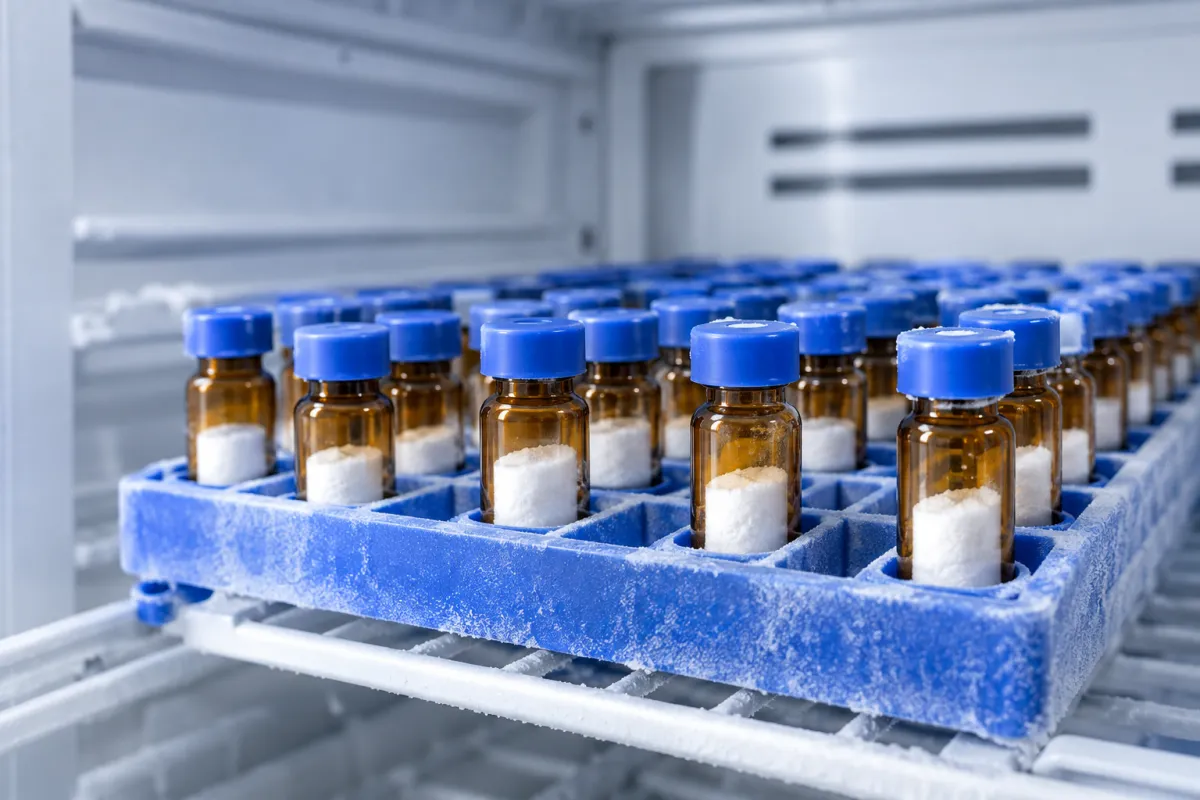 Illustration: sealed lyophilised material is commonly stored frozen and in the dark.
How does moisture affect stored lyophilised peptides?
Absorbed water speeds up many solid-state reactions, and freeze-dried material takes it up readily. WHO states that all lyophilised materials are hygroscopic, meaning they absorb water from the air 2. Oliyai et al. found residual moisture to be a significant variable in the solid-state reactivity of a lyophilised model peptide, depending on the additive used 7. Breen et al. reported that the glass transition temperature of a lyophilised antibody, the point at which a glassy solid softens and its molecules become more mobile, fell from 80 °C at 1% moisture to 25 °C at 8%, with higher moisture reducing chemical stability 3.
The container matters too. WHO prefers heat-sealed glass ampoules for international reference standards because a sealed ampoule does not exchange gases or moisture with the atmosphere, and notes that rubber or elastomer stoppers may be unsatisfactory for long-term storage because their properties may change and they may allow gas exchange 2. Duralliu et al. (2019) stored a freeze-dried influenza antigen reference material for 12 months in glass ampoules, vials with vacuum-oven dried stoppers and vials with unprocessed stoppers 8. At -20 °C they found no significant difference in moisture content between the formats; at the two warmer temperatures tested, vials with unprocessed stoppers took up the most moisture, within 3 months 8.
Practical points for moisture:
- Keep vials sealed until they are needed.
- Let a cold vial reach room temperature, still sealed, before opening it, so water from the air does not condense on the cold solid.
- Store vials in a closed secondary container with a desiccant, a drying agent such as silica gel.
- If a vial has to be opened, for example to weigh out solid for analysis, keep it open briefly and reseal it promptly.
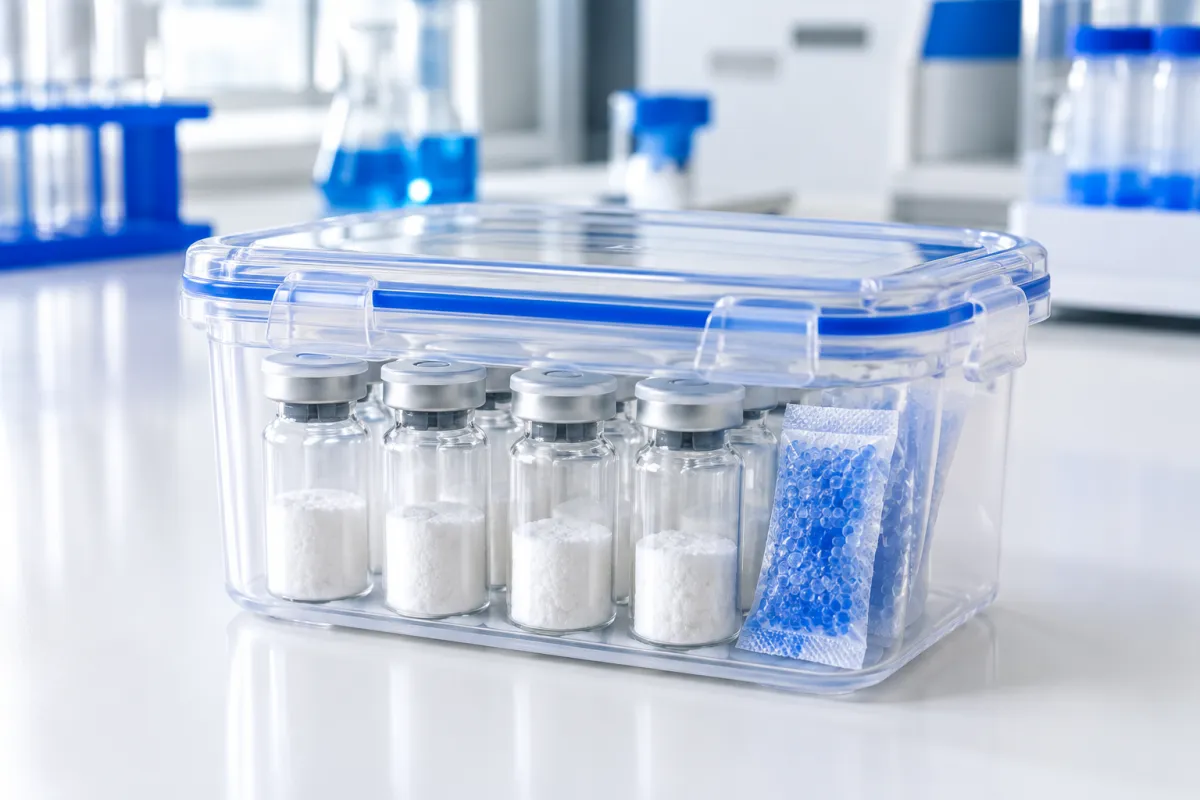 Illustration: a desiccant in a closed secondary container keeps the air around sealed vials dry.
Does light matter for a sealed vial?
Yes: light can drive oxidation of several amino acids, so sealed material is kept in the dark or in amber glass. Kerwin and Remmele’s 2007 review listed tryptophan, tyrosine, phenylalanine and cysteine (with cystine, its disulfide-bonded form) among the residues that undergo primary photo-oxidation in proteins 4. In a 2000 study of solid methionine-enkephalin, a short neuropeptide containing methionine, Sun and Gardella reported faster oxidation to the sulfoxide form (methionine with an added oxygen atom) under ultraviolet light than in laboratory air 9.
WHO’s recommendations say sealed containers should be protected from light, and that actinic (brown) glass may be needed for photosensitive materials, although it makes the contents harder to see 2. In practice, keep vials in their box or an opaque container and limit time under bench lighting.
Why does oxygen matter?
Oxygen can oxidise susceptible residues even in dry material, so the gas sealed in with the solid matters. In a 1995 review, Li, Schöneich and Borchardt listed methionine, cysteine, histidine, tryptophan and tyrosine as the residues most prone to oxidation, and noted that oxidation can be caused by contaminating oxidants, catalysed by transition metal ions and induced by light 5.
In a formulation study of human insulin-like growth factor I, a protein, Fransson et al. (1996) found that light exposure, storage temperature and oxygen content each had a considerable effect on methionine oxidation rates, and that the solid state did not significantly slow the reaction in their measurements 10. WHO recommends sealing ampoules of freeze-dried standards under vacuum or after filling with dry nitrogen, and states that residual oxygen below 45 µmol/L has been shown to ensure adequate long-term stability 2. The gas above the solid in a sealed vial is called the headspace.
What should a storage record include?
Enough to link each vial to its batch documents and its storage history. A simple record covers:
- the product name and lot (batch) number;
- the date received and the condition on arrival;
- the storage location and set temperature;
- each time the vial is removed or opened;
- the certificate of analysis for that lot.
Our COA vault lists published certificates by product and lot, and the verify page looks up a report by product name or lab report number. For what each part of a certificate means, see how to read a peptide certificate of analysis.
Frequently asked questions
How long do lyophilised peptides last in storage?
There is no single figure. Stability depends on the sequence, residual moisture, temperature, container and any additives 1. WHO describes estimating the rate of loss for freeze-dried standards from samples held at higher temperatures, using the Arrhenius equation, and cautions that such predictions are approximate 2. The storage condition on the label is the practical reference point. Our explainer on why research peptides are lyophilised covers the chemistry.
Is -80 °C better than -20 °C for lyophilised peptides?
WHO’s recommendations for freeze-dried reference standards give -20 °C as the usual storage temperature and say it may be lower 2. Colder storage slows chemical reactions, in line with the Arrhenius relationship, but how much difference it makes depends on the peptide, its residual moisture and its container. Where a label or certificate of analysis states a storage temperature, that is the condition to follow.
Can sealed lyophilised peptides be kept at room temperature?
Short periods and long-term storage are different questions. WHO notes that accelerated degradation data are used to predict losses at the higher temperatures that can occur during distribution and to set distribution conditions 2. For longer periods, Chandrasekhar and Topp (2015) reported thiol-disulfide exchange, a reaction in which sulfur-containing groups swap partners, in lyophilised peptides stored at 22 °C and ambient humidity 11, and Duralliu et al. measured moisture gain through unprocessed stoppers at warmer temperatures 8.
Why should a cold vial reach room temperature before it is opened?
A cold vial opened in room air collects condensation, and lyophilised material absorbs water readily. WHO states that all lyophilised materials are hygroscopic 2. Breen et al. reported that higher residual moisture lowered the glass transition temperature and reduced chemical stability in a lyophilised antibody 3. Letting the sealed vial warm first, then resealing it promptly after opening, limits the water the solid can take up.
References
- Lai MC, Topp EM. Solid-state chemical stability of proteins and peptides. J Pharm Sci. 1999;88(5):489-500. doi:10.1021/js980374e. PMID: 10229638. [narrative review]
- World Health Organization. Recommendations for the preparation, characterization and establishment of international and other biological reference standards (revised 2004). WHO Technical Report Series, No. 932, Annex 2 (2006). https://cdn.who.int/media/docs/default-source/biologicals/documents/trs932annex-2-inter-biol-standards-rev2004.pdf. Accessed 28 September 2026. [international guidance document]
- Breen ED, Curley JG, Overcashier DE, et al. Effect of moisture on the stability of a lyophilized humanized monoclonal antibody formulation. Pharm Res. 2001;18(9):1345-1353. doi:10.1023/a:1013054431517. PMID: 11683251. [lyophilised protein formulation study]
- Kerwin BA, Remmele RL. Protect from light: photodegradation and protein biologics. J Pharm Sci. 2007;96(6):1468-1479. doi:10.1002/jps.20815. PMID: 17230445. [narrative review]
- Li S, Schöneich C, Borchardt RT. Chemical instability of protein pharmaceuticals: mechanisms of oxidation and strategies for stabilization. Biotechnol Bioeng. 1995;48(5):490-500. doi:10.1002/bit.260480511. PMID: 18623513. [narrative review]
- Srinivasan C, Siddiqui A, Korang-Yeboah M, et al. Stability characterization and appearance of particulates in a lyophilized formulation of a model peptide hormone-human secretin. Int J Pharm. 2015;481(1-2):104-113. doi:10.1016/j.ijpharm.2015.01.044. PMID: 25636302. [lyophilised peptide formulation study]
- Oliyai C, Patel JP, Carr L, et al. Chemical pathways of peptide degradation. VII. Solid state chemical instability of an aspartyl residue in a model hexapeptide. Pharm Res. 1994;11(6):901-908. doi:10.1023/a:1018998312503. PMID: 7937533. [lyophilised peptide formulation study]
- Duralliu A, Matejtschuk P, Dubey S, et al. The influence of the closure format on the storage stability and moisture content of freeze-dried influenza antigen. Vaccine. 2019;37(32):4485-4490. doi:10.1016/j.vaccine.2019.06.070. PMID: 31277955. [freeze-dried reference material storage study]
- Sun L, Gardella JA. The solid state oxidation of methionine containing peptide: a preliminary study using time of flight secondary ion mass spectrometry. Pharm Res. 2000;17(7):859-862. doi:10.1023/a:1007516527329. PMID: 10990206. [solid-state peptide study]
- Fransson J, Florin-Robertsson E, Axelsson K, et al. Oxidation of human insulin-like growth factor I in formulation studies: kinetics of methionine oxidation in aqueous solution and in solid state. Pharm Res. 1996;13(8):1252-1257. doi:10.1023/a:1016032808039. PMID: 8865322. [protein formulation study]
- Chandrasekhar S, Topp EM. Thiol-disulfide exchange in peptides derived from human growth hormone during lyophilization and storage in the solid state. J Pharm Sci. 2015;104(4):1291-1302. doi:10.1002/jps.24370. PMID: 25631887. PMCID: PMC4359671. [lyophilised peptide study]
Check the lab report
Every published certificate of analysis names its lab, lot and test date. For laboratory research use only.