

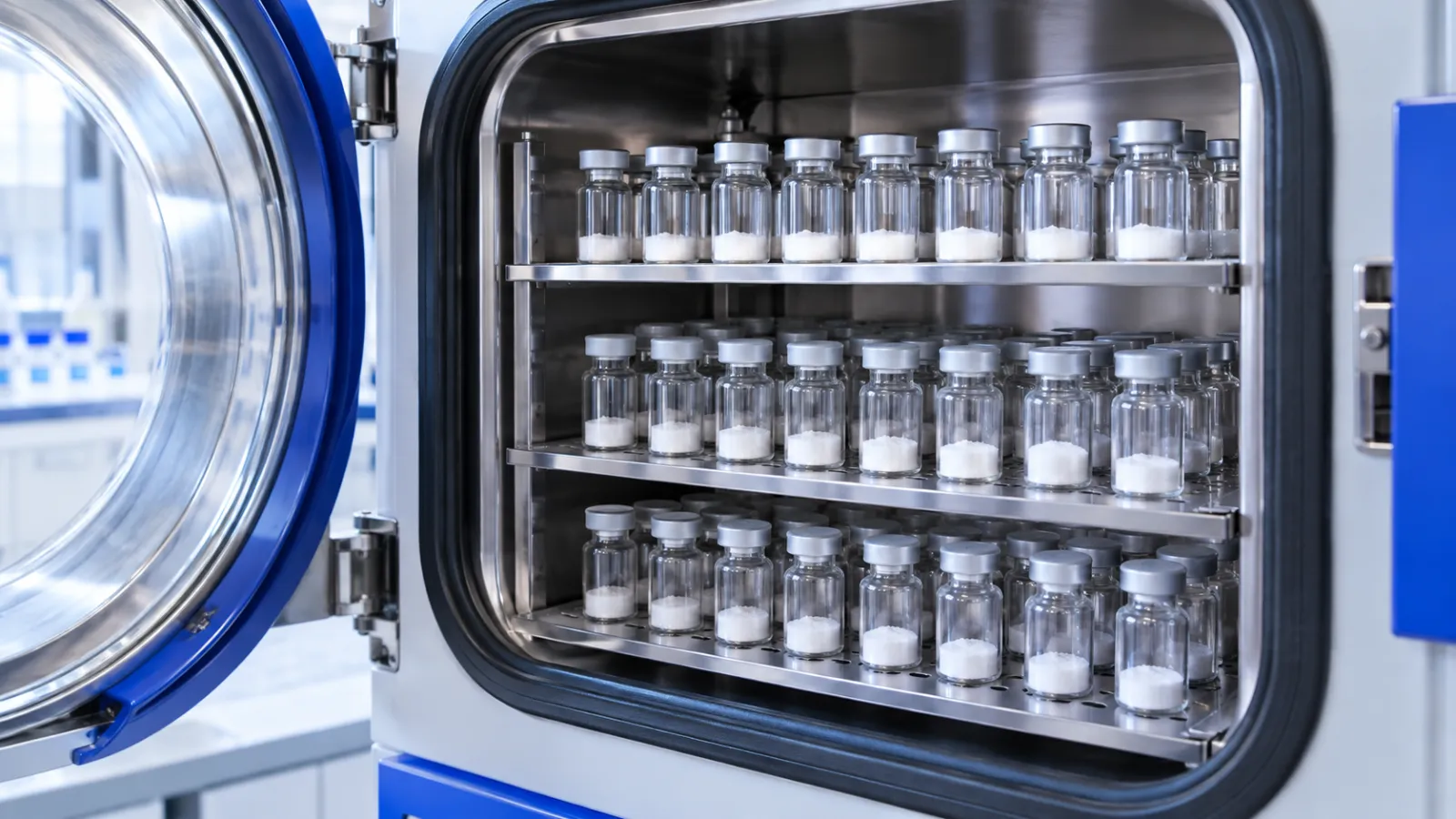
In short: Research peptides are lyophilised, or freeze-dried, because water takes part in many of the chemical reactions that break peptides down. Freeze-drying removes water from frozen material under vacuum, leaving a dry powder or “cake”. Published studies show that many of these reactions slow in the dry state but do not stop.
Peptides are short chains of amino acids (our primer what is a peptide? explains the basics), and synthetic research peptides are usually supplied as a dry solid made by lyophilisation, the technical name for freeze-drying. This article explains what the process does and why water matters to peptide chemistry. It covers sealed, dry material only. For temperature, light and moisture once a vial arrives, see the companion guide on how to store lyophilised peptides in the lab.
What does lyophilised mean?
Lyophilised means freeze-dried: the material was frozen, then its water was removed as vapour under vacuum. In a 2024 review, Karunnanithy et al. described lyophilisation as sublimating water in the form of ice at low pressure, forming a freeze-dried powder 1. Sublimation is the change from a solid straight to a gas without passing through a liquid, the way dry ice turns to vapour without melting.
Why is water a problem for peptides?
Water takes part in, or makes possible, several of the main reactions that degrade peptides, so the amount left in a dried solid matters. Lai and Topp’s 1999 review listed the major reactions that affect peptides and proteins even when dry: deamidation, peptide bond cleavage, oxidation, the Maillard reaction with reducing sugars, beta-elimination (loss of part of a side chain), and dimerisation or aggregation (molecules joining together) 2. They named temperature, moisture content, additives and the physical state of the solid as the main factors that influence those reactions 2.
The sequence matters too. Deamidation is the loss of the amide group from the side chain of asparagine, one of the standard amino acids. In a 1987 study of synthetic peptides, Geiger and Clarke showed that it ran through a ring-shaped intermediate called a succinimide, which then reacted further by hydrolysis (splitting by water) and racemisation (conversion to the mirror-image form) 3. Replacing the glycine next to the asparagine with the bulkier leucine or proline slowed degradation 33 to 50 times 3.
| Reaction | What changes | Where it has been studied | Source |
|---|---|---|---|
| Deamidation | An asparagine side chain loses its amide group through a succinimide ring | Synthetic hexapeptides; the rate depended on the neighbouring residue | 3 |
| Isomerisation | Asparagine and aspartic acid residues pass through the succinimide to a mixture that includes isoaspartyl forms, which have an altered backbone | Synthetic hexapeptides | 3 |
| Peptide bond cleavage | The backbone splits into shorter fragments | Asparagine-leucine and asparagine-proline peptides | 3 |
| Disulfide exchange | Sulfur-sulfur bonds between cysteines swap partners | Peptides derived from human growth hormone, during drying and storage | 4 |
| Oxidation and aggregation | Oxygen is added to susceptible side chains; molecules stick together | Reviewed across solid peptides and proteins | 2 |
How does freeze-drying work?
Freeze-drying runs in three stages, which Tang and Pikal’s 2004 review of process design covers in turn 5:
- Freezing. The material is cooled until its water turns to ice. How the ice forms at this stage affects the rest of the process and the final product 5.
- Primary drying. The chamber is put under vacuum and the shelves supply gentle heat so the ice sublimes. The product has to stay below its collapse temperature, above which the drying structure softens and can slump; the review uses this and a related transition, Tg’ (the glass transition of the concentrated material between ice crystals), to choose the target product temperature 5.
- Secondary drying. A final stage removes more of the water still held in the solid. The World Health Organization (WHO), in its recommendations for freeze-dried reference standards (materials used as agreed benchmarks for measurement), notes that this step is still used for materials that need very low residual moisture 6.
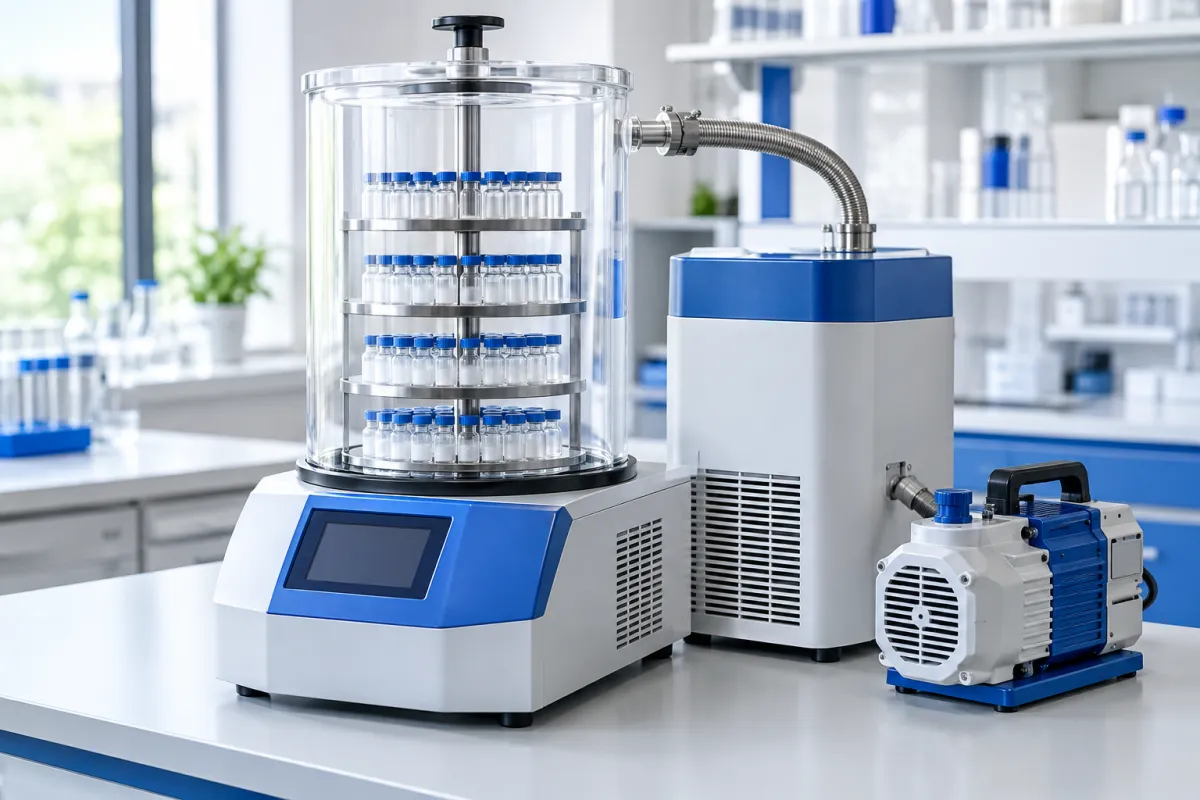 Illustration: a laboratory freeze dryer removes ice from frozen material by sublimation under vacuum.
Is freeze-drying itself gentle on peptides?
Not entirely: freezing and drying are stresses in their own right. Wang’s 2000 review noted that lyophilisation generates both freezing and drying stresses, which can denature proteins (disrupt their folded shape) to various degrees 7.
In a 2015 study of peptides derived from human growth hormone, Chandrasekhar and Topp reported loss of the native disulfide bond during primary drying, which re-formed during secondary drying 4. A cyclic version of one peptide was more reactive in the solid state than the linear version, which, the authors wrote, suggests that cyclisation does not protect against lyophilisation 4.
Pharmaceutical freeze-dried products often contain protective additives called lyoprotectants, of which disaccharides were the most effective in Karunnanithy et al.’s review of 20 studies 1. Any additive in a research peptide vial should be stated on its label and certificate of analysis.
Does a lyophilised peptide stop degrading?
No. Degradation continues in the dry state at a rate that depends on residual moisture, temperature, the sequence and anything else in the vial. Wang noted that proteins in the solid state may still have limited long-term storage stability 7. Two studies show how these variables interact:
- In a 1994 factorial study (one that varies several factors at once) of a lyophilised six-residue peptide containing aspartic acid, Oliyai et al. reported that residual moisture, temperature and especially the type of bulking agent (the additive that gives the dried cake its structure) had a significant effect on its reactivity 8.
- In a 2001 study of a lyophilised monoclonal antibody, a large protein, Breen et al. stored samples with 1 to 8% residual moisture at 5 to 50 °C for 6 or 12 months 9. The glass transition temperature, the point at which a rigid, glassy solid softens and its molecules become more mobile, fell from 80 °C at 1% moisture to 25 °C at 8%, and higher moisture reduced chemical stability 9.
The practical side, from freezer temperature to desiccants, is covered in our guide to storing lyophilised peptides.
Why is freeze-drying part of peptide manufacture?
Freeze-drying is also a manufacturing step, including when chemists change a peptide’s salt form. Peptides made by solid-phase peptide synthesis are cleaved from their resin and purified using trifluoroacetic acid (TFA), which Erckes et al. noted in 2025 leaves them as TFA salts 10. The trifluoroacetate stays with the peptide as a counter-ion, a charged partner that balances the peptide’s own charge.
Roux et al. described the classical way to replace it in 2008: freeze-drying the peptide several times with excess hydrochloric acid, which means working below pH 1, where peptides can degrade 11. Erckes et al. exchanged TFA for chloride by freeze-drying with a range of hydrochloric acid concentrations and reported no effect on peptide purity at any of them 10. The counter-ion stays in the dry powder and adds to its weight, one reason the acetate or TFA salt form of a peptide matters.
What does residual moisture mean?
Residual moisture is the water left in the solid after freeze-drying, usually expressed as a percentage of its weight. WHO’s recommendations for freeze-dried reference standards make several points about it 6:
- All lyophilised materials are hygroscopic, meaning they absorb water from the air, so containers should be sealed as soon as possible after drying, under vacuum or dry nitrogen in the case of glass ampoules.
- Coulometric Karl Fischer titration, a chemical test that reacts specifically with water, is the most widely used measurement.
- Preparations with less than 1% moisture by weight have shown adequate long-term stability, and higher values such as 5% may be suitable in some cases.
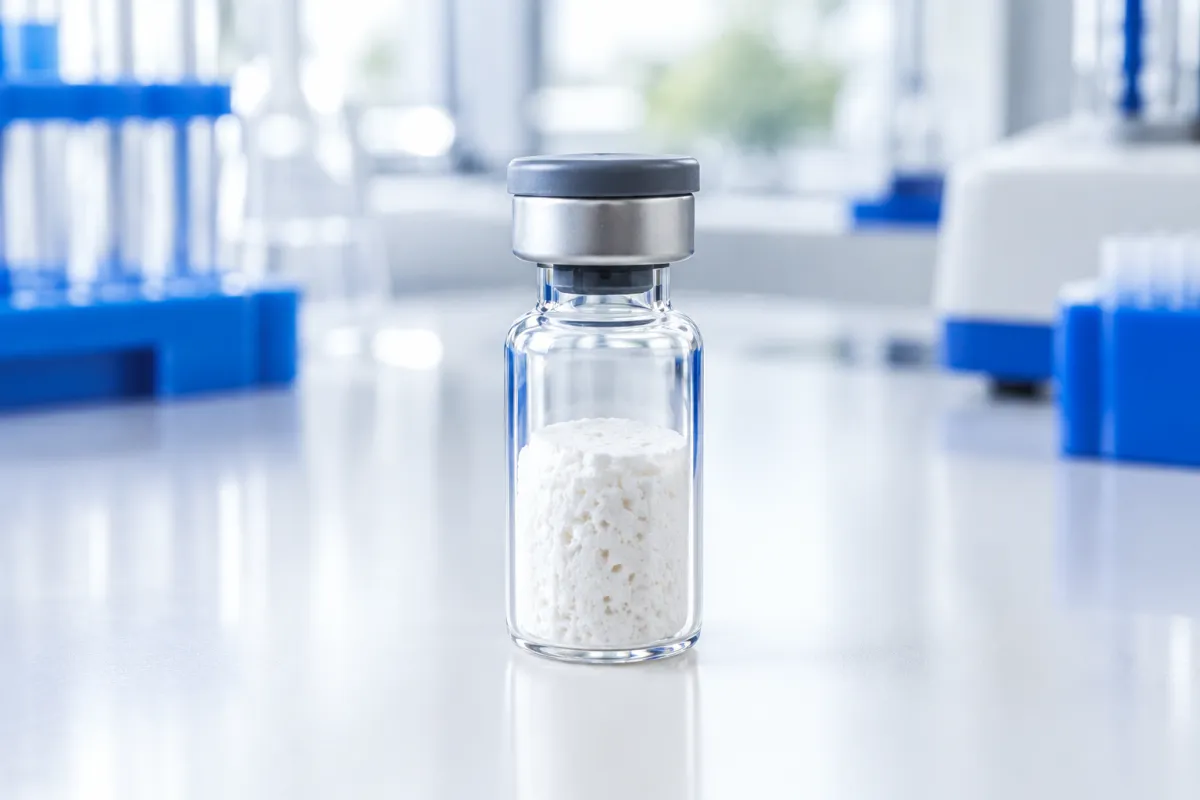 Illustration: a sealed vial of freeze-dried material, where the dry cake keeps the shape of the frozen fill.
Frequently asked questions
Is lyophilised the same as freeze-dried?
Yes. Lyophilisation is the technical term for freeze-drying: the material is frozen and its water is removed as vapour under vacuum, leaving a dry solid. Karunnanithy et al. (2024) described it as sublimating ice at low pressure to form a freeze-dried powder 1. “Lyophilised” is the Australian and British spelling and “lyophilized” the American one. Our peptide glossary defines related terms.
Does freeze-drying change a peptide’s chemistry?
It can, although not always permanently. In a 2015 study of peptides derived from human growth hormone, Chandrasekhar and Topp reported disulfide changes during primary drying that re-formed during secondary drying 4. Erckes et al. (2025) reported no effect on purity when they freeze-dried peptides with hydrochloric acid to exchange counter-ions 10. Purity is measured on the finished solid, commonly by high-performance liquid chromatography (HPLC); see HPLC purity explained.
Why are lyophilised peptides described as hygroscopic?
Hygroscopic means a material readily absorbs water from the air. WHO’s recommendations for freeze-dried reference standards state that all lyophilised materials are hygroscopic, which is why containers are sealed promptly after drying and why moisture uptake has to be prevented even while water content is measured 6. In a lyophilised antibody study, Breen et al. reported that higher residual moisture reduced chemical stability 9.
How is the water content of a lyophilised peptide measured?
For freeze-dried reference materials, WHO names coulometric Karl Fischer titration as the most widely used method and notes that preparations below 1% moisture by weight have shown adequate long-term stability 6. Because the dry powder takes up water readily, samples have to be handled so they do not gain moisture during the test. Our guide to reading a peptide COA explains where such results appear.
References
- Karunnanithy V, Abdul Rahman NHB, Abdullah NAH, et al. Effectiveness of lyoprotectants in protein stabilization during lyophilization. Pharmaceutics. 2024;16(10):1346. doi:10.3390/pharmaceutics16101346. PMID: 39458674. PMCID: PMC11510631. [literature review]
- Lai MC, Topp EM. Solid-state chemical stability of proteins and peptides. J Pharm Sci. 1999;88(5):489-500. doi:10.1021/js980374e. PMID: 10229638. [narrative review]
- Geiger T, Clarke S. Deamidation, isomerization, and racemization at asparaginyl and aspartyl residues in peptides. Succinimide-linked reactions that contribute to protein degradation. J Biol Chem. 1987;262(2):785-794. doi:10.1016/s0021-9258(19)75855-4. PMID: 3805008. [synthetic peptide chemistry study]
- Chandrasekhar S, Topp EM. Thiol-disulfide exchange in peptides derived from human growth hormone during lyophilization and storage in the solid state. J Pharm Sci. 2015;104(4):1291-1302. doi:10.1002/jps.24370. PMID: 25631887. PMCID: PMC4359671. [lyophilised peptide study]
- Tang X, Pikal MJ. Design of freeze-drying processes for pharmaceuticals: practical advice. Pharm Res. 2004;21(2):191-200. doi:10.1023/b:pham.0000016234.73023.75. PMID: 15032301. [narrative review]
- World Health Organization. Recommendations for the preparation, characterization and establishment of international and other biological reference standards (revised 2004). WHO Technical Report Series, No. 932, Annex 2 (2006). https://cdn.who.int/media/docs/default-source/biologicals/documents/trs932annex-2-inter-biol-standards-rev2004.pdf. Accessed 28 September 2026. [international guidance document]
- Wang W. Lyophilization and development of solid protein pharmaceuticals. Int J Pharm. 2000;203(1-2):1-60. doi:10.1016/s0378-5173(00)00423-3. PMID: 10967427. [narrative review]
- Oliyai C, Patel JP, Carr L, et al. Chemical pathways of peptide degradation. VII. Solid state chemical instability of an aspartyl residue in a model hexapeptide. Pharm Res. 1994;11(6):901-908. doi:10.1023/a:1018998312503. PMID: 7937533. [lyophilised peptide formulation study]
- Breen ED, Curley JG, Overcashier DE, et al. Effect of moisture on the stability of a lyophilized humanized monoclonal antibody formulation. Pharm Res. 2001;18(9):1345-1353. doi:10.1023/a:1013054431517. PMID: 11683251. [lyophilised protein formulation study]
- Erckes V, Streuli A, Chamera Rendueles L, et al. Towards a consensus for the analysis and exchange of TFA as a counterion in synthetic peptides and its influence on membrane permeation. Pharmaceuticals (Basel). 2025;18(8):1163. doi:10.3390/ph18081163. PMID: 40872554. PMCID: PMC12389442. [analytical chemistry study]
- Roux S, Zékri E, Rousseau B, et al. Elimination and exchange of trifluoroacetate counter-ion from cationic peptides: a critical evaluation of different approaches. J Pept Sci. 2008;14(3):354-359. doi:10.1002/psc.951. PMID: 18035848. [analytical chemistry study]
Check the lab report
Every published certificate of analysis names its lab, lot and test date. For laboratory research use only.