

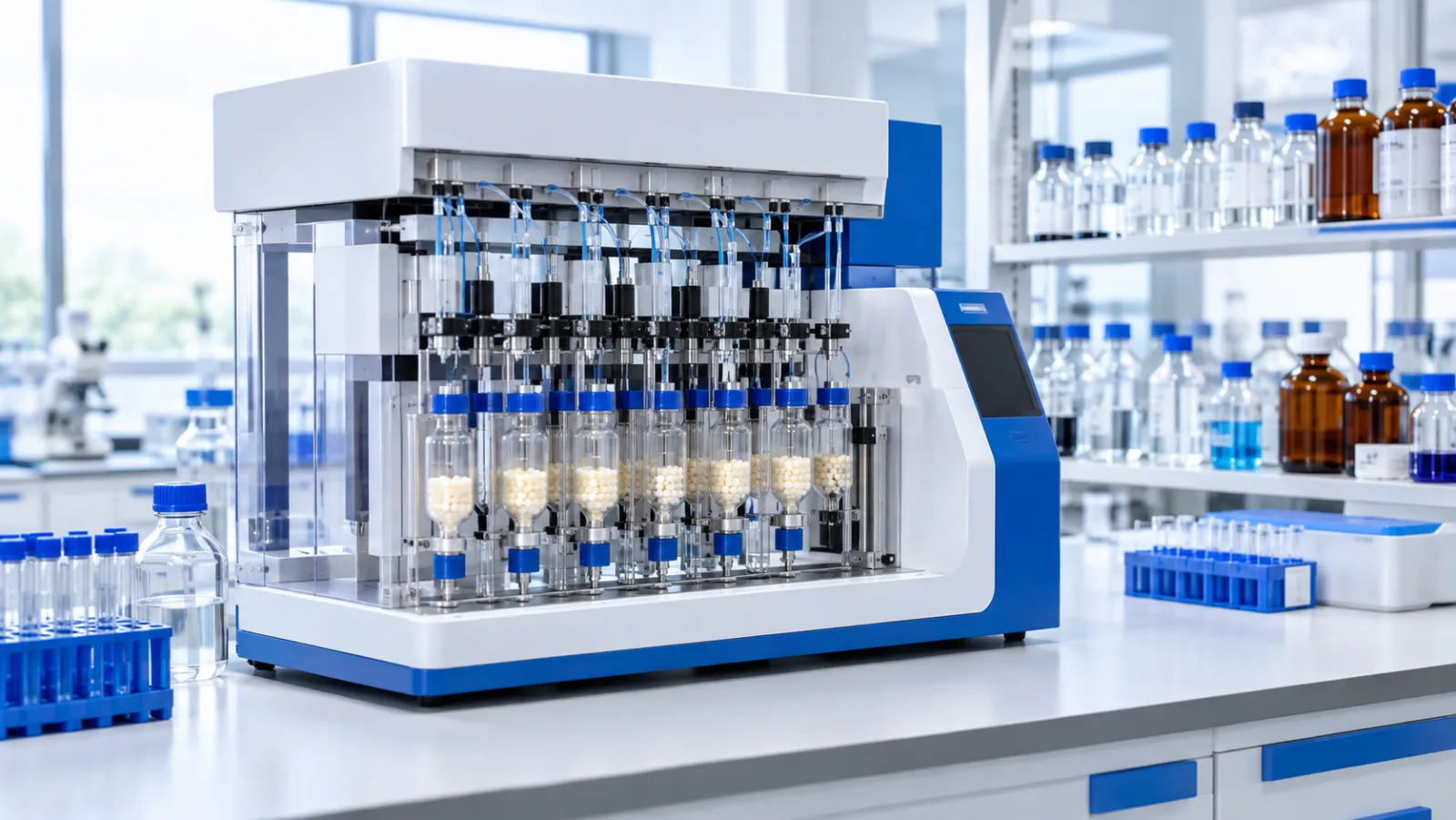
In short: Solid-phase peptide synthesis (SPPS) builds a peptide one amino acid at a time while the growing chain stays anchored to insoluble resin beads. Each round removes a temporary protecting group, couples the next amino acid and washes away excess reagent. The finished chain is cut from the resin with acid, then purified by HPLC and freeze-dried.
Most synthetic peptides are made this way 1. This explainer walks through the chemistry step by step. For a refresher on amino acids and peptide bonds, start with our primer on what a peptide is.
What is solid-phase peptide synthesis?
Solid-phase peptide synthesis is a way of making peptides in which the growing chain stays attached to an insoluble polymer support while each reagent is added and then washed away. Bruce Merrifield reported the method in 1963 with the synthesis of a tetrapeptide, a chain of four amino acids 2, and received the 1984 Nobel Prize in Chemistry for developing methods of chemical synthesis on a solid matrix 3.
Before SPPS, peptides were made in solution, where every intermediate has to be isolated and purified, which a 2014 review by Mäde et al. describes as time-consuming and technically demanding. In Merrifield’s method the chain is instead assembled from the C-terminus (the carboxyl end) towards the N-terminus (the amino end) on a polymer “resin” 4.
Why build a peptide on a solid support?
Anchoring the chain to beads means excess reagents and by-products can be washed away after every step, with no intermediate to isolate. Mäde et al. list the practical advantages 4:
- One vessel. All reactions can run in a single vessel.
- Simple clean-up. Unreacted reagents are washed and filtered away.
- Excess reagents. Reactants can be added in excess to drive each coupling towards completion.
- Automation. Steps are short and suit automated synthesisers.
The resin must be insoluble, stable enough to filter and able to swell: the review notes that beads can swell to up to six times their original volume in organic solvents. A short chemical linker joins the first amino acid to the resin, and the choice of linker decides whether the finished peptide ends in a free acid or an amide 4.
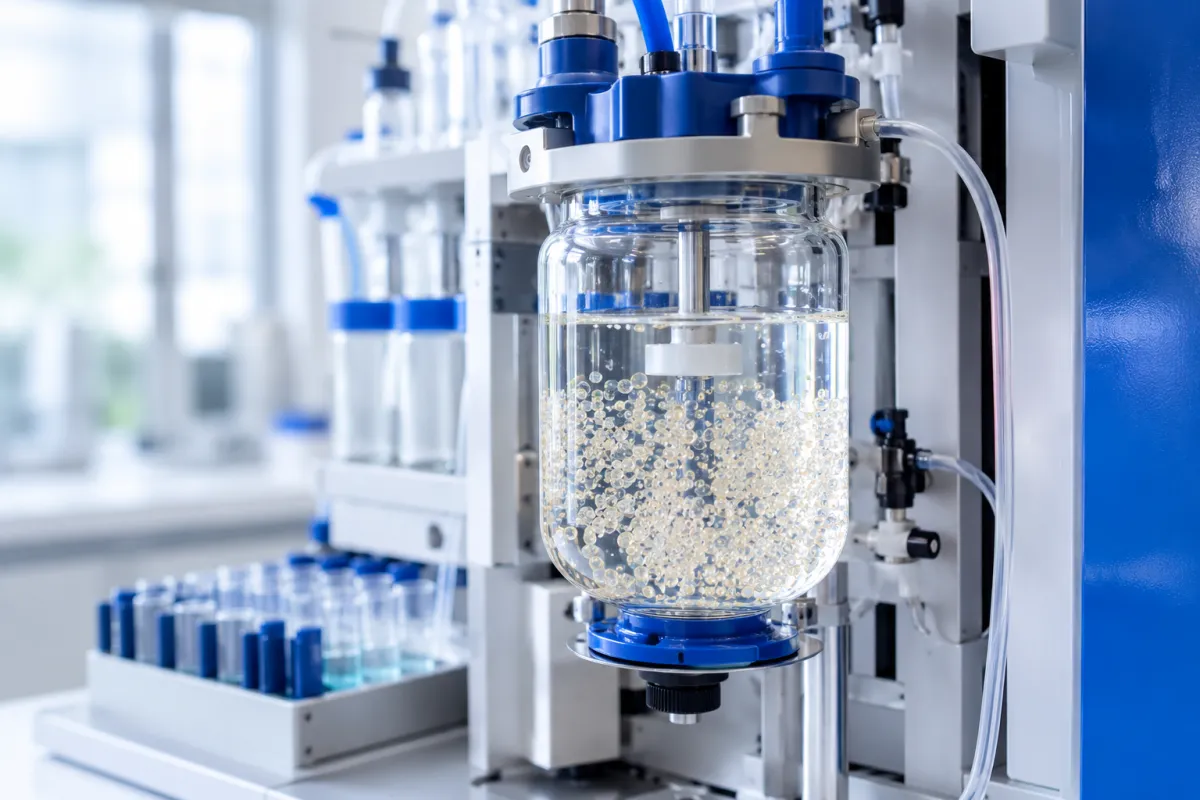 Illustration: resin beads in a reaction vessel on an automated synthesiser.
What happens in each round of synthesis?
Each round adds one amino acid through three chemical steps (deprotection, activation and coupling) separated by washes, and it repeats once for every residue in the sequence 4.
- Deprotection. Each amino acid arrives with its amino group capped by a temporary protecting group, which stops it reacting out of turn. The cap on the last residue added is removed to free its amino group. In Fmoc chemistry this is done with the base piperidine 4.
- Activation. A coupling reagent, such as the carbodiimide DIC with the additive Oxyma, or a salt such as HATU, converts the carboxyl group of the next amino acid into a more reactive form 4.
- Coupling. The activated amino acid reacts with the free amino group on the resin-bound chain, forming a new peptide bond.
- Washing. Solvent washes remove excess reagent and by-products.
Removing the Fmoc group releases a fluorene compound that absorbs ultraviolet light strongly, giving a useful indicator of how each step went 1. In 1970, Kaiser and colleagues published a colour test for detecting free terminal amino groups during solid-phase synthesis 5, a way to spot chains that failed to couple.
Small inefficiencies compound. As plain arithmetic, if each of 20 couplings reached 99% completion, about 82% of chains would be full length (0.99 to the power of 20); at 98% per step, about 67%.
What are Fmoc and Boc chemistry?
Fmoc and Boc are the two main protecting-group strategies for SPPS, each named after the temporary group that caps the amino end of the incoming amino acid 4, 1.
- Boc and benzyl. Merrifield’s original method used the tert-butyloxycarbonyl (Boc) group, removed with trifluoroacetic acid (TFA), with benzyl-type side-chain groups that need a much stronger acid, such as hydrogen fluoride (HF), for final removal 4. Because both are acid-labile, repeated TFA treatment could strip small amounts of side-chain protection in each round and gradually release peptide from the support 1.
- Fmoc and tert-butyl. The 9-fluorenylmethoxycarbonyl (Fmoc) group is removed by base, while tert-butyl side-chain groups and the resin link are removed by TFA at the end. This pairing is called orthogonal, because each kind of group comes off under completely different conditions 4. On a solid support, the reactive by-product of Fmoc removal is simply washed away, which is why the group found its place in SPPS 1.
| Feature | Boc and benzyl | Fmoc and tert-butyl |
|---|---|---|
| Temporary group removed by | TFA (acid) | Piperidine (base) |
| Side-chain groups removed by | Strong acid such as HF | TFA |
| Orthogonal? | No: relies on graded acid strength | Yes: base first, acid at the end |
| Current use | Mainly specialist applications | The method of choice |
How is the finished peptide released from the resin?
A final treatment with concentrated TFA cuts the peptide from the linker and removes the side-chain protecting groups at the same time. This generates carbocations, highly reactive positively charged fragments, which can attach to the peptide unless scavenger chemicals trap them 4.
In a 1990 methods study, King, Fields and Fields reported that these side reactions mostly modified tryptophan, tyrosine, methionine and cysteine. Of the scavenger mixtures they compared, a TFA mixture containing phenol, water, thioanisole and ethanedithiol, which they called Reagent K, was the most efficient, across 10 peptides of 20 to 50 residues 6.
Because TFA is used both for cleavage and in the usual purification method, peptides with basic residues are generally obtained as trifluoroacetate salts 7. Our explainer on acetate vs TFA salts covers why that counter-ion matters.
What impurities can solid-phase synthesis leave behind?
The main impurities are closely related peptides: chains that are missing a residue, carry an extra one, or were altered by a side reaction. Because they can differ from the target by a single residue, they are the reason what an HPLC purity percentage tells you depends on the method. A 2014 review by D’Hondt et al. grouped them as follows 8:
| Impurity | How it arises, as described by D’Hondt et al. |
|---|---|
| Deletion sequences (a residue missing) | Inefficient removal of the Fmoc group |
| Insertion sequences (an extra residue) | Excess amino acid reagent |
| Diastereomers | Racemisation during Fmoc removal, where a residue partly converts to its mirror-image form |
| Protecting-group adducts | Incomplete removal of side-chain protecting groups |
| Oxidised forms | Oxidation of amino acid side chains |
| Dimers and oligomers | Peptide chains joined together |
| Trifluoroacetate | Counter-ion carried over from synthesis or purification |
Behrendt et al. describe aspartimide formation as the most serious side reaction in Fmoc chemistry. It occurs when sequences containing aspartic acid meet strong base, and it can produce nine different by-products, some of which elute alongside the target peptide 1. Other sequences resist synthesis altogether: Paradís-Bas et al. describe “difficult peptides” whose chains form β-sheet interactions strong enough to aggregate during synthesis 9.
How are crude peptides purified and checked?
Crude peptide is usually purified by reversed-phase HPLC, identified by mass spectrometry and then freeze-dried. Mäde et al. note that soft-ionisation mass spectrometry, such as MALDI-TOF or electrospray, identifies the product and its by-products rapidly 4.
Sikora et al. describe reversed-phase HPLC on C18-modified silica, with an acid such as TFA added to the mobile phase at about 0.1%, as the routine method for purifying peptides. Volatile acids, including TFA, can be removed by lyophilisation (freeze-drying) afterwards, but TFA can also stay bound to basic residues. The review describes exchanging it, for example by switching the acid used in preparative HPLC to obtain acetate salts 7. Freeze-drying is covered in why research peptides are lyophilised, and identity testing in mass spectrometry for peptides.
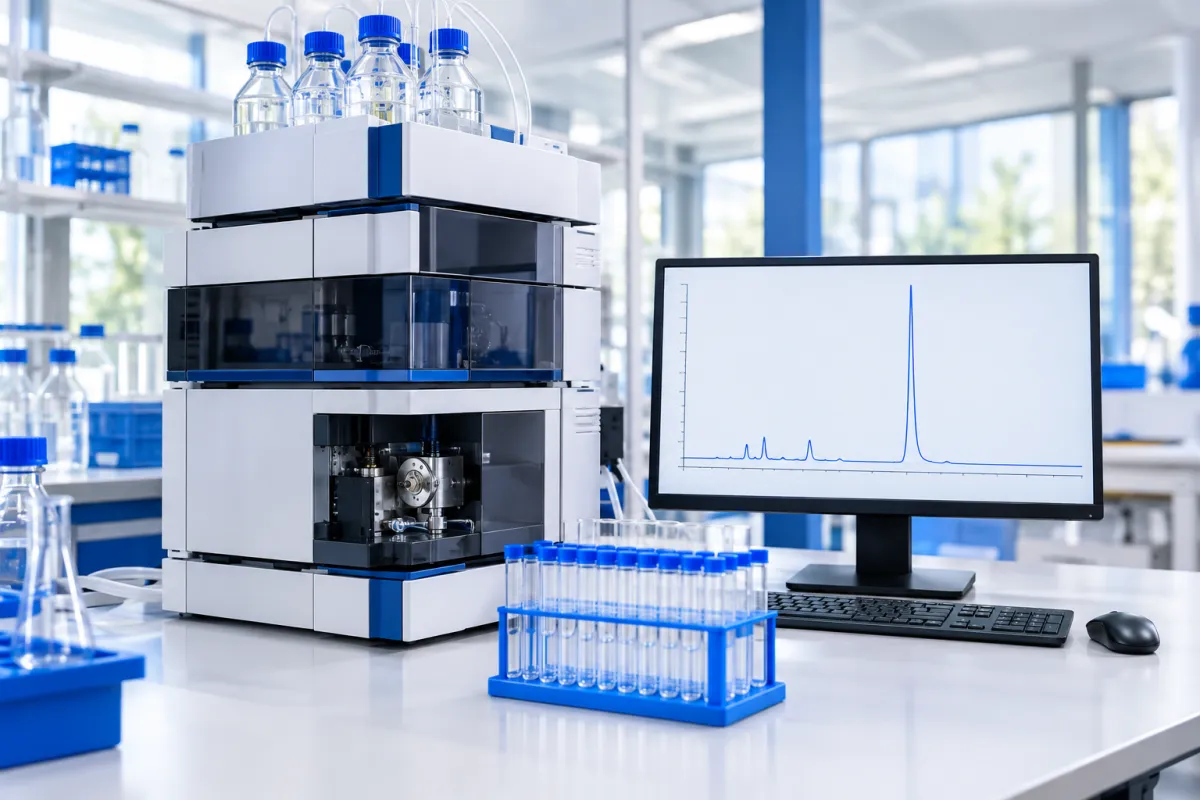 Illustration: a preparative HPLC system separating a crude synthetic mixture.
How long a peptide can solid-phase synthesis make?
There is no fixed limit, because sequence matters as much as length. Behrendt et al. note that about 50 amino acids is often quoted as the length that can be made routinely, but call the figure meaningless in practice because many much shorter sequences are extremely problematic 1.
Small proteins can be built by joining synthetic segments. In 1994, Dawson and colleagues described native chemical ligation, in which two unprotected segments form a thioester-linked intermediate that rearranges into a normal peptide bond, and used it to prepare a cytokine 10.
Frequently asked questions
Who invented solid-phase peptide synthesis?
Bruce Merrifield. He described the method in a 1963 paper reporting the solid-phase synthesis of a tetrapeptide 2, and received the 1984 Nobel Prize in Chemistry for developing methods of chemical synthesis on a solid matrix 3. His original chemistry used acid-labile Boc protecting groups; the later Fmoc approach is now the method of choice 1.
What does Fmoc mean in peptide synthesis?
Fmoc stands for 9-fluorenylmethoxycarbonyl, a protecting group that temporarily caps the amino group of each incoming amino acid. It is removed by a base, usually piperidine, while side-chain protecting groups are removed at the end with trifluoroacetic acid. Because the two kinds of group come off under different conditions, the combination is called orthogonal 4.
Why do synthetic peptides often contain TFA?
Trifluoroacetic acid (TFA) is used to cleave the finished peptide from the resin and is commonly added to the mobile phase during HPLC purification. As a result, peptides with basic residues are usually obtained as trifluoroacetate salts, and TFA can also remain adsorbed in the freeze-dried solid 7.
What is a deletion sequence?
A deletion sequence is an impurity in which one residue of the intended sequence is missing. D’Hondt et al. link deletions to inefficient removal of the Fmoc group during synthesis 8. Because a deletion peptide differs from the target by a single residue, how well it is detected depends on the analytical method, as explained in HPLC purity explained.
Is solid-phase synthesis the only way to make peptides?
No. Peptides were first made by solution-phase chemistry, and living cells assemble them on ribosomes 4. Small proteins can be built by joining synthetic segments, for example by native chemical ligation 10. For most synthetic peptides, though, Fmoc solid-phase synthesis is now the standard route 1.
References
- Behrendt R, White P, Offer J. Advances in Fmoc solid-phase peptide synthesis. J Pept Sci. 2016;22(1):4-27. doi:10.1002/psc.2836. PMID: 26785684. PMCID: PMC4745034. [narrative review]
- Merrifield RB. Solid Phase Peptide Synthesis. I. The Synthesis of a Tetrapeptide. J Am Chem Soc. 1963;85(14):2149-2154. doi:10.1021/ja00897a025. [original method report]
- The Nobel Prize. The Nobel Prize in Chemistry 1984: summary. https://www.nobelprize.org/prizes/chemistry/1984/summary/. Accessed 28 September 2026. [award record]
- Mäde V, Els-Heindl S, Beck-Sickinger AG. Automated solid-phase peptide synthesis to obtain therapeutic peptides. Beilstein J Org Chem. 2014;10:1197-1212. doi:10.3762/bjoc.10.118. PMID: 24991269. PMCID: PMC4077397. [narrative review]
- Kaiser E, Colescott RL, Bossinger CD, et al. Color test for detection of free terminal amino groups in the solid-phase synthesis of peptides. Anal Biochem. 1970;34(2):595-598. doi:10.1016/0003-2697(70)90146-6. PMID: 5443684. [methods paper]
- King DS, Fields CG, Fields GB. A cleavage method which minimizes side reactions following Fmoc solid phase peptide synthesis. Int J Pept Protein Res. 1990;36(3):255-266. doi:10.1111/j.1399-3011.1990.tb00976.x. PMID: 2279849. [methods study]
- Sikora K, Jaśkiewicz M, Neubauer D, et al. The Role of Counter-Ions in Peptides-An Overview. Pharmaceuticals (Basel). 2020;13(12):442. doi:10.3390/ph13120442. PMID: 33287352. PMCID: PMC7761850. [narrative review]
- D’Hondt M, Bracke N, Taevernier L, et al. Related impurities in peptide medicines. J Pharm Biomed Anal. 2014;101:2-30. doi:10.1016/j.jpba.2014.06.012. PMID: 25044089. [narrative review]
- Paradís-Bas M, Tulla-Puche J, Albericio F. The road to the synthesis of “difficult peptides”. Chem Soc Rev. 2016;45(3):631-654. doi:10.1039/c5cs00680e. PMID: 26612670. [narrative review]
- Dawson PE, Muir TW, Clark-Lewis I, et al. Synthesis of proteins by native chemical ligation. Science. 1994;266(5186):776-779. doi:10.1126/science.7973629. PMID: 7973629. [original method report]
Check the lab report
Every published certificate of analysis names its lab, lot and test date. For laboratory research use only.