

In short: A certificate of analysis (COA) is a batch-specific laboratory report listing each test performed, its method, the acceptance criteria and the numerical result. For synthetic peptides, the core entries are identity, usually by mass spectrometry, and purity, usually by HPLC. Content, counter-ion, water and contaminant results are separate entries. A COA is not a regulatory approval.
This guide is the starting point for our series on quality and lab testing. It walks through a peptide COA section by section, from mass spectrometry to high-performance liquid chromatography (HPLC), and links to a detailed explainer for each test. Technical terms are defined in the peptide glossary.
What is a certificate of analysis?
A certificate of analysis is a signed report of the tests performed on one batch of material, set against a stated specification. ICH Q7, the International Council for Harmonisation’s good manufacturing practice (GMP) guide for active pharmaceutical ingredients, says each certificate should list every test performed, its acceptance limits and the numerical results obtained 1. The World Health Organization (WHO) model certificate adds a statement of whether the sample complies with the specification 2.
Three terms defined in ICH Q7 appear on almost every COA 1:
- Batch (or lot) number: a unique combination of numbers, letters or symbols that identifies a batch and from which its production and distribution history can be determined.
- Specification: a list of tests, references to analytical procedures and acceptance criteria.
- Acceptance criteria: numerical limits, ranges or other measures that a test result must meet.
Both documents were written for pharmaceutical manufacturing and quality control, but they are the clearest public descriptions of a complete COA.
What should the header of a COA identify?
The header should tie the report to one batch, one laboratory and one approval date. The WHO model lists the issuing laboratory’s name and address, a certificate number with page numbering (“page X of Y”), the product name, batch number, expiry or retest date, the original manufacturer, and the date and signature of the person who approved the certificate 2.
ICH Q7 defines a retest date as the date when a material should be re-examined to confirm it is still suitable for use, and an expiry date as the end of the period in which it is expected to stay within its shelf-life specification under defined storage conditions 1.
| COA section | What it reports | Methods described in the sources | Detailed guide |
|---|---|---|---|
| Header | Product, batch number, issuing laboratory, dates, approval signature 2 | Not a test | This page |
| Identity | Whether the material is the intended peptide sequence | Mass spectrometry, HPLC retention time against a reference standard, amino acid analysis, nuclear magnetic resonance (NMR) 3 4 | Mass spectrometry for peptide identity |
| Purity | Peptide-related impurities as a share of the chromatogram | Reversed-phase HPLC with ultraviolet (UV) detection 5 | HPLC purity explained |
| Assay or content | How much of the powder’s mass is peptide | HPLC assay against a reference standard, amino acid analysis, elemental or nitrogen analysis, quantitative NMR 3 | Net peptide content explained |
| Counter-ion | The salt former, such as acetate or trifluoroacetate (TFA), and its amount | HPLC or ion chromatography 3 4 | Acetate vs TFA salts |
| Water | Moisture held in the powder | Karl Fischer titration 4 | Net peptide content explained |
| Other tests | Residual solvents, elemental impurities, bacterial endotoxins, microbiological purity 3 | Test-specific methods | Endotoxin, heavy metals and residual solvents |
What does the identity result show?
The identity result shows whether the material is the intended peptide, most often by comparing its measured molecular mass with the mass calculated from the sequence. The European Medicines Agency (EMA) guideline on synthetic peptides describes mass spectrometry as a tool that can determine a peptide’s molecular mass and confirm its sequence, and expects tables of theoretical and observed mass values 3. For releasing a peptide medicine, it recommends at least two orthogonal identification methods 3, meaning methods that ideally use different measurement principles 6.
The reason for a second method is that mass alone cannot tell every structure apart. In a 2023 paper on peptide reference standards, McCarthy et al., mostly from the United States Pharmacopeial Convention (USP), used amino acid analysis to distinguish leucine from isoleucine, which share the same molecular formula and mass 7, and noted that chiral or isobaric (same-mass) amino acids may require additional techniques 4.
Mass spectrometry for peptides explains how to compare an entry’s expected and observed mass.
What does the purity result show?
The purity result shows how much of the UV-detected signal in a chromatogram sits in the main peak, under one specified method. Reversed-phase HPLC (RP-HPLC) is the most widely used mode for peptide separations, and peptides are usually detected at 210 to 220 nm, where the peptide bond absorbs ultraviolet light 5.
The smaller peaks are mostly peptide-related impurities. A 2014 review of impurities in peptide medicines described those arising from solid-phase peptide synthesis, including deletion and insertion sequences, diastereomers formed by racemisation and adducts left by incomplete removal of protecting groups, as well as oxidation products, dimers and degradation products 8.
For peptide medicines, the EMA guideline cites European Pharmacopoeia thresholds: peptide-related impurities should be reported above 0.1%, identified above 0.5% and qualified, meaning justified with supporting data, above 1.0% 3 9. It also warns about co-eluting impurities, meaning impurities that leave the column at the same time as the main peptide and sit inside its peak 3. HPLC purity explained covers how the percentage is calculated and what it leaves out.
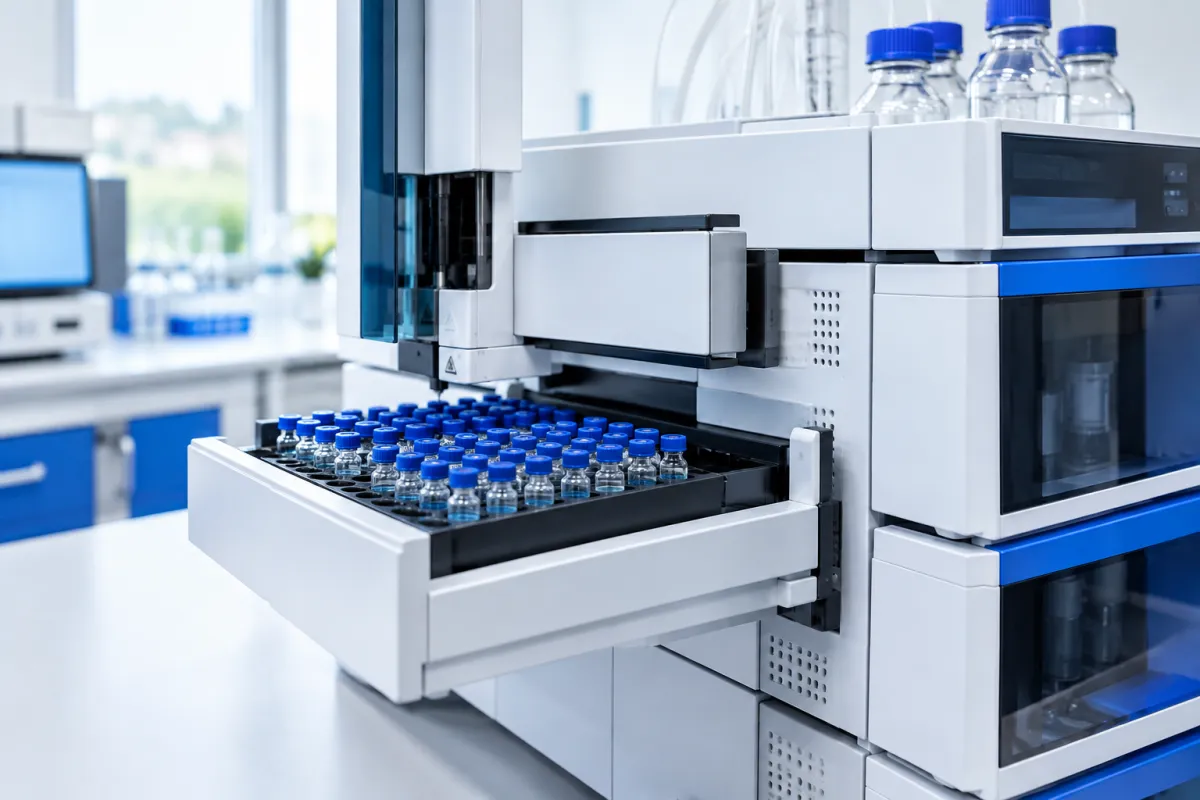 Illustration: a liquid chromatography system of the kind used for peptide purity testing.
How is purity different from peptide content?
Purity describes the peptide material in a sample, while content describes how much of the powder’s total mass is peptide. A lyophilised peptide powder also holds counter-ions, water and sometimes residual solvents, none of which an HPLC purity figure counts. The EMA guideline lists assay or content, counter-ion identity and content, residual TFA and water content as specification tests separate from purity 3.
Counter-ions can be a large share of the mass. In a 2018 analytical study of a candidate certified reference material of angiotensin II, Melanson et al. measured the TFA counter-ion at nearly 25% by mass and assigned a final purity of 691 ± 9 mg per gram 10. The net peptide content explainer covers these measurements, and acetate vs TFA salts covers the counter-ion itself.
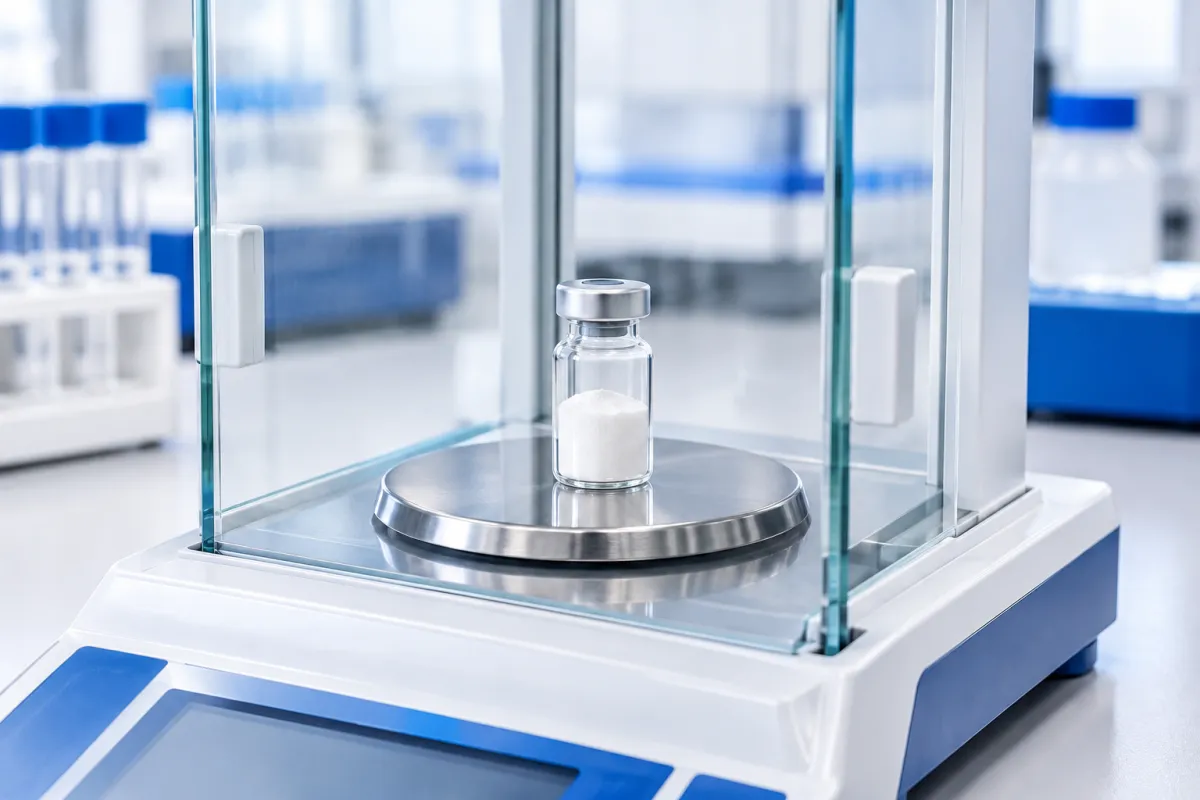 Illustration: the weight of a lyophilised powder includes more than the peptide it contains.
Which other tests can appear on a COA?
A COA can add tests for residual solvents, elemental impurities, bacterial endotoxins and microbiological purity, all four of which appear in the EMA guideline’s list of possible specification tests for synthetic peptides 3. McCarthy et al. measured residual solvents in peptide reference standard material by gas chromatography, and inorganic impurities by residue on ignition 4. Endotoxin, heavy metals and residual solvents explains each test for cell-culture and laboratory work.
Multi-component blends add another layer, because a method has to identify and measure each peptide without interference from the others 6. How multi-component peptide blends are tested covers that case.
What can a COA not tell you?
A COA reports only the tests listed, on the sample tested, by the methods named. Anything outside that scope is unmeasured, not absent.
In a 2020 analytical case study, Choules et al. used quantitative proton NMR to examine two custom synthetic peptides that had been sourced commercially, and found undeclared mannitol, a sugar alcohol that does not absorb UV light, at 20% and 43% by weight 11. The authors described liquid chromatography purity testing as “notoriously ‘blind’ to certain compounds”, for example those without a UV-absorbing group, and noted that researchers usually trust the purity declared in a supplier’s specification or certificate of analysis 11.
The WHO model also asks certificates to disclose their own limits: a statement of measurement uncertainty where relevant to the validity or application of the results, identification of results from subcontracted laboratories, and a reference to accreditation under ISO/IEC 17025, the international standard for testing laboratories, where it relates to the analysis 2.
A COA is also not a regulatory approval. The Therapeutic Goods Administration (TGA) safety advisory of 13 April 2026 names BPC-157, GHK-Cu, TB-500, retatrutide and CJC-1295 as examples of unapproved peptide products, meaning goods not included in the Australian Register of Therapeutic Goods (ARTG), and states that these products have not been evaluated by the TGA for safety, quality or effectiveness 12.
How can you check a COA against the material you hold?
Match identifiers first, then check that each result is complete and traceable to a named laboratory. Drawing on ICH Q7 and the WHO model 1 2:
- The batch or lot number on the vial label matches the COA exactly.
- The issuing laboratory is named with an address. If a supplier reissued the certificate, the laboratory that performed the analysis is still named.
- Each test lists a method reference, acceptance criteria and a numerical result, not only “pass” or “complies”.
- The certificate has an identification number, page numbering and a dated approval signature.
- Identity, purity and content appear as separate entries, so a purity figure is not read as a content figure.
- Where a chromatogram or mass spectrum is attached, the main peak and the observed mass are labelled.
Certificates published for products on this site are listed in the COA vault, and the verification page looks up a certificate by product name, lot number or report number.
Frequently asked questions
What is a certificate of analysis for a peptide?
It is a batch-specific report of the tests performed on a peptide sample, with the method, acceptance criteria and numerical result for each. ICH Q7 says a certificate should list each test with its acceptance limits and numerical results, and be dated and signed by authorised quality personnel 1. For synthetic peptides, identity and HPLC purity are the core entries.
What does “retest date” mean on a COA?
ICH Q7 defines the retest date as the date when a material should be re-examined to ensure it is still suitable for use. The expiry date is different: it marks the end of the period in which the material is expected to stay within its shelf-life specification 1. The WHO model certificate has one field for either date 2.
Is HPLC purity the same as the amount of peptide in a vial?
No. HPLC purity is the share of the UV-detected peptide signal in the main peak, and it does not count counter-ions, water or substances invisible to UV. In a 2018 study of an angiotensin II reference material, the TFA counter-ion alone made up nearly 25% of the mass 10. Net peptide content explained covers the difference in detail.
Does a COA mean a peptide product is approved by the TGA?
No. A COA is a laboratory report, not a regulatory decision. The TGA safety advisory of 13 April 2026 names BPC-157, GHK-Cu, TB-500, retatrutide and CJC-1295 as examples of unapproved peptide products, meaning goods not included in the ARTG, and states that they have not been evaluated by the TGA for safety, quality or effectiveness 12.
Who should be named as the issuer of a COA?
The laboratory that performed the analysis. The WHO model certificate starts with the issuing laboratory’s name and address and asks that subcontracted results be identified 2. ICH Q7 adds that certificates reissued by agents or brokers should name the testing laboratory and attach a copy of the original batch certificate 1.
References
- International Council for Harmonisation (ICH). Q7: Good manufacturing practice guide for active pharmaceutical ingredients (Step 4 version, 10 November 2000). https://database.ich.org/sites/default/files/Q7%20Guideline.pdf. Accessed 28 September 2026. [international guideline]
- World Health Organization. Annex 4: Model certificate of analysis. WHO Expert Committee on Specifications for Pharmaceutical Preparations, fifty-second report (WHO Technical Report Series, No. 1010, 2018). https://www.who.int/publications/m/item/trs1010-annex4. Accessed 28 September 2026. [international guidance]
- European Medicines Agency. Guideline on the development and manufacture of synthetic peptides (EMA/CHMP/CVMP/QWP/367182/2025; adopted December 2025, in effect from 1 June 2026). https://www.ema.europa.eu/en/development-manufacture-synthetic-peptides-scientific-guideline. Accessed 28 September 2026. [regulatory guideline]
- McCarthy D, Han Y, Carrick K, et al. Reference Standards to Support Quality of Synthetic Peptide Therapeutics. Pharm Res. 2023;40(6):1317-1328. doi:10.1007/s11095-023-03493-1. PMID: 36949371. PMCID: PMC10338602. [analytical methods paper with case studies]
- Mant CT, Chen Y, Yan Z, et al. HPLC analysis and purification of peptides. Methods Mol Biol. 2007;386:3-55. doi:10.1007/978-1-59745-430-8_1. PMID: 18604941. PMCID: PMC7119934. [methods chapter]
- International Council for Harmonisation (ICH). Q2(R2): Validation of analytical procedures (adopted 1 November 2023). https://database.ich.org/sites/default/files/ICH_Q2%28R2%29_Guideline_2023_1130.pdf. Accessed 28 September 2026. [international guideline]
- PubChem. Leucine, CID 6106 (https://pubchem.ncbi.nlm.nih.gov/compound/6106) and Isoleucine, CID 6306 (https://pubchem.ncbi.nlm.nih.gov/compound/6306): molecular formula and exact mass. Accessed 28 September 2026. [chemical database]
- D’Hondt M, Bracke N, Taevernier L, et al. Related impurities in peptide medicines. J Pharm Biomed Anal. 2014;101:2-30. doi:10.1016/j.jpba.2014.06.012. PMID: 25044089. [narrative review]
- International Council for Harmonisation (ICH). Q3A(R2): Impurities in new drug substances (Step 4 version, 25 October 2006). https://database.ich.org/sites/default/files/Q3A%28R2%29%20Guideline.pdf. Accessed 28 September 2026. [international guideline]
- Melanson JE, Thibeault MP, Stocks BB, et al. Purity assignment for peptide certified reference materials by combining qNMR and LC-MS/MS amino acid analysis results: application to angiotensin II. Anal Bioanal Chem. 2018;410(26):6719-6731. doi:10.1007/s00216-018-1272-7. PMID: 30143839. [analytical chemistry study]
- Choules MP, Bisson J, Simmler C, et al. NMR reveals an undeclared constituent in custom synthetic peptides. J Pharm Biomed Anal. 2020;178:112915. doi:10.1016/j.jpba.2019.112915. PMID: 31671336. PMCID: PMC6913887. [analytical case study]
- Therapeutic Goods Administration. Understanding your responsibilities when importing, compounding and supplying unapproved peptide products (safety advisory, 13 April 2026). https://www.tga.gov.au/safety/safety-monitoring-and-information/safety-alerts/understanding-your-responsibilities-when-importing-compounding-and-supplying-unapproved-peptide-products. Accessed 28 September 2026. [regulator safety advisory]
Check the lab report
Every published certificate of analysis names its lab, lot and test date. For laboratory research use only.