

In short: This glossary defines 50 terms that appear in peptide research papers and on certificates of analysis. The terms are grouped into peptide chemistry, identity and composition, synthesis and storage, laboratory testing, reading the research, and Australian regulation. Each entry gives a plain-English definition and, where useful, a primary source or a longer explainer.
Peptide papers and testing reports share a vocabulary that is rarely explained on the page. This glossary collects the terms that come up most often across this blog. If you are new to the subject, start with our primer, what is a peptide?, then use this page as a reference. Terms that appear on laboratory reports link to our guide on how to read a peptide certificate of analysis, and terms about study design link to how to read a peptide study. Entries are grouped by topic rather than listed alphabetically, and each one stands on its own.
What terms describe a peptide’s chemistry?
These terms describe what a peptide is made of and how its building blocks are joined and modified.
Amino acid
An amino acid is a small molecule with an amino group, a carboxylic acid group and a side chain attached to a central carbon atom. Twenty amino acids are encoded by the genetic code. Each has a three-letter and a one-letter abbreviation, so glycine is Gly or G, and each side chain differs in size, charge and attraction to water.
Residue
A residue is an amino acid once it has been built into a peptide chain. Forming each peptide bond removes the atoms of one water molecule, so what remains is the amino acid’s residue. Positions are numbered from the N-terminus: “His2” means the histidine at position 2.
Peptide
A peptide is a chain of amino acids joined by peptide bonds. The line between peptides and proteins is a convention rather than a sharp boundary: shorter chains are called peptides and longer, folded chains are called proteins. Our primer, what is a peptide?, covers the basics.
Peptide bond
A peptide bond is the amide bond that links the carboxyl group of one amino acid to the amino group of the next, releasing a molecule of water as it forms. A chain of peptide bonds forms the peptide backbone, and it gives every peptide a direction, from the N-terminus to the C-terminus.
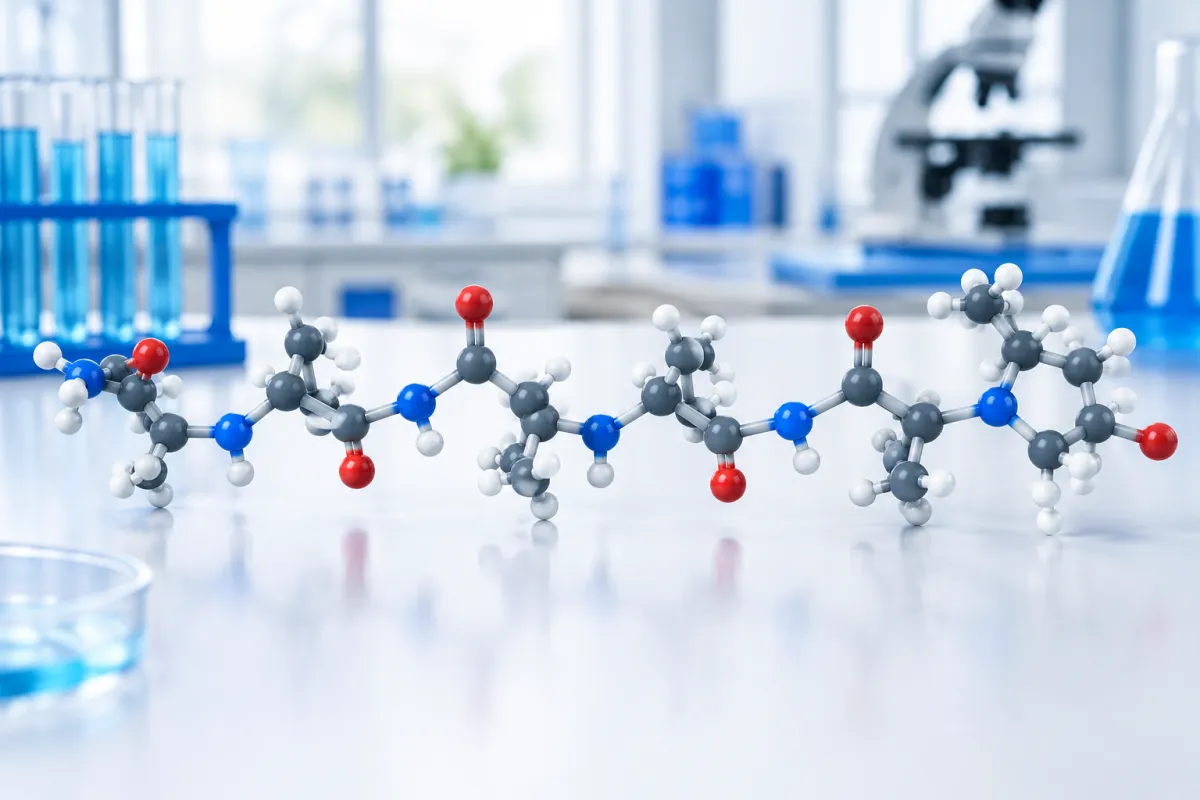 Illustration: amino acid units joined into a short chain. It does not show a specific peptide.
Tripeptide
A tripeptide is a peptide of three amino acid residues. Two examples covered on this blog are GHK (Gly-His-Lys), the copper-binding peptide in GHK-Cu, and KPV (Lys-Pro-Val), which matches the last three residues of alpha-melanocyte-stimulating hormone (KPV). A dipeptide has two residues.
Sequence
A peptide’s sequence is the order of its amino acids, written from the N-terminus to the C-terminus in three-letter code (Gly-His-Lys) or one-letter code (GHK). Sequence is the core of a peptide’s identity: the same amino acids in a different order make a different compound with a different structure.
N-terminus
The N-terminus is the end of a peptide chain with a free amino group, written on the left by convention. It can be chemically modified. A common modification is acetylation, the addition of an acetyl group (written Ac-), which removes the positive charge the free amino group would otherwise carry.
C-terminus
The C-terminus is the end of a peptide chain with a free carboxylic acid group, written on the right. Suffixes in sequence notation show its form: “-OH” means the free acid and “-NH2” means an amide. The two forms have different molecular formulas, so the suffix matters when checking identity.
Amidation
Amidation is the replacement of the C-terminal carboxylic acid with an amide group. Many peptide hormones made in the body end this way; UniProt, for example, annotates the final valine of alpha-melanocyte-stimulating hormone in human pro-opiomelanocortin as a valine amide 1. An amide and a free acid differ in mass by about 1 dalton.
Disulfide bond
A disulfide bond is a covalent link between the sulfur atoms of two cysteine side chains. It can close a single peptide into a ring or join two separate chains. Forming one removes two hydrogen atoms, so the molecular formula and mass of a peptide depend on whether its disulfide bonds are formed.
Parent protein
A parent protein is the larger protein from which a peptide or fragment is derived. KPV, for example, matches residues 148 to 150 of human pro-opiomelanocortin, the precursor protein that also yields alpha-melanocyte-stimulating hormone 1. UniProt catalogues parent protein sequences and marks where each peptide sits within them.
Analogue
An analogue is a compound made by changing a known peptide: swapping an amino acid, switching one to its mirror-image D-form, or adding a chemical group. In a 1991 mouse study, versions of acetylated, amidated KPV with single D-amino acids differed in activity from the original 2. Results for an analogue do not automatically apply to the parent peptide.
Chelate
A chelate is a complex in which a metal ion is held by two or more atoms of the same molecule. GHK-Cu is an example: in a 2011 structural study, copper(II) in solution was held by three nitrogen atoms of the GHK peptide 3. The metal changes the formula, weight and identifiers of the material.
What terms describe a peptide’s identity and composition?
These terms appear in the identity section of a certificate of analysis and in compound databases.
Molecular formula
A molecular formula lists the number of atoms of each element in one molecule, such as C14H24N6O4 for the GHK peptide 4. Modifications such as amidation, acetylation or a bound metal change the formula, so it is a quick check that a document describes the expected form of a compound.
Molecular weight
Molecular weight is the average mass of one molecule, reported in daltons (Da) or grams per mole (g/mol); the two numbers are the same. PubChem lists 340.38 g/mol for the GHK peptide 4. Mass spectrometry often reports the monoisotopic mass instead, calculated from the most common isotope of each element, which differs slightly.
CAS number
A CAS number is a registry number that the Chemical Abstracts Service assigns to a specific substance. Different forms of one peptide can have different numbers: PubChem lists 49557-75-7 for the GHK peptide 4 and 89030-95-5 for its 1:1 copper complex, prezatide copper 5. A CAS number identifies a substance; it says nothing about purity.
PubChem CID
A PubChem CID is the compound identifier in PubChem, the chemistry database of the US National Institutes of Health. Each distinct structure has its own CID, so a peptide, its salts and its metal complexes can have separate records. KPV, for example, is CID 125672 6, and our compound reviews list the CID in their key facts tables.
Counter-ion
A counter-ion is an ion of opposite charge that balances the charge on a peptide in its solid salt form. Peptides with basic residues such as lysine carry positive charges and are isolated as salts with anions such as acetate, trifluoroacetate or chloride. The counter-ion adds weight but is not peptide. See acetate vs TFA salts.
Trifluoroacetate (TFA)
Trifluoroacetate is the anion of trifluoroacetic acid, which is used in reversed-phase HPLC. In a 1999 cell study, Cornish and colleagues noted that HPLC-purified peptides are often TFA salts, reported that TFA reduced cell numbers in osteoblast cultures, and recommended converting such peptides to a hydrochloride or equivalent salt before biological testing 7.
What terms describe how peptides are made and stored?
These terms cover the chemical synthesis of research peptides and the solid form in which they are supplied.
Solid-phase peptide synthesis
Solid-phase peptide synthesis (SPPS) builds a peptide on insoluble resin beads, adding one amino acid at a time and washing away excess reagents after each step. Merrifield described the approach in 1963, with the synthesis of a tetrapeptide 8. Our explainer on solid-phase peptide synthesis walks through the steps.
Protecting group
A protecting group is a temporary chemical group that blocks a reactive site during synthesis so that only the intended bond forms. In the widely used Fmoc method, the fluorenylmethoxycarbonyl (Fmoc) group protects each incoming amino acid’s amino group and is removed before the next amino acid is added. Side-chain protecting groups are removed at the end.
Crude peptide
Crude peptide is the material released from the resin at the end of synthesis, before purification. It contains the target peptide plus by-products such as deletion sequences and truncated chains. Preparative reversed-phase HPLC is one way of purifying it, and Mant and colleagues describe purification methods for peptides and recombinant proteins 9.
Deletion sequence
A deletion sequence is a synthesis by-product missing one or more amino acids because a coupling step did not go to completion. Deletion sequences are close in structure and mass to the target peptide, so they are among the impurities that HPLC separates and mass spectrometry identifies. They are one reason purity is rarely 100%.
Lyophilisation
Lyophilisation, or freeze-drying, removes water from frozen material by turning ice directly into vapour under vacuum. A 2000 review by Wang describes it as the most common method for preparing solid protein pharmaceuticals and notes that freezing and drying both place stresses on the molecules 10. See why research peptides are lyophilised.
Hygroscopic
A hygroscopic material absorbs water from the air. Freeze-dried peptide powders can pick up moisture once exposed, which adds weight that is not peptide and can affect stability. This is one reason sealed containers matter and why some certificates report water content. See how to store lyophilised peptides.
What terms appear in laboratory testing and on a COA?
These terms describe the tests used to confirm a peptide’s identity, purity and content, and the documents that report them.
Certificate of analysis
A certificate of analysis (COA) reports test results for one batch of material. It usually covers identity and purity, and may add content, water, endotoxin, heavy metals or residual solvents. Our guide to reading a peptide COA explains each section, and our published certificates are grouped by product.
Batch
A batch, or lot, is a quantity of material made in one production run and treated as uniform, identified by a batch or lot number. Results on a certificate of analysis apply only to the batch named on it, not to other batches of the same product. Our verification page looks up a certificate by product name or lab report number.
HPLC
High-performance liquid chromatography (HPLC) pumps a sample in liquid through a packed column under pressure and separates its components by how strongly each interacts with the column. Mant and colleagues describe size-exclusion, ion-exchange and reversed-phase HPLC as the major modes used for peptides 9. See HPLC purity explained.
Reversed-phase chromatography
Reversed-phase chromatography is a widely used HPLC mode for peptides. The column packing is water-repelling, often C18 silica, and the mobile phase shifts from mostly water towards an organic solvent such as acetonitrile, so more hydrophobic peptides emerge later. A published KPV method used a C18 column with water and acetonitrile containing trifluoroacetic acid 11.
Chromatogram
A chromatogram is the trace an HPLC detector produces: detector signal on the vertical axis against time on the horizontal axis. Each separated component appears as a peak. The area under each peak is used to calculate purity, and the position of each peak is its retention time.
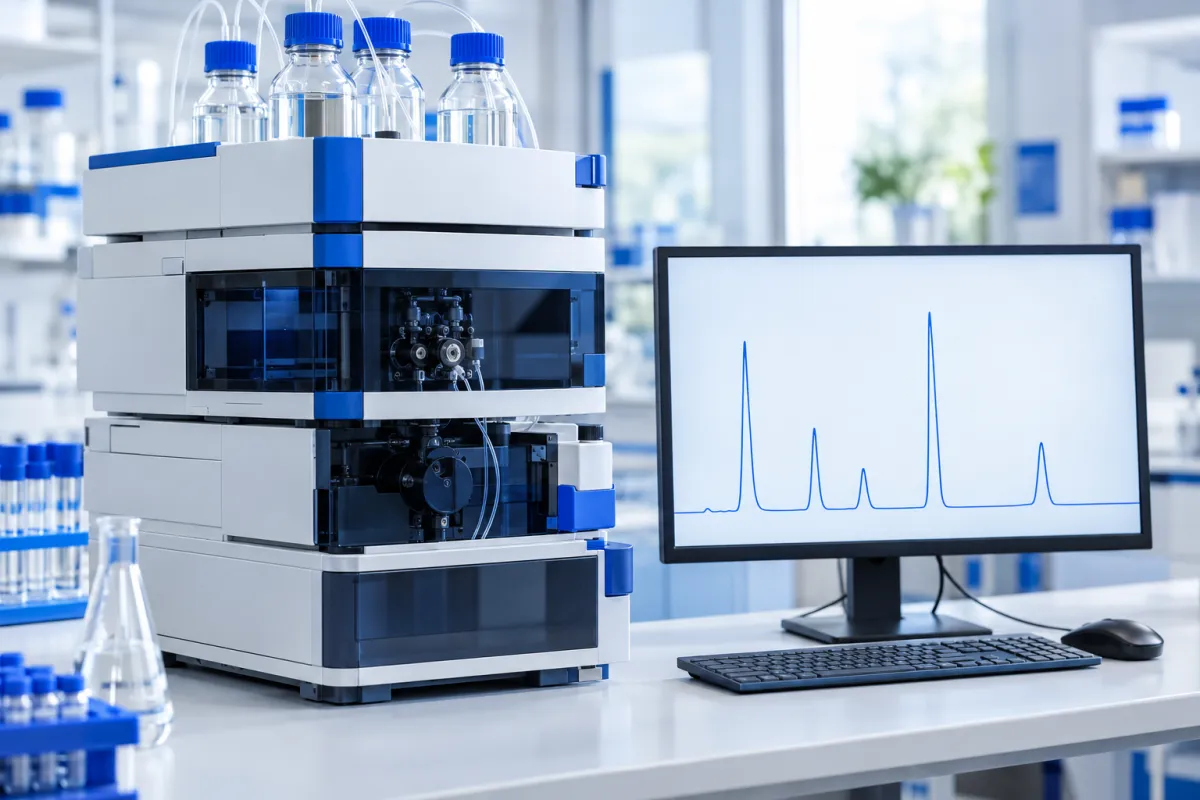 Illustration: an HPLC system and a chromatogram, the source of the purity figure on a certificate of analysis.
Retention time
Retention time is the time a component takes to travel through the column to the detector. Under fixed conditions it is characteristic of a compound, so matching it against a reference standard is one identity check. Different compounds can share a retention time, which is why identity is usually confirmed by mass spectrometry as well.
Purity
On a peptide certificate of analysis, purity usually means HPLC area percentage: the target peak’s area as a share of all peak areas detected at one wavelength. It does not account for water, counter-ions or anything the detector cannot see, which is why it differs from net peptide content. See HPLC purity explained.
Mass spectrometry
Mass spectrometry turns molecules into gas-phase ions and measures their mass-to-charge ratio. For peptides it confirms identity by matching the measured mass with the mass expected from the sequence. In 1988, Karas and Hillenkamp reported laser desorption ionisation of proteins above 10,000 daltons 12. See mass spectrometry for peptides.
Electrospray ionisation
Electrospray ionisation (ESI) sprays a solution through a charged needle to produce ions for mass spectrometry. In a 1989 review, Fenn and colleagues described it as a way to produce intact ions from large, fragile biological molecules, with spectra showing series of multiply charged ions 13. It is often coupled directly to HPLC, a combination called LC-MS.
Mass-to-charge ratio
The mass-to-charge ratio, written m/z, is what a mass spectrometer measures. An ion carrying two charges appears at about half its mass. Electrospray spectra of larger molecules therefore show a series of peaks, each differing by one charge 13, which software converts back to a single molecular mass for comparison with the expected value.
Net peptide content
Net peptide content is the proportion of a weighed sample that is peptide, as opposed to water, counter-ions and other non-peptide material. It is measured separately from HPLC purity, often by amino acid analysis, and the two numbers answer different questions. See net peptide content explained.
Amino acid analysis
Amino acid analysis breaks a peptide into its individual amino acids, usually by heating it in strong acid, then separates and measures each one. The result confirms the peptide’s composition and gives an absolute amount of peptide in the sample, which is why the method is used to determine net peptide content.
Endotoxin
Endotoxin is lipopolysaccharide from the outer membrane of Gram-negative bacteria. It is measured because it can trigger strong responses in cell culture and animal work. The limulus amebocyte lysate (LAL) test uses horseshoe crab blood cells and traces back to work on endotoxin and the clotting of Limulus blood 14. See the other tests on a COA.
Residual solvents
Residual solvents are traces of organic solvents, such as acetonitrile, left over from synthesis and purification. They are usually measured by gas chromatography and appear on some certificates of analysis alongside endotoxin and heavy metals. Our explainer on endotoxin, heavy metals and residual solvents covers all three tests.
What terms appear when reading the research?
These terms describe study types, biological measurements and the identifiers used to find and check papers.
In vitro
In vitro, Latin for “in glass”, describes experiments in tubes, plates or flasks, including cell culture. A cell line is a population of cells that keeps dividing in culture, such as the RAW 264.7 mouse macrophage line used in a 2001 melanocortin peptide study 15. See how to read a peptide study.
In vivo
In vivo describes experiments in a living organism, usually an animal model: a mouse or rat in which a condition is induced chemically, surgically or genetically. An animal study shows what happened in that model under those conditions. It is not a result in people, and the model may reproduce only part of a human disease.
Preclinical
Preclinical research is research done before any testing in people: chemistry, in vitro and animal studies. Most of the published literature on the compounds covered on this blog is preclinical, and each of our reviews states which study types exist. See why most peptide research is preclinical.
Randomised controlled trial
A randomised controlled trial assigns participants by chance to the intervention or to a control, such as a placebo, so that the groups should differ only by the intervention. Evidence hierarchies such as those used by Australia’s National Health and Medical Research Council rank randomised trials above observational studies.
Systematic review
A systematic review searches the literature with a pre-specified, reproducible method, applies explicit criteria for including studies, and appraises each one. A meta-analysis goes further and combines the numerical results. Systematic reviews of randomised trials sit at the top of most evidence hierarchies; narrative reviews, which summarise without a formal search method, do not.
Receptor
A receptor is a protein, often on the cell surface, that binds a specific molecule and triggers a response inside the cell. The melanocortin receptors, MC1R to MC5R, are one family 16. Whether a peptide binds a given receptor is tested with binding assays and with measurements of the signals the receptor produces.
Cytokine
A cytokine is a small signalling protein released by cells, especially immune cells, to act on other cells. TNF-alpha, IL-1beta and IL-6 are cytokines often measured in inflammation studies, including the lung and colitis models described in our GHK-Cu and KPV research reviews.
PMID, PMCID and DOI
These are three identifiers for a paper. The PMID is its PubMed record number. The PMCID points to free full text in PubMed Central. The DOI, or digital object identifier, is a permanent link to the publisher’s version through doi.org. Our reference lists give all three where they exist.
Retraction
A retraction is the formal withdrawal of a published paper, usually because of serious error or misconduct. The paper stays online with a notice. Before citing a paper, we check Europe PMC for retraction notices, as described in our editorial standards. The Retraction Watch Database keeps a public record of retractions.
What regulatory terms appear in Australian peptide research?
Two terms come up in the regulatory and anti-doping sections of our compound reviews.
ARTG
The Australian Register of Therapeutic Goods (ARTG) is the TGA’s register of therapeutic goods. The TGA’s safety advisory of 13 April 2026 describes unapproved peptide products as goods not included in the ARTG, and names BPC-157, GHK-Cu, TB-500, retatrutide and CJC-1295 as examples 17. The register can be searched on the TGA website.
WADA Prohibited List
The WADA Prohibited List is the World Anti-Doping Agency’s annual list of substances and methods prohibited in sport. The 2026 list took effect on 1 January 2026, and its section S0 (non-approved substances) names BPC-157 among its examples 18. See our anti-doping status table and Sport Integrity Australia.
Frequently asked questions
What is the difference between a peptide and a protein?
Both are chains of amino acids joined by peptide bonds. The difference is mainly size and folding: peptides are short chains, while proteins are longer chains that usually fold into a defined three-dimensional shape. The boundary is a convention rather than a strict rule. Our primer, what is a peptide?, explains the chemistry in more detail.
What is the difference between HPLC purity and net peptide content?
HPLC purity is the share of the detected peak area that belongs to the target peptide. Net peptide content is the share of the weighed material that is peptide at all, after water and counter-ions are accounted for. A sample can have high purity and a lower net content. Our explainers on HPLC purity and net peptide content cover both.
What do the letters in peptide names like GHK and KPV mean?
They are one-letter amino acid codes, read from the N-terminus to the C-terminus. GHK is glycine, histidine and lysine; KPV is lysine, proline and valine. Each letter stands for one residue, so both names describe tripeptides. PubChem lists the GHK peptide as C14H24N6O4 4 and KPV as CID 125672 6.
What does “in vitro” mean in a peptide study?
In vitro means the experiment was done outside a living organism, for example in cultured cells. Such results show what happened in that system, not in an animal or a person. In vivo studies use living animals, and clinical studies involve people. Our guide to how to read a peptide study explains how these evidence types differ.
Where can I check a peptide’s formula and identifiers?
PubChem lists molecular formulas, molecular weights, CAS numbers and synonyms for many peptides; for example, it records C16H30N4O4 and 342.43 g/mol for KPV 6. UniProt holds parent protein sequences, such as human pro-opiomelanocortin 1. A certificate of analysis should match the database entry for the form supplied.
References
- UniProt. Pro-opiomelanocortin, human (P01189). https://www.uniprot.org/uniprotkb/P01189/entry. Accessed 28 September 2026. [protein database]
- Hiltz ME, Catania A, Lipton JM. Anti-inflammatory activity of alpha-MSH(11-13) analogs: influences of alteration in stereochemistry. Peptides. 1991;12(4):767-771. doi:10.1016/0196-9781(91)90131-8. PMID: 1788140. [mouse study]
- Hureau C, Eury H, Guillot R, et al. X-ray and solution structures of Cu(II) GHK and Cu(II) DAHK complexes: influence on their redox properties. Chemistry: A European Journal. 2011;17(36):10151-10160. doi:10.1002/chem.201100751. PMID: 21780203. [chemistry study]
- PubChem. Glycyl-L-histidyl-L-lysine (CID 73587). https://pubchem.ncbi.nlm.nih.gov/compound/73587. Accessed 28 September 2026. [compound database]
- PubChem. Prezatide copper (CID 71587328). https://pubchem.ncbi.nlm.nih.gov/compound/71587328. Accessed 28 September 2026. [compound database]
- PubChem. Msh (11-13), Lys-Pro-Val (CID 125672). https://pubchem.ncbi.nlm.nih.gov/compound/125672. Accessed 28 September 2026. [compound database]
- Cornish J, Callon KE, Lin CQ, et al. Trifluoroacetate, a contaminant in purified proteins, inhibits proliferation of osteoblasts and chondrocytes. American Journal of Physiology. 1999;277(5):E779-83. doi:10.1152/ajpendo.1999.277.5.e779. PMID: 10567002. [cell study]
- Merrifield RB. Solid phase peptide synthesis. I. The synthesis of a tetrapeptide. Journal of the American Chemical Society. 1963;85(14):2149-2154. doi:10.1021/ja00897a025. [chemistry methods paper]
- Mant CT, Chen Y, Yan Z, et al. HPLC analysis and purification of peptides. Methods in Molecular Biology. 2007;386:3-55. doi:10.1007/978-1-59745-430-8_1. PMID: 18604941. PMCID: PMC7119934. [methods chapter]
- Wang W. Lyophilization and development of solid protein pharmaceuticals. International Journal of Pharmaceutics. 2000;203(1-2):1-60. doi:10.1016/s0378-5173(00)00423-3. PMID: 10967427. [narrative review]
- Pawar KR, Mulabagal V, Smith F, et al. Stability-indicating HPLC assay for lysine-proline-valine (KPV) in aqueous solutions and skin homogenates. Biomedical Chromatography. 2015;29(5):716-721. doi:10.1002/bmc.3347. PMID: 25298219. [analytical method study]
- Karas M, Hillenkamp F. Laser desorption ionization of proteins with molecular masses exceeding 10,000 daltons. Analytical Chemistry. 1988;60(20):2299-2301. doi:10.1021/ac00171a028. PMID: 3239801. [analytical methods paper]
- Fenn JB, Mann M, Meng CK, et al. Electrospray ionization for mass spectrometry of large biomolecules. Science. 1989;246(4926):64-71. doi:10.1126/science.2675315. PMID: 2675315. [narrative review]
- Levin J, Bang FB. The role of endotoxin in the extracellular coagulation of Limulus blood. Bulletin of the Johns Hopkins Hospital. 1964;115:265-274. PMID: 14209047. [laboratory study]
- Mandrika I, Muceniece R, Wikberg JE. Effects of melanocortin peptides on lipopolysaccharide/interferon-gamma-induced NF-kappaB DNA binding and nitric oxide production in macrophage-like RAW 264.7 cells: evidence for dual mechanisms of action. Biochemical Pharmacology. 2001;61(5):613-621. doi:10.1016/s0006-2952(00)00583-9. PMID: 11239505. [cell study]
- Chavatte P, Yous S, Lesieur D, et al. Conformational analysis of tripeptide Ac-Lys-Pro-Val-NH2, COOH-terminal sequence of alpha-MSH. Journal of Pharmacy and Pharmacology. 2001;53(7):949-953. doi:10.1211/0022357011776360. PMID: 11480545. [computational modelling study]
- Therapeutic Goods Administration. Understanding your responsibilities when importing, compounding and supplying unapproved peptide products (safety advisory, 13 April 2026). https://www.tga.gov.au/safety/safety-monitoring-and-information/safety-alerts/understanding-your-responsibilities-when-importing-compounding-and-supplying-unapproved-peptide-products. Accessed 28 September 2026. [regulator]
- World Anti-Doping Agency. World Anti-Doping Code International Standard: Prohibited List 2026. https://www.wada-ama.org/en/prohibited-list. Accessed 28 September 2026. [anti-doping regulator]
Check the lab report
Every published certificate of analysis names its lab, lot and test date. For laboratory research use only.