

In short: The BPC-157 and TB-500 blend holds two peptides in equal amounts by mass. KLOW holds the same two, 10 mg each, plus 50 mg of GHK-Cu and 10 mg of KPV. One rat study has tested BPC-157 and TB-500 together; none has tested KLOW. The TGA names BPC-157, TB-500 and GHK-Cu as unapproved peptide products.
Both products are lyophilised (freeze-dried) peptide mixtures for laboratory research, and they share two components. This comparison covers composition, research, testing and regulatory status. It does not rank them: they are different materials for different study designs. Each blend has its own article, on the BPC-157 and TB-500 blend and the KLOW peptide blend.
Key facts
| BPC-157 and TB-500 blend | KLOW blend | |
|---|---|---|
| Components | BPC-157, TB-500 | BPC-157, TB-500, GHK-Cu, KPV |
| Composition by mass | 1:1, supplied as 10 mg (5 mg of each) or 20 mg (10 mg of each) | 80 mg: GHK-Cu 50 mg; BPC-157, TB-500 and KPV 10 mg each |
| TB-500 form | Full-length thymosin beta-4 acetate, 43 amino acids | Full-length thymosin beta-4 acetate, 43 amino acids |
| Share of each shared peptide | 50% each | 12.5% each |
| Molecular weights in the mixture (g/mol, PubChem) 1 | 1419.5 (BPC-157) and 4963 (thymosin beta-4) | Those two, plus 402.92 (GHK-Cu) and 342.43 (KPV) |
| Metal present | No | Copper, bound in GHK-Cu |
| Published studies of the mixture | One rat study of the two peptides combined 2 | None found |
| Components named in the TGA advisory of 13 April 2026 3 | Both | Three of four (not KPV) |
| Components named on the 2026 WADA Prohibited List 4 | Both: BPC-157 in S0, TB-500 in S2.3 | BPC-157 and TB-500; GHK-Cu and KPV are not named |
In both blends, TB-500 is full-length thymosin beta-4 acetate, the 43-amino-acid peptide listed in UniProt as P62328 5, per the supplier’s specification, and the batch certificate records it. The name TB-500 is also used in the market for a 7-residue fragment, Ac-LKKTETQ (889.0 g/mol) 1.
What is the difference between KLOW and the BPC-157 and TB-500 blend?
KLOW contains four peptides and the BPC-157 and TB-500 blend contains two; the two they share are the same named compounds, and KLOW adds GHK-Cu and KPV.
The proportions differ as much as the component lists. In the two-component blend, BPC-157 and TB-500 each make up half the peptide mass. In KLOW, each makes up one-eighth, and GHK-Cu makes up five-eighths.
The number of molecules also differs from the mass ratio. The four components range from 342.43 to 4963 g/mol 1. In the two-component blend, equal masses of BPC-157 and thymosin beta-4 hold about 3.5 molecules of BPC-157 for every molecule of thymosin beta-4, and in KLOW a milligram of KPV holds about 14 times as many molecules as a milligram of thymosin beta-4.
Which components do the two blends share?
Both blends contain BPC-157 and TB-500, two peptides with separate origins and literatures.
BPC-157 is a 15-amino-acid peptide, GEPPPGKPADDAGLV, that Chang et al. (2011) described as a partial sequence of a protein discovered in human gastric juice 6. A 2025 systematic review of its musculoskeletal literature included 36 studies, 35 of them preclinical and one clinical, and found no clinical safety data 7. Most of the literature comes from one group: of 199 PubMed records with BPC-157 in the title on 28 September 2026, 166 list P. Sikiric as an author 8, and Sikiric’s group is based at the University of Zagreb 9.
TB-500 in both blends is full-length thymosin beta-4 acetate. UniProt lists human thymosin beta-4 as a 43-amino-acid chain with an acetylated N-terminal serine, once its first methionine is removed 5. Safer et al. (1991) reported that it formed a 1:1 complex with actin monomers and inhibited actin polymerisation 10. Phase 1 trials in healthy volunteers have tested synthetic and recombinant thymosin beta-4, measuring tolerability and pharmacokinetics 11 12. TB-500 vs thymosin beta-4 explains how the name is used.
 Illustration: two sealed research vials of lyophilised powder.
What do GHK-Cu and KPV add to KLOW’s composition?
GHK-Cu adds a copper complex of a tripeptide, and KPV adds a second tripeptide, derived from a hormone sequence.
GHK-Cu is the copper(II) complex of glycyl-L-histidyl-L-lysine. Pickart et al. (1980) reported that GHK isolated from plasma came with roughly equimolar copper and that the tripeptide readily formed complexes with copper(II) 13. Lau and Sarkar (1981) found several copper and GHK species in solution, depending on pH 14.
KPV is the tripeptide lysine-proline-valine, the last three residues of alpha-melanocyte-stimulating hormone (alpha-MSH), which UniProt places at residues 138 to 150 of pro-opiomelanocortin 5. Dalmasso et al. (2008) reported that KPV entered intestinal epithelial and immune cells through the peptide transporter PepT1 and inhibited NF-κB signalling in cell lines, and reported lower colitis incidence in two mouse models 15.
What research exists on each combination?
One controlled rat study has tested BPC-157 and TB-500 together, and no study has tested KLOW or any mixture of its four components.
Biçer et al. (2026) randomly assigned 32 rats with a repaired Achilles tendon transection to four groups: control, BPC-157, TB-500, and both peptides together. After four weeks they measured maximum load to failure, histology scores and collagen types I and III. They reported higher load to failure in the BPC-157 and TB-500 groups than in controls, significant only for TB-500, and no additional effect from combining the two over either alone. The abstract describes TB-500 as synthetic thymosin beta-4 without stating whether the fragment or the full protein was used 2.
For KLOW, a PubMed search on 28 September 2026 for “KLOW” with “peptide” returned no records, and searches pairing GHK-Cu or KPV with BPC-157 or TB-500 returned no study of a combination. Evidence for KLOW’s components therefore comes from studies of each compound alone.
| Study | Study type | Model | What was measured | Reported finding |
|---|---|---|---|---|
| Biçer, 2026 (BPC-157 and TB-500) | Animal study | Rats with a repaired Achilles tendon transection | Load to failure, histology scores, collagen I and III | Higher load to failure with BPC-157 and TB-500, significant only for TB-500; no additional effect from the combination |
| Staresinic, 2003 (BPC-157) | Animal and cell study | Rats with a transected Achilles tendon; cultured rat tendon cells | Load to failure, functional index, histology | Higher load to failure and functional index values than controls |
| Bock-Marquette, 2004 (thymosin beta-4) | Cell and animal study | Cultured heart muscle cells; mice after coronary artery ligation | Cell migration and survival; ILK and Akt activity | More migration and survival in culture; higher ILK and Akt activity in mice |
| Park, 2016 (GHK-Cu) | Animal and cell study | Mice with lipopolysaccharide-induced lung injury; macrophages | TNF-α, IL-6, NF-κB and p38 signalling | Lower TNF-α and IL-6 and suppressed signalling |
| Dalmasso, 2008 (KPV) | Cell and animal study | Human intestinal cell lines; mice with two types of induced colitis | NF-κB and MAP kinase signalling, PepT1 uptake | Inhibited inflammatory signalling via PepT1; lower colitis incidence |
All of these are cell or animal studies. How to read a peptide study explains what that type of evidence can and cannot show.
How does testing differ between a two-component and a four-component blend?
A four-component blend has twice as many analytes, a much wider spread of molecular sizes, a metal complex and a more uneven mass ratio, so its test methods have more to separate and measure.
In the two-component blend, a method has to resolve and quantify BPC-157 (1419.5 g/mol) and thymosin beta-4 (4963 g/mol), present in equal masses 1. Reversed-phase HPLC has been used to quantify thymosin beta-4 and separate it from closely related beta-thymosins 19. KLOW adds two tripeptides of 342.43 and 402.92 g/mol, so one run spans a 14-fold mass range. Small, polar peptides can be poorly retained on reversed-phase columns, and Janvier et al. (2017) developed a hydrophilic interaction liquid chromatography method for polar peptides for that reason 20. GHK-Cu also brings copper, which forms several species with GHK in solution 14, so the peptide and the copper are separate measurements.
The uneven ratio matters as well. Three of KLOW’s components each make up 12.5% of the mass, next to one at 62.5%. Peak areas do not translate directly into mass either: Kuipers and Gruppen (2007) reported that at 214 nm tryptophan absorbs about 30 times more than a peptide bond and histidine about six times more 21. Each component therefore has to be measured against its own reference standard.
Identity testing works the same way for both blends. Fenn et al. (1989) described electrospray spectra of large molecules as sequences of multiply charged peaks 22; the mass of a 43-residue peptide such as thymosin beta-4 is read from such a series, while the tripeptides sit far lower in the mass range. The expected 4963 g/mol for thymosin beta-4 is also far from the 889.0 g/mol of the fragment sold under the same name 1. How multi-component peptide blends are tested explains each step, and batch reports for both products are in our COA library.
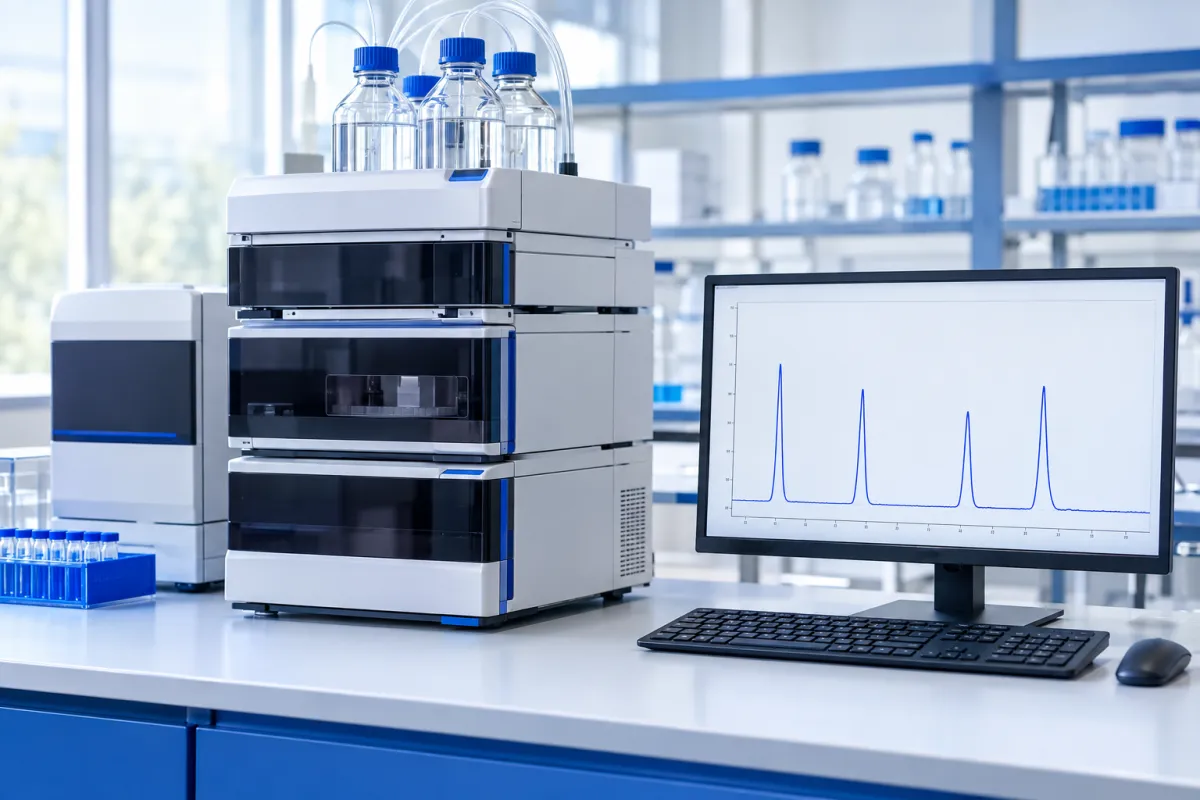 Illustration: a four-component blend gives more peaks to separate than a two-component blend.
How do the regulatory and anti-doping statuses of the two blends compare?
Both blends contain BPC-157 and TB-500, which are named by both the TGA and WADA; KLOW’s extra components add GHK-Cu, which the TGA names, and KPV, which neither names.
The TGA safety advisory of 13 April 2026 names BPC-157, GHK-Cu, TB-500, retatrutide and CJC-1295 as examples of unapproved peptide products, meaning goods not included in the Australian Register of Therapeutic Goods, and states that they have not been evaluated by the TGA for safety, quality or effectiveness 3.
The 2026 WADA Prohibited List names BPC-157 under S0, non-approved substances, and “thymosin-β4 and its derivatives e.g. TB-500” under S2.3, growth factors and growth factor modulators 4. GHK-Cu and KPV are not named on the 2026 list. Check the current WADA Prohibited List for changes, and see our anti-doping status overview.
Frequently asked questions
What is the difference between KLOW and the BPC-157 and TB-500 blend?
KLOW contains four peptides: GHK-Cu (50 mg), BPC-157, TB-500 and KPV (10 mg each), 80 mg in total. The BPC-157 and TB-500 blend contains only BPC-157 and TB-500, in equal amounts by mass. Both are lyophilised research materials. The only published study of either mixture is a 2026 rat study of BPC-157 and TB-500 combined 2. The KLOW article describes each component.
Has either blend been studied as a mixture?
Only the two-component pairing. Biçer et al. (2026) compared BPC-157, TB-500 and the combination in rats after Achilles tendon repair, and reported no additional effect from combining them 2. We found no study of KLOW or of any mixture that includes GHK-Cu or KPV with BPC-157 or TB-500 in PubMed on 28 September 2026. Research on GHK-Cu and KPV comes from studies that did not include BPC-157 or TB-500.
Are the BPC-157 and TB-500 in KLOW the same compounds as in the two-component blend?
Yes. In both blends, TB-500 is full-length thymosin beta-4 acetate, the 43-amino-acid peptide of 4963 g/mol 5 1, per the supplier’s specification, and each batch certificate records it. The name TB-500 is also used in the market for a 7-residue fragment of 889.0 g/mol 23. Our COA library holds published reports, and TB-500 vs thymosin beta-4 explains the naming.
Why is a four-component blend harder to test than a two-component blend?
It has more analytes to separate and measure, molecules from 3 to 43 amino acids long, two small polar tripeptides and a copper complex. Small polar peptides can need a separation other than reversed-phase chromatography 20, and peptides absorb UV light unequally 21, so each component is measured against its own reference standard. How multi-component peptide blends are tested sets out the full process.
Are both blends’ components on the WADA Prohibited List?
The two shared components are: BPC-157 under S0, non-approved substances, and thymosin-β4 and its derivatives, including TB-500, under S2.3 of the 2026 list 4. KLOW’s other components, GHK-Cu and KPV, are not named on the 2026 list. Check the current WADA Prohibited List and our anti-doping status overview for updates.
References
- PubChem, National Center for Biotechnology Information. Compound summaries for BPC-157 (CID 9941957), prezatide copper, GHK-Cu (CID 71587328), thymosin beta-4, timbetasin (CID 16132341), TB-500 fragment Ac-LKKTETQ (CID 62707662), Lys-Pro-Val, KPV (CID 125672). Accessed 28 September 2026. [chemical database]
- Biçer O, Adanir O, Güleryüz Y, et al. Effects of BPC-157 and TB-500 on Achilles tendon healing in rats: A histopathological and biomechanical study. Jt Dis Relat Surg. 2026;37(3):822-837. doi:10.52312/jdrs.2026.2951. PMID: 42542926. [rat study]
- Therapeutic Goods Administration. Understanding your responsibilities when importing, compounding and supplying unapproved peptide products. Safety advisory, 13 April 2026. https://www.tga.gov.au/safety/safety-monitoring-and-information/safety-alerts/understanding-your-responsibilities-when-importing-compounding-and-supplying-unapproved-peptide-products. Accessed 28 September 2026. [regulator advisory]
- World Anti-Doping Agency. World Anti-Doping Code International Standard: Prohibited List 2026, in effect from 1 January 2026. https://www.wada-ama.org/en/prohibited-list. Accessed 28 September 2026. [anti-doping standard]
- UniProt Consortium. UniProtKB entries P62328, thymosin beta-4, human and P01189, pro-opiomelanocortin, human. Accessed 28 September 2026. [protein database]
- Chang CH, Tsai WC, Lin MS, et al. The promoting effect of pentadecapeptide BPC 157 on tendon healing involves tendon outgrowth, cell survival, and cell migration. J Appl Physiol (1985). 2011;110(3):774-780. doi:10.1152/japplphysiol.00945.2010. PMID: 21030672. [rat tendon explant and cell study]
- Vasireddi N, Hahamyan H, Salata MJ, et al. Emerging Use of BPC-157 in Orthopaedic Sports Medicine: A Systematic Review. HSS J. 2025;21(4):485-495. doi:10.1177/15563316251355551. PMID: 40756949. PMCID: PMC12313605. [systematic review]
- National Library of Medicine. PubMed title search for BPC-157 (“BPC 157”[ti] OR “BPC-157”[ti] OR “BPC157”[ti]), alone and combined with Sikiric P[au]. https://pubmed.ncbi.nlm.nih.gov/. Searched 28 September 2026. [database search]
- Seiwerth S, Rucman R, Turkovic B, et al. BPC 157 and Standard Angiogenic Growth Factors. Gastrointestinal Tract Healing, Lessons from Tendon, Ligament, Muscle and Bone Healing. Curr Pharm Des. 2018;24(18):1972-1989. doi:10.2174/1381612824666180712110447. PMID: 29998800. [narrative review]
- Safer D, Elzinga M, Nachmias VT. Thymosin beta 4 and Fx, an actin-sequestering peptide, are indistinguishable. J Biol Chem. 1991;266(7):4029-4032. doi:10.1016/s0021-9258(20)64278-8. PMID: 1999398. [biochemistry study]
- Ruff D, Crockford D, Girardi G, et al. A randomized, placebo-controlled, single and multiple dose study of intravenous thymosin beta4 in healthy volunteers. Ann N Y Acad Sci. 2010;1194:223-229. doi:10.1111/j.1749-6632.2010.05474.x. PMID: 20536472. [phase 1 randomised, placebo-controlled trial]
- Wang X, Liu L, Qi L, et al. A first-in-human, randomized, double-blind, single- and multiple-dose, phase I study of recombinant human thymosin β4 in healthy Chinese volunteers. J Cell Mol Med. 2021;25(17):8222-8228. doi:10.1111/jcmm.16693. PMID: 34346165. PMCID: PMC8419156. [phase 1 randomised, double-blind trial]
- Pickart L, Freedman JH, Loker WJ, et al. Growth-modulating plasma tripeptide may function by facilitating copper uptake into cells. Nature. 1980;288(5792):715-717. doi:10.1038/288715a0. PMID: 7453802. [chemistry and cell study]
- Lau SJ, Sarkar B. The interaction of copper(II) and glycyl-L-histidyl-L-lysine, a growth-modulating tripeptide from plasma. Biochem J. 1981;199(3):649-656. doi:10.1042/bj1990649. PMID: 7340824. PMCID: PMC1163421. [solution chemistry study]
- Dalmasso G, Charrier-Hisamuddin L, Nguyen HT, et al. PepT1-mediated tripeptide KPV uptake reduces intestinal inflammation. Gastroenterology. 2008;134(1):166-178. doi:10.1053/j.gastro.2007.10.026. PMID: 18061177. PMCID: PMC2431115. [cell and mouse study]
- Staresinic M, Sebecic B, Patrlj L, et al. Gastric pentadecapeptide BPC 157 accelerates healing of transected rat Achilles tendon and in vitro stimulates tendocytes growth. J Orthop Res. 2003;21(6):976-983. doi:10.1016/s0736-0266(03)00110-4. PMID: 14554208. [rat study with cultured tendon cells]
- Bock-Marquette I, Saxena A, White MD, et al. Thymosin beta4 activates integrin-linked kinase and promotes cardiac cell migration, survival and cardiac repair. Nature. 2004;432(7016):466-472. doi:10.1038/nature03000. PMID: 15565145. [cell and mouse study]
- Park JR, Lee H, Kim SI, et al. The tri-peptide GHK-Cu complex ameliorates lipopolysaccharide-induced acute lung injury in mice. Oncotarget. 2016;7(36):58405-58417. doi:10.18632/oncotarget.11168. PMID: 27517151. PMCID: PMC5295439. [mouse and cell study]
- Hannappel E. One-step procedure for the determination of thymosin beta 4 in small tissue samples and its separation from other thymosin beta 4-like peptides by high-pressure liquid chromatography. Anal Biochem. 1986;156(2):390-396. doi:10.1016/0003-2697(86)90270-8. PMID: 3766940. [analytical method study]
- Janvier S, De Sutter E, Wynendaele E, et al. Analysis of illegal peptide drugs via HILIC-DAD-MS. Talanta. 2017;174:562-571. doi:10.1016/j.talanta.2017.06.034. PMID: 28738623. [analytical method validation study]
- Kuipers BJ, Gruppen H. Prediction of molar extinction coefficients of proteins and peptides using UV absorption of the constituent amino acids at 214 nm to enable quantitative reverse phase high-performance liquid chromatography-mass spectrometry analysis. J Agric Food Chem. 2007;55(14):5445-5451. doi:10.1021/jf070337l. PMID: 17539659. [analytical chemistry study]
- Fenn JB, Mann M, Meng CK, et al. Electrospray ionization for mass spectrometry of large biomolecules. Science. 1989;246(4926):64-71. doi:10.1126/science.2675315. PMID: 2675315. [methods review]
- Esposito S, Esposito S, Deventer K, et al. Synthesis and characterization of the N-terminal acetylated 17-23 fragment of thymosin beta 4 identified in TB-500, a product suspected to possess doping potential. Drug Test Anal. 2012;4(9):733-738. doi:10.1002/dta.1402. PMID: 22962027. [analytical chemistry study]
Reference material. Certified Research Peptides supplies KLOW blend for laboratory research, with a batch certificate of analysis: KLOW blend.
Check the lab report
Every published certificate of analysis names its lab, lot and test date. For laboratory research use only.