

In short: A BPC-157 and TB-500 blend is one vial holding two synthetic peptides: BPC-157, a 15-residue sequence from a gastric juice compound, and TB-500, a name used for thymosin beta-4 or its fragment. Each was studied separately, mostly in cell and animal models; one rat study tested both together. In Australia, the TGA names both as unapproved peptide products.
A blend adds nothing new at the molecular level: each peptide keeps its own sequence and mass. That makes it possible to review the research on each component separately and to test each one separately. For the full reviews, see our BPC-157 research review and our TB-500 research review. For how this blend differs from a four-component one, see KLOW vs the BPC-157 and TB-500 blend.
Key facts
In the blend Certified Research Peptides supplies, the TB-500 component is full-length thymosin beta-4 acetate (43 residues), according to our supplier’s specification. The table gives identifiers for each component on its own.
| BPC-157 | TB-500 (thymosin beta-4 acetate) | |
|---|---|---|
| Synonyms | BPC 157, Bepecin, PL 14736, PLD-116 1 | Thymosin beta-4, Tβ4, timbetasin 2 |
| Sequence | GEPPPGKPADDAGLV 1 | Ac-SDKPDMAEIEKFDKSKLKKTETQEKNPLPSKETIEQEKQAGES 3 |
| Length | 15 amino acids | 43 amino acids |
| Molecular formula | C62H98N16O22 1 | C212H350N56O78S (peptide, excluding acetate) 2 |
| Molecular weight | 1,419.5 g/mol 1 | 4,963 g/mol (peptide, excluding acetate) 2 |
| Monoisotopic mass | 1,418.70 Da 1 | 4,960.49 Da 2 |
| CAS number | 137525-51-0 1 | 77591-33-4 2 |
| PubChem CID | 9941957 | 16132341 |
| Origin | Partial sequence of body protection compound, isolated from human gastric juice 4 | Actin-binding protein of the beta-thymosin family, UniProt P62328 |
| Evidence base | Mostly rodent and cell studies; one retrospective clinical report | Cell and animal studies; human trials of the full protein, none of the blend |
| WADA status | S0, non-approved substances, prohibited at all times 5 | S2.3, “Thymosin-β4 and its derivatives e.g. TB-500”, prohibited at all times 5 |
| TGA status | Named in the TGA safety advisory of 13 April 2026 as an unapproved peptide product, not included in the ARTG 6 | TB-500 named in the same advisory as an unapproved peptide product, not included in the ARTG 6 |
The name TB-500 is also used for a seven-residue fragment of thymosin beta-4, Ac-LKKTETQ (C38H68N10O14, 889.0 g/mol, PubChem CID 62707662) 7. Blends sold under the same name elsewhere may contain either material.
What is a BPC-157 and TB-500 blend?
A BPC-157 and TB-500 blend is a lyophilised (freeze-dried) powder containing two separately made peptides in one vial.
The two peptides are mixed, not joined. Neither is chemically bonded to the other, so each can be separated and measured on its own, which is the basis of blend testing. A certificate of analysis for a blend should therefore report identity for each component separately.
The name TB-500 needs the most care. In anti-doping research it first described a synthetic fragment of thymosin beta-4, Ac-LKKTETQ 8. Elsewhere it is used for the full protein. When Delcourt et al. analysed products sold online as TB500 and TB1000, they reported that contents were not consistently in line with earlier descriptions 9. A blend’s TB-500 component therefore has to be identified by measurement, not by its label. Our comparison of TB-500 and thymosin beta-4 explains the difference.
How are the two components structured?
The two components are unrelated peptides of very different sizes: BPC-157 has 15 residues and full-length thymosin beta-4 has 43.
BPC-157. Its sequence is Gly-Glu-Pro-Pro-Pro-Gly-Lys-Pro-Ala-Asp-Asp-Ala-Gly-Leu-Val, with four proline residues 1. Chang et al. describe it as a partial sequence of body protection compound (BPC), which was discovered in and isolated from human gastric juice 4. Staresinic et al. called it a “stable gastric pentadecapeptide” (a peptide of 15 residues) and noted in 2003 that it had been given the development codes PLD-116 and PL 14736 10.
Thymosin beta-4. A single chain of 43 residues with an acetylated N-terminal serine, the starting end of the chain 3. UniProt annotates the whole chain as disordered, meaning it has no fixed folded shape on its own 3. UniProt describes its function as binding and sequestering actin monomers; actin is the protein that forms much of a cell’s internal scaffolding 3. Safer et al. reported in 1991 that it forms a one-to-one complex with actin monomers and inhibits their assembly into filaments 11.
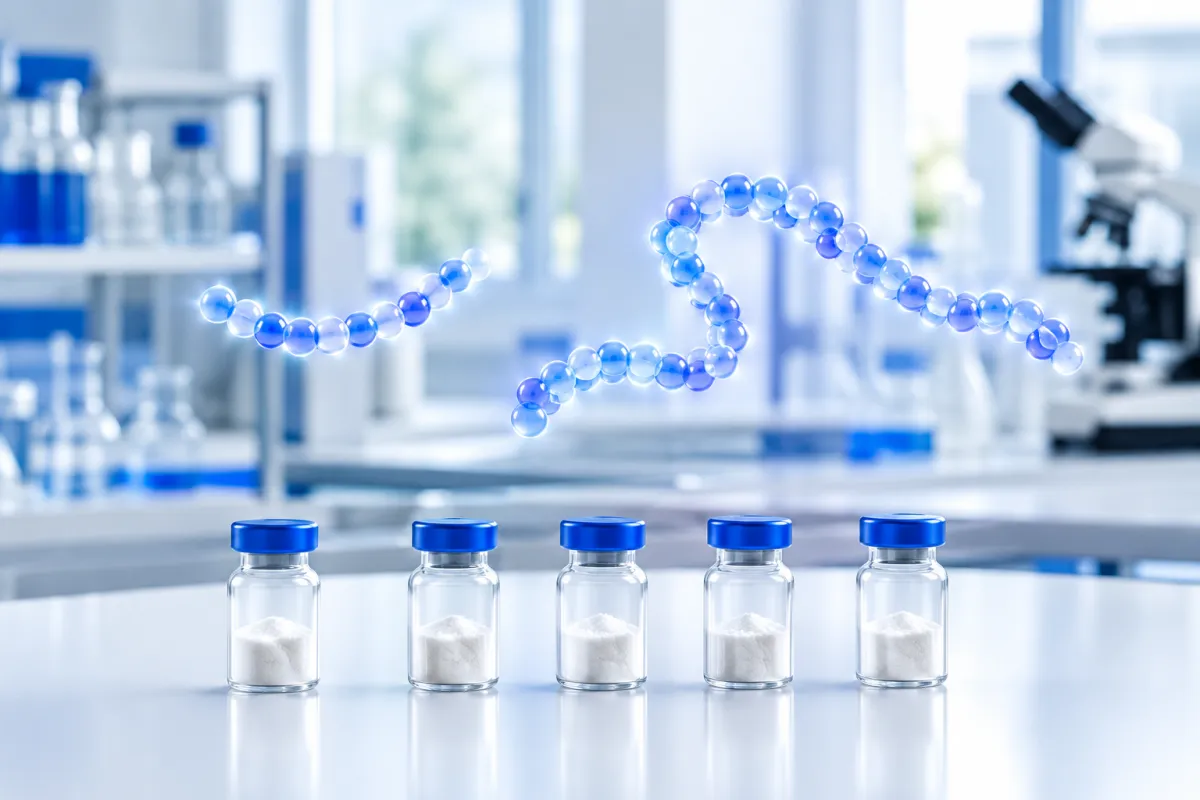 Illustration: two separate peptide chains of different lengths, standing for the two components of a blend. Not an exact structure.
What mechanisms have researchers studied?
Mechanism studies on both peptides have looked at cell migration and at survival signalling, but in separate experiments and different models.
- BPC-157 and tendon fibroblasts. In a 2011 cell and tissue-explant study, Chang et al. reported that BPC-157 increased the outgrowth of rat Achilles tendon explants, increased fibroblast survival under hydrogen peroxide stress and increased fibroblast migration in a concentration-dependent way. It did not directly change fibroblast proliferation. They linked these findings to increased phosphorylation of FAK and paxillin, two proteins involved in cell adhesion 4.
- BPC-157 and VEGFR2. In 2017, Hsieh et al. reported that BPC-157 increased the expression and internalisation of VEGFR2, a receptor for vascular endothelial growth factor, in rat muscle and human endothelial cells, and activated the VEGFR2-Akt-eNOS signalling pathway 12.
- Thymosin beta-4 and ILK. In 2004, Bock-Marquette et al. reported that thymosin beta-4 formed a complex with PINCH and integrin-linked kinase (ILK), leading to activation of Akt, a kinase involved in cell survival, in heart cells and in mice 13.
- Thymosin beta-4’s actin-binding motif. In 2003, Philp et al. reported that the protein and its seven-residue actin-binding motif had near-identical activity in endothelial cell migration and vessel sprouting assays 14.
Both sets of studies report Akt activation. The authors of the one combination study suggested that the two peptides may converge on shared downstream pathways, and said this hypothesis still needs testing 15.
What does the published research include?
The research on each component is mostly animal and cell work, and only one published study has tested the two together.
| Study | Study type | Model | What was measured | Reported finding |
|---|---|---|---|---|
| Staresinic, 2003 | Animal and cell study | Rat Achilles tendon transection; cultured tendon cells | Load of failure, Achilles functional index, tissue histology; cell growth | BPC-157 groups had increased load of failure and Young’s modulus, and higher functional index values, than controls; in culture it had no effect on growth alone but opposed the growth-inhibiting aldehyde 4-hydroxynonenal |
| Chang, 2011 | Cell and explant study | Rat Achilles tendon explants and fibroblasts | Outgrowth, proliferation, survival, migration, FAK and paxillin | BPC-157 accelerated explant outgrowth, increased survival under oxidative stress and migration, with no direct effect on proliferation |
| Hsieh, 2017 | Cell, chick embryo and rat study | Chick chorioallantoic membrane; endothelial tube formation; rat hind limb ischaemia | Vessel density, blood flow recovery, VEGFR2 expression | BPC-157 increased vessel density, accelerated blood flow recovery and increased VEGFR2 expression |
| Vasireddi, 2025 | Systematic review | 36 studies of BPC-157 | Mechanism, musculoskeletal outcomes, metabolism, safety | 35 of the included studies were preclinical and one was clinical; the authors found no clinical safety data |
| Malinda, 1999 | Animal and cell study | Rat full-thickness wound model; keratinocyte migration assay | Re-epithelialisation, wound contraction, collagen | Full-length thymosin beta-4 increased re-epithelialisation by 42% over saline at day 4 and by up to 61% at day 7 |
| Bock-Marquette, 2004 | Cell and animal study | Cardiomyocytes; mouse coronary artery ligation | Cell migration and survival; ILK and Akt; cardiac function | Thymosin beta-4 activated Akt through a complex with PINCH and ILK; treated mice had greater early myocyte survival after ligation |
| Ruff, 2010 | Phase 1 randomised, placebo-controlled trial | 40 healthy volunteers, synthetic full-length thymosin beta-4 | Adverse events; pharmacokinetics | Adverse events were infrequent and mild or moderate, with no serious adverse events reported |
| Biçer, 2026 | Animal study | Rat Achilles tendon transection and repair; four groups of eight | Maximum load to failure; Bonar and Movin histology scores; collagen types I and III | The TB-500 group had significantly higher load to failure than controls; the BPC-157 group was higher but not significantly; the combined group showed no additional effect over either peptide alone |
Our guide to reading a peptide study explains how much weight each of these study types can carry.
Has the combination itself been studied?
One published animal study has tested BPC-157 and TB-500 together, and we found no human trials of the combination.
A Europe PMC search on 28 September 2026 for records mentioning both peptides returned 31 results. Only one was a study that gave the two peptides together; the others were reviews, preprints, analytical method papers and conference abstracts. In that study, Biçer et al. cut and repaired the Achilles tendon in 32 rats and assigned eight each to control, BPC-157, TB-500 and combined groups for four weeks 15. They reported:
- significantly higher maximum load to failure in the TB-500 group than in controls
- significantly lower total Bonar scores (a histology score for tendon degeneration) in the TB-500 group, and lower total Movin scores in the TB-500 and combined groups
- no additional effect from combining the two peptides compared with either alone
The authors described the work as exploratory. Their abstract calls the TB-500 used “synthetic thymosin beta-4” without giving a sequence 15. ClinicalTrials.gov listed no trial of the two peptides together when searched on 28 September 2026 19.
What are the limits of the evidence?
The main limits are that almost all the evidence is preclinical, that one research group produced most of the BPC-157 literature, and that “TB-500” covers more than one molecule.
- Concentration of BPC-157 research. Of 199 PubMed-indexed records in Europe PMC with BPC 157 in the title, 166 list P Sikiric as an author (search run 28 September 2026) 20. Studies by Chang, Hsieh and colleagues are examples of work from outside that group 4, 12.
- Little human data for BPC-157. The 2025 systematic review found one clinical study among 36, a retrospective report, and no clinical safety data 16.
- Different materials under one name. Human trials of thymosin beta-4 used the full protein 18, some mechanism work used only its seven-residue motif 14, and the combination study did not state which form it used 15. Findings on one form cannot be assumed to apply to another.
- One small combination study. The only combination study used eight rats per group over four weeks and was described as exploratory 15.
- Nothing on the blend as a material. We found no published study of how the two peptides behave when stored together in one vial.
What is the regulatory and anti-doping status in Australia?
The TGA names both components as unapproved peptide products, and both are prohibited in sport.
- TGA advisory. The TGA safety advisory of 13 April 2026 names BPC-157 and TB-500 as examples of unapproved peptide products, meaning goods not included in the Australian Register of Therapeutic Goods (ARTG). It says these products have not been evaluated by the TGA for safety, quality or effectiveness 6.
- Anti-doping. BPC-157 is prohibited under section S0 (non-approved substances) of the WADA Prohibited List, and has been named there since 2022 5, 21. The 2026 list places “Thymosin-β4 and its derivatives e.g. TB-500” in section S2.3, growth factors and growth factor modulators 5. Both sections apply at all times. Our anti-doping status guide covers related compounds.
How is each component identified and tested in a blend?
Each peptide has to be identified and quantified on its own, because a single purity figure for the vial cannot show that both are present or in what proportion.
Separation by HPLC. High-performance liquid chromatography passes the dissolved sample through a column that holds different molecules for different times. Two unrelated peptides of 15 and 43 residues would be expected to leave the column as separate peaks, and each peak can be assessed for purity. Our explainer on HPLC purity covers what the figure means.
Identity by mass spectrometry. The expected monoisotopic masses are far apart: 1,418.70 Da for BPC-157 and 4,960.49 Da for full-length thymosin beta-4 1, 2. The fragment Ac-LKKTETQ would appear at 888.49 Da instead 7. A mass spectrometry identity test therefore confirms both components and also shows which form of TB-500 is present.
Published methods for each peptide. Anti-doping laboratories have published liquid chromatography-mass spectrometry methods for both. Cox et al. validated a method for BPC-157 in urine after identifying it in confiscated vials 22. Esposito et al. and Ho et al. published comparable work on the TB-500 fragment 8, 23.
Amount of each component. Purity and identity do not state how much of each peptide the vial holds. That is a separate measurement, explained in our post on net peptide content.
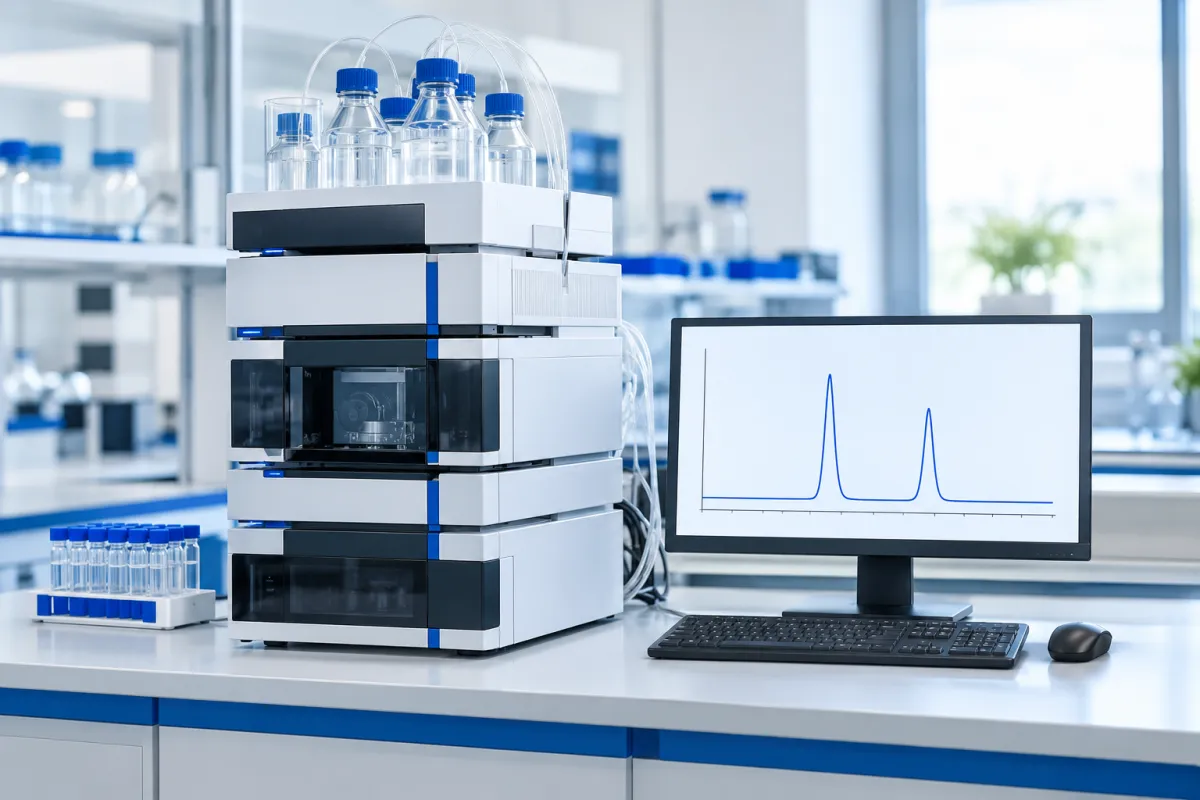 Illustration: a chromatogram with two separate peaks, the pattern expected when two different peptides are analysed together.
For the full method, see how multi-component peptide blends are tested. Our published batch reports are on the certificates of analysis page, and any report can be checked on the verification page.
Frequently asked questions
What does a BPC-157 and TB-500 blend contain?
It contains two separate synthetic peptides in one lyophilised powder: BPC-157, a 15-residue peptide with the formula C62H98N16O22 (PubChem), and a TB-500 component. The TB-500 in our blend is full-length thymosin beta-4 acetate, a 43-residue protein (PubChem), according to our supplier’s specification. Other products may use the seven-residue fragment Ac-LKKTETQ instead (PubChem), so identity needs confirming by mass spectrometry.
Has the BPC-157 and TB-500 combination been studied?
One published animal study has tested it. In a 2026 rat Achilles tendon study, Biçer et al. compared control, BPC-157, TB-500 and combined groups of eight rats each, and reported no additional effect from the combination compared with either peptide alone (Biçer et al., 2026). We found no human trials of the combination in ClinicalTrials.gov on 28 September 2026.
How can a lab confirm both peptides are present in a blend?
HPLC separates the two peptides into distinct peaks, and mass spectrometry confirms each one by its mass: about 1,418.70 Da for BPC-157 and 4,960.49 Da for full-length thymosin beta-4 (PubChem, PubChem). A certificate of analysis for a blend should report identity for each component, not a single figure. Our guide to how peptide blends are tested explains the steps.
What are the molecular weights of BPC-157 and TB-500?
PubChem lists BPC-157 at 1,419.5 g/mol, with CAS number 137525-51-0 (CID 9941957). Full-length thymosin beta-4, the form of TB-500 in our blend, is 4,963 g/mol, CAS 77591-33-4 (CID 16132341). The seven-residue fragment also sold as TB-500 is 889.0 g/mol (CID 62707662). These values are for the peptides alone, without acetate or other counter-ions.
Are BPC-157 and TB-500 prohibited in sport?
Yes. The WADA 2026 Prohibited List names BPC-157 under section S0, non-approved substances, and “Thymosin-β4 and its derivatives e.g. TB-500” under section S2.3, growth factors and growth factor modulators. Both are prohibited at all times (WADA, 2026). Australian athletes can check their obligations with Sport Integrity Australia, and our anti-doping status guide covers related compounds.
References
- PubChem. Bpc-157, Compound CID 9941957. National Center for Biotechnology Information. https://pubchem.ncbi.nlm.nih.gov/compound/9941957, accessed 28 September 2026. [chemical database]
- PubChem. Timbetasin (thymosin beta-4), Compound CID 16132341. National Center for Biotechnology Information. https://pubchem.ncbi.nlm.nih.gov/compound/16132341, accessed 28 September 2026. [chemical database]
- UniProt. P62328, Thymosin beta-4 (TMSB4X), human. https://www.uniprot.org/uniprotkb/P62328/entry, accessed 28 September 2026. [protein database]
- Chang CH, Tsai WC, Lin MS, et al. The promoting effect of pentadecapeptide BPC 157 on tendon healing involves tendon outgrowth, cell survival, and cell migration. J Appl Physiol (1985). 2011;110(3):774-780. doi:10.1152/japplphysiol.00945.2010. PMID: 21030672. [cell and explant study]
- World Anti-Doping Agency. Prohibited List 2026, sections S0 and S2.3. https://www.wada-ama.org/en/prohibited-list, accessed 28 September 2026. [regulatory document]
- Therapeutic Goods Administration. Understanding your responsibilities when importing, compounding and supplying unapproved peptide products (safety advisory, 13 April 2026). https://www.tga.gov.au/safety/safety-monitoring-and-information/safety-alerts/understanding-your-responsibilities-when-importing-compounding-and-supplying-unapproved-peptide-products, accessed 28 September 2026. [regulatory advisory]
- PubChem. TB500, Compound CID 62707662. National Center for Biotechnology Information. https://pubchem.ncbi.nlm.nih.gov/compound/62707662, accessed 28 September 2026. [chemical database]
- Esposito S, Esposito S, Deventer K, et al. Synthesis and characterization of the N-terminal acetylated 17-23 fragment of thymosin beta 4 identified in TB-500, a product suspected to possess doping potential. Drug Test Anal. 2012;4(9):733-738. doi:10.1002/dta.1402. PMID: 22962027. [analytical study]
- Delcourt V, Garcia P, Chabot B, et al. TB500/TB1000 and SGF1000: A scientific approach for a better understanding of misbranded and adulterated drugs. Drug Test Anal. 2023;15(4):458-464. doi:10.1002/dta.3421. PMID: 36482504. [product analysis, short communication]
- Staresinic M, Sebecic B, Patrlj L, et al. Gastric pentadecapeptide BPC 157 accelerates healing of transected rat Achilles tendon and in vitro stimulates tendocytes growth. J Orthop Res. 2003;21(6):976-983. doi:10.1016/s0736-0266(03)00110-4. PMID: 14554208. [rodent and cell study]
- Safer D, Elzinga M, Nachmias VT. Thymosin beta 4 and Fx, an actin-sequestering peptide, are indistinguishable. J Biol Chem. 1991;266(7):4029-4032. doi:10.1016/s0021-9258(20)64278-8. PMID: 1999398. [biochemical study]
- Hsieh MJ, Liu HT, Wang CN, et al. Therapeutic potential of pro-angiogenic BPC157 is associated with VEGFR2 activation and up-regulation. J Mol Med (Berl). 2017;95(3):323-333. doi:10.1007/s00109-016-1488-y. PMID: 27847966. [cell, chick embryo and rodent study]
- Bock-Marquette I, Saxena A, White MD, et al. Thymosin beta4 activates integrin-linked kinase and promotes cardiac cell migration, survival and cardiac repair. Nature. 2004;432(7016):466-472. doi:10.1038/nature03000. PMID: 15565145. [cell and rodent study]
- Philp D, Huff T, Gho YS, et al. The actin binding site on thymosin beta4 promotes angiogenesis. FASEB J. 2003;17(14):2103-2105. doi:10.1096/fj.03-0121fje. PMID: 14500546. [cell and ex vivo study]
- Biçer O, Adanir O, Güleryüz Y, et al. Effects of BPC-157 and TB-500 on Achilles tendon healing in rats: A histopathological and biomechanical study. Jt Dis Relat Surg. 2026;37(3):822-837. doi:10.52312/jdrs.2026.2951. PMID: 42542926. [rodent study]
- Vasireddi N, Hahamyan H, Salata MJ, et al. Emerging Use of BPC-157 in Orthopaedic Sports Medicine: A Systematic Review. HSS J. 2025;21(4):485-495. doi:10.1177/15563316251355551. PMID: 40756949. PMCID: PMC12313605. [systematic review]
- Malinda KM, Sidhu GS, Mani H, et al. Thymosin beta4 accelerates wound healing. J Invest Dermatol. 1999;113(3):364-368. doi:10.1046/j.1523-1747.1999.00708.x. PMID: 10469335. [rodent and cell study]
- Ruff D, Crockford D, Girardi G, et al. A randomized, placebo-controlled, single and multiple dose study of intravenous thymosin beta4 in healthy volunteers. Ann N Y Acad Sci. 2010;1194:223-229. doi:10.1111/j.1749-6632.2010.05474.x. PMID: 20536472. [phase 1 randomised controlled trial]
- ClinicalTrials.gov. Search results for “BPC-157” and for “TB-500”. US National Library of Medicine. https://clinicaltrials.gov/search?term=BPC-157, accessed 28 September 2026. [trial registry]
- Europe PMC. Search: (TITLE:“BPC 157” OR TITLE:“BPC-157” OR TITLE:“BPC157”) AND SRC:MED, with and without AUTH:“Sikiric P”. https://europepmc.org/search?query=%28TITLE%3A%22BPC%20157%22%20OR%20TITLE%3A%22BPC-157%22%20OR%20TITLE%3A%22BPC157%22%29%20AND%20SRC%3AMED, accessed 28 September 2026. [literature database search]
- US Anti-Doping Agency. BPC-157: what athletes should know about the prohibited experimental peptide. https://www.usada.org/spirit-of-sport/bpc-157-peptide-prohibited/, accessed 28 September 2026. [anti-doping explainer]
- Cox HD, Miller GD, Eichner D. Detection and in vitro metabolism of the confiscated peptides BPC 157 and MGF R23H. Drug Test Anal. 2017;9(10):1490-1498. doi:10.1002/dta.2152. PMID: 28035768. [analytical study]
- Ho EN, Kwok WH, Lau MY, et al. Doping control analysis of TB-500, a synthetic version of an active region of thymosin β₄, in equine urine and plasma by liquid chromatography-mass spectrometry. J Chromatogr A. 2012;1265:57-69. doi:10.1016/j.chroma.2012.09.043. PMID: 23084823. [analytical study, equine samples]
Reference material. Certified Research Peptides supplies BPC-157 + TB-500 Blend for laboratory research, with a batch certificate of analysis: BPC-157 + TB-500 Blend.
Check the lab report
Every published certificate of analysis names its lab, lot and test date. For laboratory research use only.