

In short: No. Thymosin beta-4 is a 43-amino-acid protein found in most mammalian cells. TB-500, as characterised in doping-control research, is a synthetic seven-residue fragment of it (Ac-LKKTETQ), though the name is also used for the full protein. Thymosin beta-4 has human trial data; the fragment’s record is preclinical. In Australia, the TGA names TB-500 as an unapproved peptide product.
This comparison sits alongside our full review of the published TB-500 research. Here the focus is what separates the two molecules, why the names get mixed up, and how a laboratory tells them apart.
Key facts
| TB-500 (as described in doping-control papers) | Thymosin beta-4 | |
|---|---|---|
| What it is | Synthetic peptide fragment | Protein made by the body; also produced by chemical synthesis or recombinant expression |
| Synonyms | TB500, TB 500, Ac-LKKTETQ, N-acetylated LKKTETQ 1 | Tβ4, Fx, timbetasin 2 |
| Length | 7 amino acids | 43 amino acids in the mature protein 3 |
| Sequence | Ac-Leu-Lys-Lys-Thr-Glu-Thr-Gln-OH 1 | Ac-SDKPDMAEIEKFDKSKLKKTETQEKNPLPSKETIEQEKQAGES 3 |
| Relationship | Residues 17 to 23 of thymosin beta-4, with an added N-terminal acetyl group | Full-length protein |
| Molecular formula | C38H68N10O14 1 | C212H350N56O78S 2 |
| Molecular weight | 889.0 g/mol 1 | 4,963 g/mol 2 |
| Monoisotopic mass | 888.49 Da 1 | 4,960.49 Da 2 |
| CAS number | 885340-08-9 1 | 77591-33-4 2 |
| PubChem CID | 62707662 | 16132341 |
| UniProt entry | None (synthetic fragment) | P62328 (human) |
| Evidence base | Cell, animal and analytical studies; no published human trial results found | Cell and animal studies, plus phase 1 to phase 3 human trials |
| WADA 2026 | Prohibited at all times, section S2.3, named as an example 4 | Prohibited at all times, section S2.3 4 |
| TGA advisory, 13 April 2026 | Named as an example of an unapproved peptide product 5 | Not named in the advisory |
| Material Certified Research Peptides supplies as TB-500 | No | Yes: thymosin beta-4 acetate, 43 residues (supplier specification) |
Are TB-500 and thymosin beta-4 the same compound?
Not as the names are used in the scientific literature: there, TB-500 is a different molecule from thymosin beta-4, with a different sequence, length and mass, although it is derived from it.
Thymosin beta-4 (Tβ4) is a 43-residue protein, first sequenced from calf thymus in 1981 6. TB-500, as identified by anti-doping chemists, is a synthetic peptide made of seven residues from the middle of Tβ4 (residues 17 to 23, LKKTETQ), with an acetyl group added to its N-terminus, the starting end of the chain 7, 8. Ho et al. described that acetylation as artificial, because leucine 17 is not acetylated inside the intact protein 8. By mass, the fragment is about 18% of the whole protein: 889.0 against 4,963 g/mol 1, 2.
The two names are often treated as interchangeable because the label “TB-500” is also applied to the full protein, including in at least one published rat study 9.
Where does thymosin beta-4 come from?
Thymosin beta-4 is a protein encoded by the human TMSB4X gene, and it binds actin, the protein that forms the cell’s internal scaffolding 3.
Low, Hu and Goldstein isolated it from calf thymus and reported its full sequence in 1981: 43 residues, with a blocked (acetylated) N-terminus 6. That origin explains the name “thymosin”. Later work showed it is not confined to the thymus: a 2010 review describes it as present in essentially all cells and body fluids 10. In 1991, Safer et al. reported that Fx, an abundant peptide from human platelets, was identical to Tβ4, and that it formed a one-to-one complex with actin monomers (G-actin) and inhibited their assembly into filaments 11.
Tβ4 has also been made by solid-phase synthesis, first reported in 1983 12, and as a recombinant protein produced by engineered cells (NL005), used in a 2021 phase 1 trial 13.
Where did the name TB-500 come from?
In the scientific literature, TB-500 was first characterised by anti-doping laboratories rather than by drug developers.
In 2012, Ho et al. described TB-500 as a veterinary preparation whose key ingredient was LKKTETQ with an acetylated N-terminus, and developed liquid chromatography-mass spectrometry (LC-MS) methods to detect it and its breakdown products in horse urine and plasma 8. The same year, Esposito et al. identified the acetylated 17 to 23 fragment (Ac-LKKTETQ) in a TB-500 product using high-resolution mass spectrometry, and synthesised it as a reference standard 7. Kwok et al. later called N-acetylated LKKTETQ the “active ingredient of TB-500” 14, and PubChem indexes TB-500 under this structure 1.
How do their structures differ?
TB-500 contains Tβ4’s central actin-binding motif but none of the rest of the protein.
Tβ4 has no fixed folded shape on its own: UniProt annotates the whole chain as a disordered region 3. In 1996, Van Troys et al. mapped how it contacts actin using chemically synthesised variants. They reported two separate structural parts that both take part in binding: an N-terminal segment (residues 1 to 16), which needs to coil into an alpha-helix to bind, and a six-residue motif at residues 17 to 22. Lysine residues 14 and 18 appeared important for electrostatic contact with actin 15.
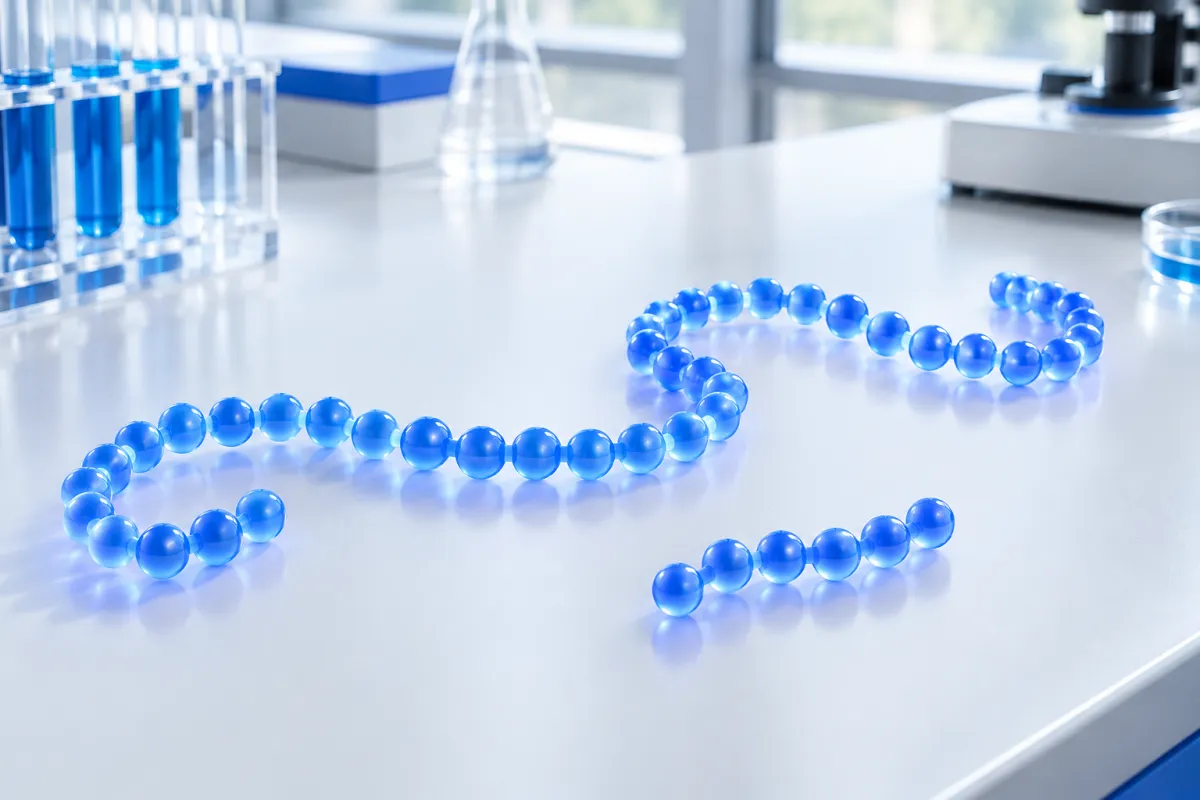 Illustration: a long chain beside a short one, standing for a full protein and a seven-residue fragment. Not an exact structure.
Measured against that map, TB-500:
- keeps the 17 to 22 motif and adds glutamine 23
- lacks the N-terminal segment, including lysine 14
- lacks residues 24 to 43
- carries an acetyl group on leucine 17, which is not there in the intact protein 8
Other named sites in Tβ4 fall outside the fragment. A 2010 review by Sosne et al. describes the N-terminal tetrapeptide Ac-SDKP and a 15-residue N-terminal sequence as separate active sites 10. UniProt lists Ac-SDKP (residues 1 to 4) as a peptide in its own right 3.
Does research on thymosin beta-4 apply to TB-500?
Only in part: a handful of studies tested the 17 to 23 sequence directly, while most Tβ4 research, including every human trial we found, used the full protein.
Studies that tested the fragment’s sequence. In a 2003 cell and tissue study, Philp et al. reported that Tβ4 and its seven-residue actin-binding motif had near-identical activity in assays of endothelial cell migration (the cells that line blood vessels) and of vessel sprouting from chick aortic tissue, while peptides lacking any part of the motif were inactive 16. In a 2003 mouse study from the same group, the synthetic peptide LKKTETQ produced dermal wound repair in aged mice comparable to that seen with the parent protein 17. In a 2018 study of human hepatic stellate cells (liver cells central to fibrosis, or scarring), Shah et al. reported that the 17 to 23 peptide, but not the 1 to 15 peptide, blunted markers of activation induced by the growth factor PDGF-BB 18.
A caveat on acetylation. Those studies used LKKTETQ without the acetyl group. Rahaman et al. studied acetylated TB-500 itself in 2024. In rats, the main breakdown product (metabolite) was Ac-LK, and in a fibroblast wound assay only the metabolite Ac-LKKTE showed significant activity compared with control, not TB-500 itself 19. The authors suggested that earlier reported activity might come from that metabolite.
Human trials. Registered and published human trials involve full-length Tβ4. They include a phase 1 study of synthetic Tβ4 in healthy volunteers 20, a phase 1 study of recombinant Tβ4 13, and trials of a Tβ4 formulation (RGN-259) in dry eye and in neurotrophic keratopathy, a disorder of the corneal surface 21, 22. ClinicalTrials.gov lists further Tβ4 studies 23. We found no published human trial results for Ac-LKKTETQ in Europe PMC or ClinicalTrials.gov on 28 September 2026.
| Material tested | Example studies | Evidence type |
|---|---|---|
| Full-length Tβ4 | Safer 1991 11; Ruff 2010 20; Sosne 2022 22 | Biochemical, cell, animal and human trials |
| LKKTETQ, not acetylated | Philp 2003 16, 17; Shah 2018 18 | Cell and animal |
| Ac-LKKTETQ (TB-500) | Ho 2012 8; Rahaman 2024 19 | Analytical, metabolism, cell and rat |
| “TB-500” with composition not stated in the abstract | Biçer 2026 9 | Rat tendon model |
For how to weigh these evidence types, see our guide to reading a peptide study.
Why do products labelled TB-500 vary?
Products sold as TB-500 vary because the name is not tied to one defined substance outside the analytical literature.
Delcourt et al. reported in 2023 that products sold online as TB500 and TB1000 did not consistently match earlier descriptions 24. In 2025, the same group wrote that intelligence and doping-control laboratories had found numerous online products claiming to contain either a synthetic acetylated fragment of Tβ4 or Tβ4 itself 25. Research papers show the same looseness: a 2026 rat study described the “TB-500” it tested as synthetic thymosin beta-4 9.
The practical point is that a label saying TB-500 does not tell you which molecule is in the vial. A certificate of analysis with a measured mass does. The TB-500 that Certified Research Peptides supplies is full-length thymosin beta-4 acetate, the 43-residue protein, according to our supplier’s specification.
How can a laboratory tell them apart?
Mass spectrometry separates them easily, because their masses differ by more than 4,000 Da.
The monoisotopic mass (calculated from the most common isotope of each element) of Ac-LKKTETQ is 888.49 Da, and that of full-length Tβ4 is 4,960.49 Da, according to PubChem 1, 2. A mass spectrometry identity test will show which one is present, while HPLC purity shows how much of the sample is the main component. Our published batch reports are on the certificates of analysis page.
Anti-doping science also treats them as separate targets:
- For the fragment, methods look for Ac-LKKTETQ and its metabolites, such as Ac-LK 8, 14, 19.
- For full-length Tβ4, Rahaman et al. proposed the fragment Ac-Tβ1-14 as a urinary marker in rats 26.
How do regulators and anti-doping rules treat them?
WADA prohibits both in sport, while the TGA’s 2026 safety advisory names TB-500 specifically.
- WADA: The 2026 Prohibited List places “Thymosin-β4 and its derivatives e.g. TB-500” in section S2.3 (growth factors and growth factor modulators), prohibited at all times 4. Our anti-doping status guide covers other compounds.
- TGA: The TGA safety advisory of 13 April 2026 names TB-500 as an example of an unapproved peptide product, meaning goods not included in the Australian Register of Therapeutic Goods (ARTG), and says these products have not been evaluated by the TGA for safety, quality or effectiveness 5.
For how TB-500’s research differs from that of BPC-157, see BPC-157 vs TB-500.
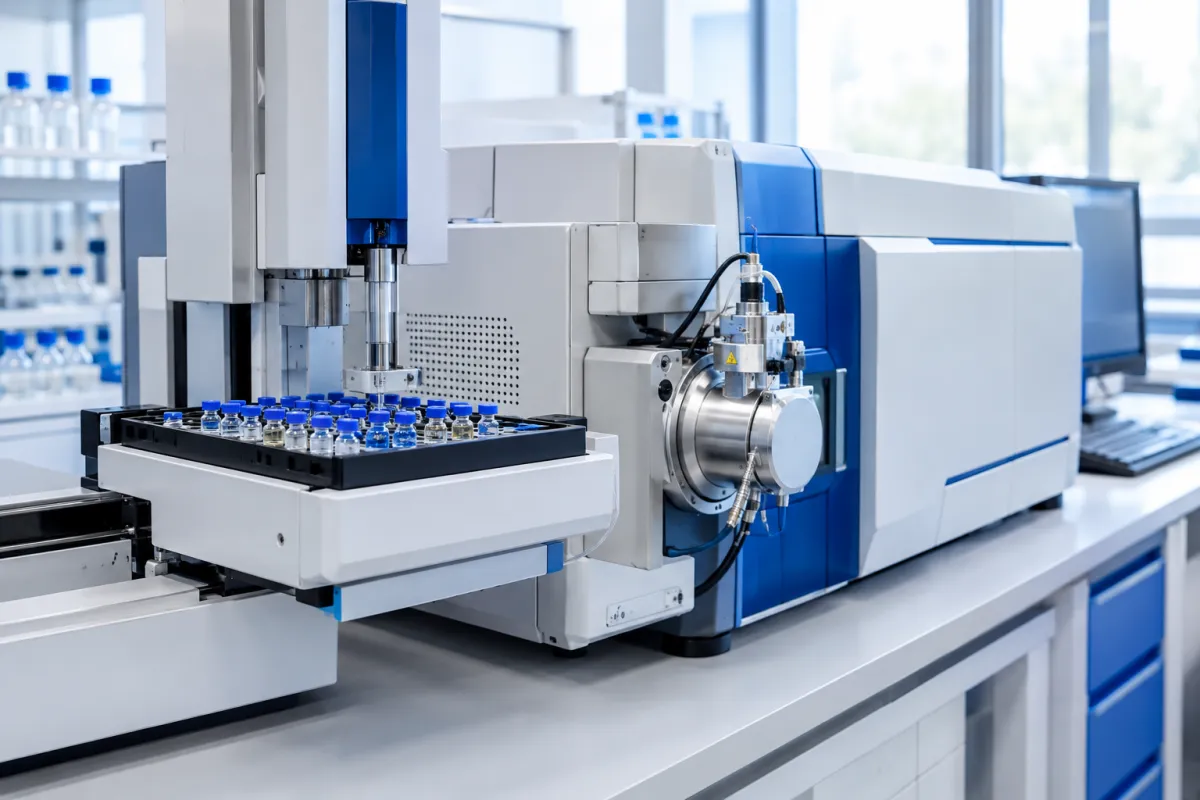 Illustration: a mass spectrometer, the instrument used to tell a seven-residue fragment from a 43-residue protein.
Frequently asked questions
Is TB-500 just another name for thymosin beta-4?
Not strictly. In the anti-doping literature, TB-500 is a synthetic seven-residue peptide, Ac-LKKTETQ, matching residues 17 to 23 of thymosin beta-4 with an added acetyl group (Esposito et al., 2012; Ho et al., 2012). The name is also applied to the full 43-residue protein (Biçer et al., 2026), and product contents vary (Delcourt et al., 2023), so only a measured mass confirms which is present.
What is the molecular weight of TB-500 compared with thymosin beta-4?
PubChem gives TB-500 (Ac-LKKTETQ) a formula of C38H68N10O14 and a molecular weight of 889.0 g/mol (CID 62707662). Thymosin beta-4 has a formula of C212H350N56O78S and a molecular weight of 4,963 g/mol (CID 16132341). The difference of more than 4,000 Da is why mass spectrometry distinguishes them without difficulty.
Which part of thymosin beta-4 does TB-500 correspond to?
TB-500 corresponds to residues 17 to 23 of the mature protein, the sequence LKKTETQ (Ho et al., 2012). Van Troys et al. mapped residues 17 to 22 as one of two regions that contact actin, the other being the N-terminal segment, residues 1 to 16 (1996). TB-500 therefore contains one actin-binding region and lacks the other, along with residues 24 to 43.
Has TB-500 been tested in human clinical trials?
We found no published human trial results for the acetylated fragment Ac-LKKTETQ in Europe PMC or ClinicalTrials.gov, searched on 28 September 2026. Human trials registered and published to date involve full-length thymosin beta-4, including phase 1 studies in healthy volunteers (Ruff et al., 2010) and trials in eye conditions (Sosne et al., 2022). Research on the fragment remains cell, animal and analytical work.
Are TB-500 and thymosin beta-4 both prohibited in sport?
Yes. The WADA 2026 Prohibited List names “Thymosin-β4 and its derivatives e.g. TB-500” under section S2.3, growth factors and growth factor modulators, prohibited at all times (WADA, 2026). Australian athletes can check their obligations with Sport Integrity Australia. Our anti-doping status guide lists other research peptides.
References
- PubChem. TB500, Compound CID 62707662. National Center for Biotechnology Information. https://pubchem.ncbi.nlm.nih.gov/compound/62707662, accessed 28 September 2026. [chemical database]
- PubChem. Timbetasin (thymosin beta-4), Compound CID 16132341. National Center for Biotechnology Information. https://pubchem.ncbi.nlm.nih.gov/compound/16132341, accessed 28 September 2026. [chemical database]
- UniProt. P62328, Thymosin beta-4 (TMSB4X), human. https://www.uniprot.org/uniprotkb/P62328/entry, accessed 28 September 2026. [protein database]
- World Anti-Doping Agency. Prohibited List 2026, section S2.3. https://www.wada-ama.org/en/prohibited-list, accessed 28 September 2026. [regulatory document]
- Therapeutic Goods Administration. Understanding your responsibilities when importing, compounding and supplying unapproved peptide products (safety advisory, 13 April 2026). https://www.tga.gov.au/safety/safety-monitoring-and-information/safety-alerts/understanding-your-responsibilities-when-importing-compounding-and-supplying-unapproved-peptide-products, accessed 28 September 2026. [regulatory advisory]
- Low TL, Hu SK, Goldstein AL. Complete amino acid sequence of bovine thymosin beta 4: a thymic hormone that induces terminal deoxynucleotidyl transferase activity in thymocyte populations. Proc Natl Acad Sci U S A. 1981;78(2):1162-1166. doi:10.1073/pnas.78.2.1162. PMID: 6940133. PMCID: PMC319967. [biochemical study]
- Esposito S, Esposito S, Deventer K, et al. Synthesis and characterization of the N-terminal acetylated 17-23 fragment of thymosin beta 4 identified in TB-500, a product suspected to possess doping potential. Drug Test Anal. 2012;4(9):733-738. doi:10.1002/dta.1402. PMID: 22962027. [analytical study]
- Ho EN, Kwok WH, Lau MY, et al. Doping control analysis of TB-500, a synthetic version of an active region of thymosin β₄, in equine urine and plasma by liquid chromatography-mass spectrometry. J Chromatogr A. 2012;1265:57-69. doi:10.1016/j.chroma.2012.09.043. PMID: 23084823. [analytical study, equine samples]
- Biçer O, Adanir O, Güleryüz Y, et al. Effects of BPC-157 and TB-500 on Achilles tendon healing in rats: A histopathological and biomechanical study. Jt Dis Relat Surg. 2026;37(3):822-837. doi:10.52312/jdrs.2026.2951. PMID: 42542926. [rodent study]
- Sosne G, Qiu P, Goldstein AL, et al. Biological activities of thymosin beta4 defined by active sites in short peptide sequences. FASEB J. 2010;24(7):2144-2151. doi:10.1096/fj.09-142307. PMID: 20179146. [narrative review]
- Safer D, Elzinga M, Nachmias VT. Thymosin beta 4 and Fx, an actin-sequestering peptide, are indistinguishable. J Biol Chem. 1991;266(7):4029-4032. doi:10.1016/s0021-9258(20)64278-8. PMID: 1999398. [biochemical study]
- Low TL, Wang SS, Goldstein AL. Solid-phase synthesis of thymosin beta 4: chemical and biological characterization of the synthetic peptide. Biochemistry. 1983;22(4):733-740. doi:10.1021/bi00273a004. PMID: 6838821. [synthesis study]
- Wang X, Liu L, Qi L, et al. A first-in-human, randomized, double-blind, single- and multiple-dose, phase I study of recombinant human thymosin β4 in healthy Chinese volunteers. J Cell Mol Med. 2021;25(17):8222-8228. doi:10.1111/jcmm.16693. PMID: 34346165. PMCID: PMC8419156. [phase 1 randomised controlled trial]
- Kwok WH, Ho EN, Lau MY, et al. Doping control analysis of seven bioactive peptides in horse plasma by liquid chromatography-mass spectrometry. Anal Bioanal Chem. 2013;405(8):2595-2606. doi:10.1007/s00216-012-6697-9. PMID: 23318763. [analytical study, equine samples]
- Van Troys M, Dewitte D, Goethals M, et al. The actin binding site of thymosin beta 4 mapped by mutational analysis. EMBO J. 1996;15(2):201-210. doi:10.1002/j.1460-2075.1996.tb00350.x. PMID: 8617195. PMCID: PMC449934. [biochemical study]
- Philp D, Huff T, Gho YS, et al. The actin binding site on thymosin beta4 promotes angiogenesis. FASEB J. 2003;17(14):2103-2105. doi:10.1096/fj.03-0121fje. PMID: 14500546. [cell and ex vivo study]
- Philp D, Badamchian M, Scheremeta B, et al. Thymosin beta 4 and a synthetic peptide containing its actin-binding domain promote dermal wound repair in db/db diabetic mice and in aged mice. Wound Repair Regen. 2003;11(1):19-24. doi:10.1046/j.1524-475x.2003.11105.x. PMID: 12581423. [rodent study]
- Shah R, Reyes-Gordillo K, Rojkind M. Thymosin β4 inhibits PDGF-BB induced activation, proliferation, and migration of human hepatic stellate cells via its actin-binding domain. Expert Opin Biol Ther. 2018;18(sup1):177-184. doi:10.1080/14712598.2018.1478961. PMID: 30063851. PMCID: PMC6748868. [cell study]
- Rahaman KA, Muresan AR, Min H, et al. Simultaneous quantification of TB-500 and its metabolites in in-vitro experiments and rats by UHPLC-Q-Exactive orbitrap MS/MS and their screening by wound healing activities in-vitro. J Chromatogr B Analyt Technol Biomed Life Sci. 2024;1235:124033. doi:10.1016/j.jchromb.2024.124033. PMID: 38382158. [analytical, cell and rodent study]
- Ruff D, Crockford D, Girardi G, et al. A randomized, placebo-controlled, single and multiple dose study of intravenous thymosin beta4 in healthy volunteers. Ann N Y Acad Sci. 2010;1194:223-229. doi:10.1111/j.1749-6632.2010.05474.x. PMID: 20536472. [phase 1 randomised controlled trial]
- Sosne G, Dunn SP, Kim C. Thymosin β4 significantly improves signs and symptoms of severe dry eye in a phase 2 randomized trial. Cornea. 2015;34(5):491-496. doi:10.1097/ico.0000000000000379. PMID: 25826322. Trial registration: NCT01393132. [phase 2 randomised controlled trial]
- Sosne G, Kleinman HK, Springs C, et al. 0.1% RGN-259 (Thymosin ß4) Ophthalmic Solution Promotes Healing and Improves Comfort in Neurotrophic Keratopathy Patients in a Randomized, Placebo-Controlled, Double-Masked Phase III Clinical Trial. Int J Mol Sci. 2022;24(1):554. doi:10.3390/ijms24010554. PMID: 36613994. PMCID: PMC9820614. [phase 3 randomised controlled trial]
- ClinicalTrials.gov. Search results for “thymosin beta 4”. US National Library of Medicine. https://clinicaltrials.gov/search?term=thymosin%20beta%204, accessed 28 September 2026. [trial registry]
- Delcourt V, Garcia P, Chabot B, et al. TB500/TB1000 and SGF1000: A scientific approach for a better understanding of misbranded and adulterated drugs. Drug Test Anal. 2023;15(4):458-464. doi:10.1002/dta.3421. PMID: 36482504. [product analysis, short communication]
- Delcourt V, Garcia P, Chabot B, et al. Equine Doping Controls of Thymosin β 4: A Population Study and Strategy for Misuse Detection. Drug Test Anal. 2025;17(7):1071-1077. doi:10.1002/dta.3806. PMID: 39314109. [analytical and population study, equine samples]
- Rahaman KA, Muresan AR, Hasan ML, et al. Detection and quantification of the metabolite Ac-Tβ1-14 in in vitro experiments and urine of rats treated with Ac-Tβ4: A potential biomarker of Ac-Tβ4 for doping tests. Drug Test Anal. 2023;15(11-12):1454-1467. doi:10.1002/dta.3552. PMID: 37515313. [analytical, cell and rodent study]
Reference material. Certified Research Peptides supplies TB-500 for laboratory research, with a batch certificate of analysis: TB-500.
Check the lab report
Every published certificate of analysis names its lab, lot and test date. For laboratory research use only.