

In short: The 2026 WADA Prohibited List names BPC-157 (section S0), TB-500 (S2.3), CJC-1295 and ipamorelin (S2.2.4) and MOTS-c (S4.4.1), and prohibits all five at all times. GHK-Cu, KPV, SS-31 and NAD+ are not named, which WADA says does not by itself mean a substance is permitted. Sport Integrity Australia applies the WADA Code in Australia.
This page sets out what the current World Anti-Doping Agency (WADA) Prohibited List says about nine compounds that appear in peptide research, and how the List is applied in Australia. It reports status as published, checked against the 2026 List on 28 September 2026, and does not assess what any compound does; for evidence, see the compound reviews and how to read a peptide study.
What is the anti-doping status of each research peptide?
Five of the nine compounds are named in the 2026 WADA Prohibited List and are prohibited at all times; the other four are not named.
| Compound | Named in the 2026 List? | Section of the List | When prohibited | Specified or non-Specified |
|---|---|---|---|---|
| BPC-157 | Yes | S0, non-approved substances | At all times | Specified |
| TB-500 | Yes, under thymosin-β4 and its derivatives | S2.3, growth factors and growth factor modulators | At all times | Non-Specified |
| CJC-1295 | Yes | S2.2.4, growth hormone releasing factors (GHRH analogues) | At all times | Non-Specified |
| Ipamorelin | Yes | S2.2.4, growth hormone releasing factors (growth hormone secretagogues) | At all times | Non-Specified |
| MOTS-c | Yes | S4.4.1, metabolic modulators (AMPK activators) | At all times | Non-Specified |
| GHK-Cu | Not named | Check the current WADA Prohibited List | Not stated | Not stated |
| KPV | Not named | Check the current WADA Prohibited List | Not stated | Not stated |
| SS-31 (elamipretide) | Not named | Check the current WADA Prohibited List | Not stated | Not stated |
| NAD+ | Not named | Check the current WADA Prohibited List | Not stated | Not stated |
Source: WADA 2026 Prohibited List 1.
What is the WADA Prohibited List?
The WADA Prohibited List is the international standard, under the World Anti-Doping Code, that names the substances and methods prohibited in sport and when. It is updated at least annually; the 2026 edition took effect on 1 January 2026 1.
Substance sections S0 to S5 and method sections M1 to M3 apply at all times, in and out of competition; S6 to S9 apply in competition only; and P1 applies in particular sports. Each section is also classed as Specified or non-Specified, a distinction used in sanctioning under Article 10 of the Code. The List states that Specified Substances should not be considered less important or less dangerous than others 1.
Section S0 is a catch-all. It covers any pharmacological substance that is not addressed by another section and has no current approval by any government health authority for human therapeutic use, for example drugs in preclinical or clinical development, discontinued drugs, designer drugs and substances approved only for veterinary use 1.
The examples in each section are not a complete list. WADA’s frequently asked questions state that a substance not appearing on the List is not necessarily permitted, because most categories include only common examples 2. WADA’s List page also advises that if a substance or method cannot be found, its status should be checked with the relevant anti-doping organisation 2.
How does the WADA List apply in Australia?
In Australia, the WADA Prohibited List is applied by Sport Integrity Australia, the national anti-doping organisation. Sport Integrity Australia describes itself as responsible for applying the World Anti-Doping Code in Australia, and states that anyone signed up to a sports organisation that abides by the National Anti-Doping Rules can be sanctioned for doping 3.
Sport Integrity Australia has published guidance on peptides:
- its peptides page lists BPC-157, CJC-1295, ibutamoren (MK-677), ipamorelin, MOTS-c and thymosin beta-4 (TB-500) as common examples of unapproved peptides prohibited in sport, and states that possession or use of prohibited peptide products by athletes can result in an anti-doping rule violation 4;
- the same page lists GHK-Cu among examples of unapproved peptide products being promoted, in a section about TGA warnings rather than in its list of prohibited examples 4;
- its BPC-157 page states that a therapeutic use exemption (TUE, a permission to use a prohibited substance for a documented medical reason) would not be granted for BPC-157 5.
For checking medications, Sport Integrity Australia points athletes to Global DRO, a lookup tool based on the current WADA List, which does not cover dietary supplements in general 6.
Which research peptides are named on the 2026 List?
BPC-157, TB-500, CJC-1295, ipamorelin and MOTS-c are named in the 2026 List, across four sections and subsections.
BPC-157: section S0. The 2026 List names BPC-157 as an example in S0, non-approved substances, alongside 2,4-dinitrophenol and two other substance classes 1. It was the first substance named by example in S0, from the 2022 List 7, and the US Anti-Doping Agency publishes a plain-language explainer 8. See our review of the published research on BPC-157.
TB-500: section S2.3. Section S2.3 (growth factors and growth factor modulators) lists “Thymosin-β4 and its derivatives e.g. TB-500” 1. TB-500 is a name used both for full-length thymosin beta-4 and for a seven-residue fragment of it 4, 9, and the entry names both thymosin-β4 itself and TB-500. See what the research on TB-500 covers.
CJC-1295 and ipamorelin: section S2.2.4. Section S2.2.4 (growth hormone releasing factors) names growth hormone-releasing hormone (GHRH) and its analogues, with CJC-1295 among the examples, and growth hormone secretagogues and their mimetics, with ipamorelin among the examples 1. An analogue is a modified version of a hormone, and a secretagogue is a substance that triggers secretion. See our review of CJC-1295 and ipamorelin.
MOTS-c: section S4.4.1. Section S4.4.1 (metabolic modulators) names activators of AMP-activated protein kinase (AMPK, an enzyme involved in cellular energy balance), and lists “mitochondrial open reading frame of the 12S rRNA-c (MOTS-c)” among its examples 1. See our MOTS-c research review.
Section S2 also states that “other substances with similar chemical structure or similar biological effect(s)” are prohibited, so the named compounds are examples rather than the full scope of the section 1.
 Illustration: sealed vials of lyophilised peptide in a laboratory rack.
What about GHK-Cu, KPV, SS-31 and NAD+?
GHK-Cu, KPV, SS-31 (elamipretide) and NAD+ are not named anywhere in the 2026 Prohibited List, but that alone does not establish that they are permitted.
- GHK-Cu, a copper complex of the tripeptide glycyl-histidyl-lysine 10, is not in the 2026 List 1, although the TGA’s advisory of 13 April 2026 names it as an unapproved peptide product 11. See our GHK-Cu review.
- KPV, the tripeptide lysyl-prolyl-valine 12 that forms the last three residues of alpha-melanocyte-stimulating hormone 13, is not in the 2026 List 1. See our KPV review.
- SS-31, also known as elamipretide 14, is not in the 2026 List under either name 1. See our SS-31 review.
- NAD+ (nicotinamide adenine dinucleotide), a dinucleotide rather than a peptide 15, is not in the 2026 List 1. See NAD+ biochemistry.
For all four, check the current WADA Prohibited List and, in Australia, Sport Integrity Australia. WADA states that the examples in most categories are not exhaustive and that S0 covers substances without government approval for human therapeutic use 2. Whether a compound falls within S0 or another section is for anti-doping authorities to decide, not this page.
How do anti-doping laboratories detect research peptides?
Anti-doping laboratories detect these peptides mainly with liquid chromatography coupled to mass spectrometry (LC-MS), and have published methods built from seized products and from studies of each peptide’s metabolites (breakdown products).
| Study | Study type | Samples | What was measured | Reported finding |
|---|---|---|---|---|
| Henninge, 2010 | Analytical | Unknown preparation seized in Norway | Peptide identity by LC-HRMS/MS | Found a 29-amino-acid peptide with a C-terminal amide, consistent with CJC-1295 |
| Thomas, 2011 | Analytical method | Human urine | Extraction and detection of growth hormone releasing peptides, including ipamorelin | Validated a qualitative LC-MS method with detection limits of 0.2 to 1 ng/mL |
| Esposito, 2012 | Analytical | One commercial product sold as TB-500 | Identity of the active ingredient | Identified Ac-LKKTETQ, the acetylated 17 to 23 fragment of thymosin beta-4 |
| Ho, 2012 | Analytical and animal | Horse urine and plasma | The acetylated fragment sold as TB-500, and its metabolites | Detected the peptide at 0.02 ng/mL in plasma and 0.01 ng/mL in urine |
| Cox, 2017 | Analytical method | Confiscated vials; plasma and urine in vitro | BPC-157 identity, metabolism and detection | Identified BPC 157 in vials; validated a urine method with a detection limit of 0.1 ng/mL |
| Krug, 2018 | Analytical | Black market products | Identity of growth hormone releasing peptides | Identified glycine-extended analogues, including Gly-ipamorelin |
| Knoop, 2019 | Analytical method | Plasma | MOTS-c detection | Validated an LC-MS method with a detection limit of 100 pg/mL, covering four metabolites and two oxidation products |
The technique is explained in our guide to mass spectrometry for peptide identity testing.
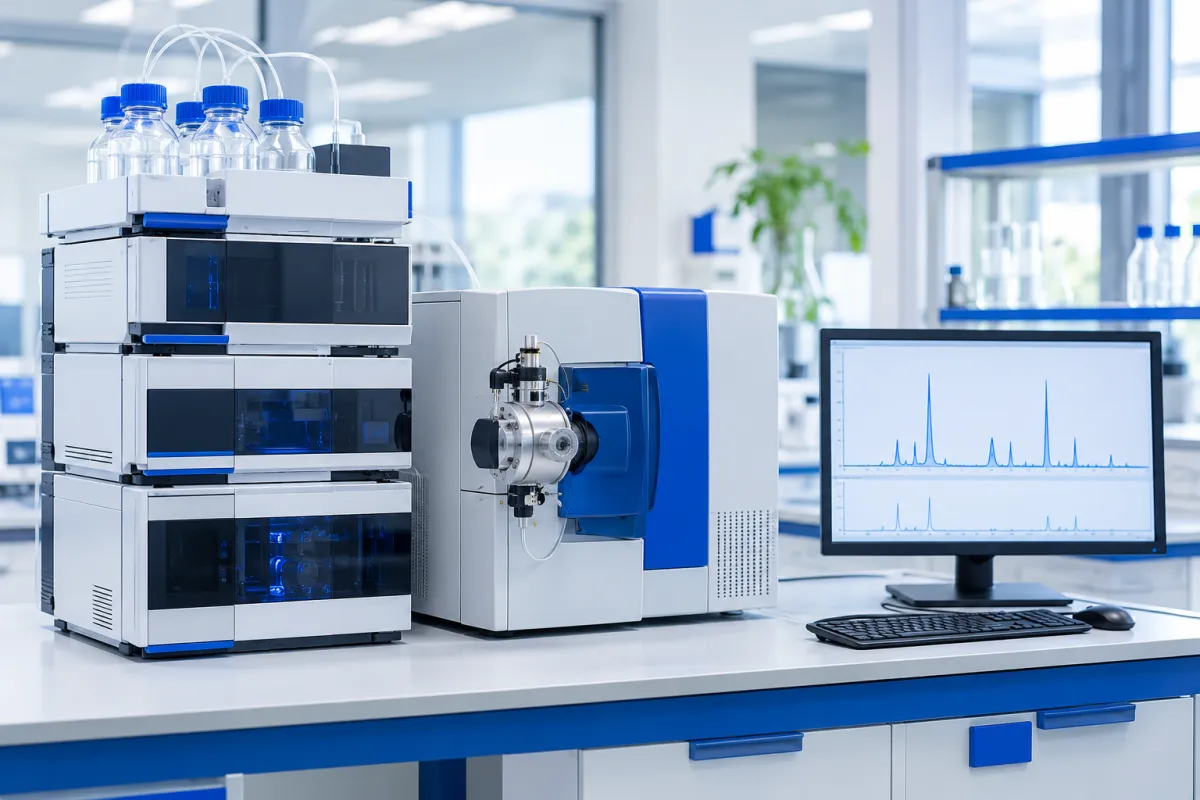 Illustration: a liquid chromatography mass spectrometry system, the type of instrument anti-doping laboratories use to detect peptides.
What does anti-doping status tell a researcher?
Anti-doping status shows whether sport’s rules prohibit a substance, not whether it is an approved medicine or what the evidence on it shows.
It is separate from TGA status. The TGA’s safety advisory of 13 April 2026 names BPC-157, GHK-Cu, TB-500, retatrutide and CJC-1295 as examples of unapproved peptide products: goods not included in the Australian Register of Therapeutic Goods, which the TGA has not evaluated for safety, quality or effectiveness 11. GHK-Cu, for example, is named by the TGA but not by the 2026 WADA List.
It is not an evidence rating. A place on the List says nothing about the strength of a compound’s research, most of which is cell and animal work; see why most peptide research is preclinical.
It can change. WADA reviews the List annually in consultation with scientific, medical and anti-doping experts, publishes each edition three months before it takes effect, and can add a substance at any time in exceptional circumstances 2. Check the current List rather than relying on any page, including this one.
Frequently asked questions
Is BPC-157 banned by WADA?
Yes. BPC-157 is named in section S0 (non-approved substances) of the 2026 WADA Prohibited List, which prohibits S0 substances at all times, in and out of competition, and classes them as Specified Substances 1. It has been named in S0 since the 2022 List 7. Sport Integrity Australia states that a therapeutic use exemption would not be granted for BPC-157 5.
Is TB-500 on the WADA Prohibited List?
Yes. Section S2.3 of the 2026 WADA Prohibited List, growth factors and growth factor modulators, lists “Thymosin-β4 and its derivatives e.g. TB-500”, which covers the full protein and derivatives of it. S2 substances are prohibited at all times and are non-Specified 1. Sport Integrity Australia also lists thymosin beta-4 (TB-500) among common examples of unapproved peptides prohibited in sport 4. See our TB-500 research review.
Are CJC-1295 and ipamorelin prohibited in sport?
Yes. Section S2.2.4 of the 2026 WADA Prohibited List, growth hormone releasing factors, names CJC-1295 as an example of a growth hormone-releasing hormone analogue and ipamorelin as an example of a growth hormone secretagogue. Both are prohibited at all times and are non-Specified 1. Sport Integrity Australia lists both among prohibited peptides 4.
Is GHK-Cu banned in sport?
GHK-Cu is not named in the 2026 WADA Prohibited List 1. WADA states that a substance not appearing on the List is not necessarily permitted, because most categories list only common examples, and advises checking with the relevant anti-doping organisation 2. In Australia that is Sport Integrity Australia. Check the current WADA Prohibited List.
Does the WADA Prohibited List apply in Australia?
Yes. Sport Integrity Australia is Australia’s anti-doping organisation and describes itself as responsible for applying the World Anti-Doping Code in Australia. It states that anyone signed up to a sports organisation that abides by the National Anti-Doping Rules can be sanctioned for doping 3. The Prohibited List is part of that Code 1.
How can I check whether a substance is prohibited in sport?
Sport Integrity Australia recommends Global DRO for checking medications against the current WADA Prohibited List, and notes that Global DRO does not give the status of dietary supplements in general 6. For substances not listed there, WADA advises contacting the relevant anti-doping organisation 2. The full List is published on the WADA website.
References
- World Anti-Doping Agency. The Prohibited List (2026 Prohibited List, in effect from 1 January 2026). https://www.wada-ama.org/en/prohibited-list, accessed 28 September 2026. [anti-doping standard]
- World Anti-Doping Agency. The Prohibited List: search disclaimer and frequently asked questions. https://www.wada-ama.org/en/prohibited-list#faq-anchor, accessed 28 September 2026. [anti-doping agency]
- Sport Integrity Australia. Anti-doping. https://www.sportintegrity.gov.au/what-we-do/anti-doping, accessed 28 September 2026. [anti-doping agency]
- Sport Integrity Australia. Peptides explained. https://www.sportintegrity.gov.au/what-we-do/anti-doping/substance-education/peptides, accessed 28 September 2026. [anti-doping agency]
- Sport Integrity Australia. BPC-157 information. https://www.sportintegrity.gov.au/what-we-do/anti-doping/substance-education/bpc-157, accessed 28 September 2026. [anti-doping agency]
- Sport Integrity Australia. Check substances on Global DRO. https://www.sportintegrity.gov.au/what-we-do/anti-doping/substance-education/check-substances, accessed 28 September 2026. [anti-doping agency]
- World Anti-Doping Agency. WADA publishes 2022 Prohibited List (news release, 30 September 2021). https://www.wada-ama.org/en/news/wada-publishes-2022-prohibited-list, accessed 28 September 2026. [anti-doping agency]
- US Anti-Doping Agency. BPC-157: what athletes should know about the prohibited experimental peptide. https://www.usada.org/spirit-of-sport/bpc-157-peptide-prohibited/, accessed 28 September 2026. [anti-doping agency]
- Esposito S, Deventer K, Goeman J, et al. Synthesis and characterization of the N-terminal acetylated 17-23 fragment of thymosin beta 4 identified in TB-500, a product suspected to possess doping potential. Drug Test Anal. 2012;4(9):733-738. doi:10.1002/dta.1402. PMID: 22962027. [analytical chemistry study]
- PubChem. Glycyl-L-histidyl-L-lysine (GHK), compound summary (CID 73587). National Center for Biotechnology Information. https://pubchem.ncbi.nlm.nih.gov/compound/73587, accessed 28 September 2026. [chemical database]
- Therapeutic Goods Administration. Understanding your responsibilities when importing, compounding and supplying unapproved peptide products (safety advisory, 13 April 2026). https://www.tga.gov.au/safety/safety-monitoring-and-information/safety-alerts/understanding-your-responsibilities-when-importing-compounding-and-supplying-unapproved-peptide-products, accessed 28 September 2026. [regulator]
- PubChem. Lys-Pro-Val, MSH (11-13), compound summary (CID 125672). National Center for Biotechnology Information. https://pubchem.ncbi.nlm.nih.gov/compound/125672, accessed 28 September 2026. [chemical database]
- UniProt. P01189, pro-opiomelanocortin (POMC), human, including the melanocyte-stimulating hormone alpha peptide. https://www.uniprot.org/uniprotkb/P01189/entry, accessed 28 September 2026. [protein database]
- PubChem. Elamipretide, compound summary (CID 11764719). National Center for Biotechnology Information. https://pubchem.ncbi.nlm.nih.gov/compound/11764719, accessed 28 September 2026. [chemical database]
- PubChem. Nadide (NAD+), compound summary (CID 5892). National Center for Biotechnology Information. https://pubchem.ncbi.nlm.nih.gov/compound/5892, accessed 28 September 2026. [chemical database]
- Henninge J, Pepaj M, Hullstein I, et al. Identification of CJC-1295, a growth-hormone-releasing peptide, in an unknown pharmaceutical preparation. Drug Test Anal. 2010;2(11-12):647-650. doi:10.1002/dta.233. PMID: 21204297. [analytical chemistry study]
- Thomas A, Höppner S, Geyer H, et al. Determination of growth hormone releasing peptides (GHRP) and their major metabolites in human urine for doping controls by means of liquid chromatography mass spectrometry. Anal Bioanal Chem. 2011;401(2):507-516. doi:10.1007/s00216-011-4702-3. PMID: 21298258. [analytical method study]
- Ho EN, Kwok WH, Lau MY, et al. Doping control analysis of TB-500, a synthetic version of an active region of thymosin β₄, in equine urine and plasma by liquid chromatography-mass spectrometry. J Chromatogr A. 2012;1265:57-69. doi:10.1016/j.chroma.2012.09.043. PMID: 23084823. [analytical method study in horses]
- Cox HD, Miller GD, Eichner D. Detection and in vitro metabolism of the confiscated peptides BPC 157 and MGF R23H. Drug Test Anal. 2017;9(10):1490-1498. doi:10.1002/dta.2152. PMID: 28035768. [analytical method study]
- Krug O, Thomas A, Malerød-Fjeld H, et al. Analysis of new growth promoting black market products. Growth Horm IGF Res. 2018;41:1-6. doi:10.1016/j.ghir.2018.05.001. PMID: 29864719. [analytical chemistry study]
- Knoop A, Thomas A, Thevis M. Development of a mass spectrometry based detection method for the mitochondrion-derived peptide MOTS-c in plasma samples for doping control purposes. Rapid Commun Mass Spectrom. 2019;33(4):371-380. doi:10.1002/rcm.8337. PMID: 30394592. [analytical method study]
Check the lab report
Every published certificate of analysis names its lab, lot and test date. For laboratory research use only.