


In short: Synthetic peptides with basic groups are isolated as salts. Trifluoroacetate (TFA) comes from resin cleavage and HPLC purification; acetate is introduced by an exchange step. Published cell and animal studies reported that TFA salts can alter proliferation and toxicity readouts, and TFA can account for a large share of a peptide salt’s weight.
Every synthetic peptide with positively charged groups carries negatively charged partners, its counter-ions. On a certificate of analysis (COA), the counter-ion accounts for part of what the vial weighs, which is why it sits alongside net peptide content. This explainer compares trifluoroacetate, the counter-ion left by standard synthesis, with acetate, the counter-ion of most approved peptide medicines 1, and covers how each is measured and exchanged.
What is a counter-ion in a synthetic peptide?
It is the anion that balances the positive charges on a peptide’s basic groups. Those groups are the free N-terminus and the side chains of arginine, histidine and lysine 2. In a 2025 analytical study, Erckes et al. tested whether counter-ion content tracks the number of positive charges, assuming one counter-ion per charge under the acidic conditions used in purification 2.
For medicines, the European Medicines Agency (EMA) guideline on synthetic peptides asks for the counter-ion to be stated, along with whether it is present in a stoichiometric (fixed ratio) or non-stoichiometric amount. If there is no counter-ion, the free base should be stated instead 3.
Where does TFA come from?
From the two steps of standard peptide production that use trifluoroacetic acid. In Fmoc solid-phase peptide synthesis, TFA replaced hydrogen fluoride as the reagent that removes side-chain protecting groups and cleaves the finished peptide from the resin. TFA is also widely used as an ion-pairing reagent in reversed-phase HPLC purification. Because TFA binds strongly to the peptide, freeze-drying the purified solution leaves a peptide TFA salt 2.
Andrushchenko et al. described TFA as almost always present in commercially synthesised peptides 4.
Acid strength explains why TFA is hard to displace. Sikora et al. list pKa values at 25 °C of 0.52 for TFA and 4.76 for acetic acid 1; the lower the pKa, the stronger the acid. Roux et al. noted that the classic way to remove TFA uses an even stronger acid, hydrochloric acid, which means working below pH 1 and can degrade the peptide 5.
How do acetate and TFA salts compare?
They differ in acid strength, in mass, in how they reach the peptide and in how they behave during analysis.
| Property | Trifluoroacetate (TFA) | Acetate |
|---|---|---|
| Parent acid (PubChem) 6 | Trifluoroacetic acid, C2HF3O2, 114.02 g/mol, CID 6422, CAS 76-05-1 | Acetic acid, C2H4O2, 60.05 g/mol, CID 176, CAS 64-19-7 |
| Anion mass (PubChem) 6 | 113.02 g/mol (CID 84468) | 59.04 g/mol (CID 175) |
| pKa of the acid at 25 °C 1 | 0.52 | 4.76 |
| How it reaches the peptide | Resin cleavage and HPLC ion pairing 2 | Exchange by reversed-phase HPLC, ion-exchange resin or freeze-drying from acetic acid 5 7 |
| ICH Q3C listing of the acid 8 | Among solvents with no adequate toxicological data | Class 3, low toxic potential |
| Use in approved peptide medicines 1 | A few exceptions | Most approved peptide pharmaceuticals |
| Analytical behaviour | Strong infrared band at 1673 cm-1 that overlaps the amide I band 4; ion suppression in LC-MS 1 | Volatile additive suited to LC-MS 1 |
Sikora et al. gave three reasons most approved peptide drugs are acetate salts: concern about trifluoroacetate toxicity, history (early purification by countercurrent distribution used acetic acid systems), and the milder conditions of exchange to acetate compared with hydrochloric acid 1.
Why does the counter-ion change the weighed amount?
Because the counter-ion is weighed along with the peptide. The trifluoroacetate anion (113.02 g/mol) weighs nearly twice as much as acetate (59.04 g/mol) 6, so for the same number of basic groups a TFA salt carries more non-peptide mass.
Erckes et al. calculated that their test peptides should contain about 25% TFA by weight as TFA salts, or about 10% chloride as hydrochloride salts. Measured TFA content reached up to 35% of total weight, and chloride up to 10% 2. The authors noted that TFA can introduce a weighing error because salt forms differ in molecular weight 2. In a separate 2021 study, Streuli et al. also found an unexpectedly high sodium content in synthetic peptides 9.
For medicines, the EMA guideline defines strength by the mass of peptide base, not including salt or counter-ion, and expresses LC assay limits on a counter-ion-free, anhydrous basis 3. The same idea underlies net peptide content on research COAs.
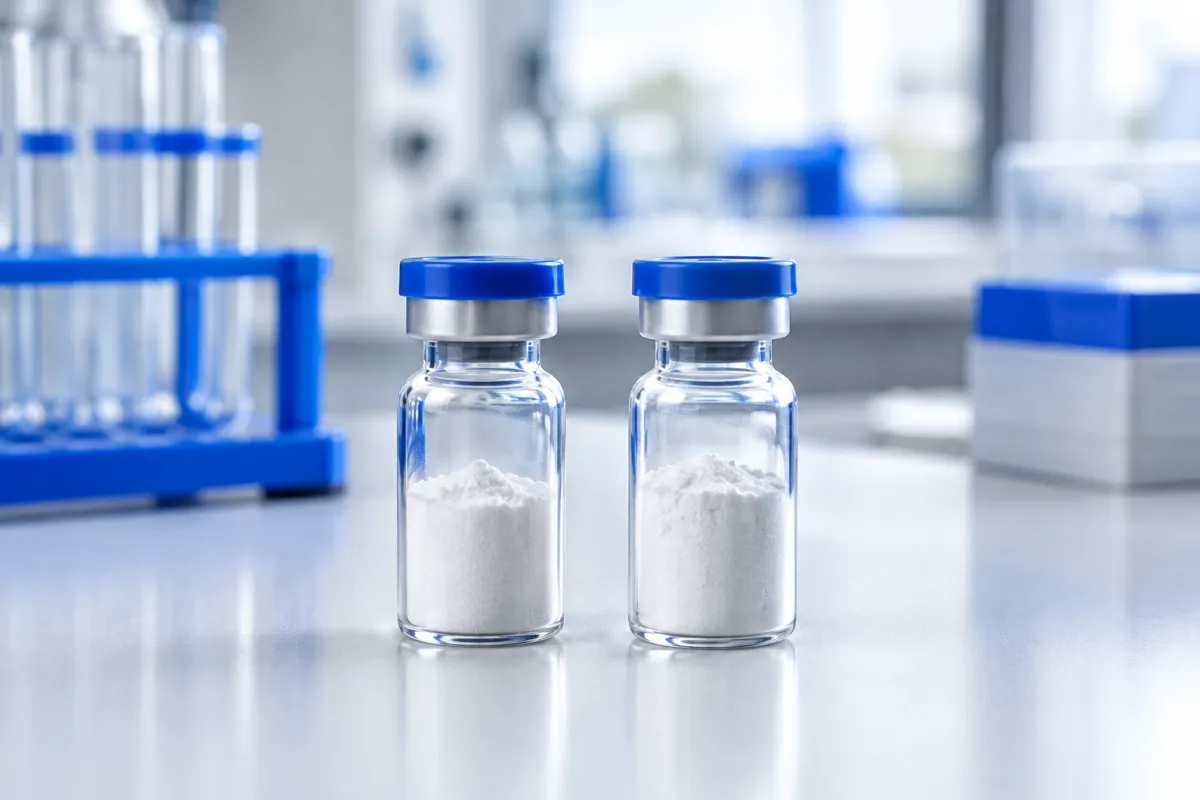 Illustration: two salt forms of a peptide can look identical in the vial.
What did studies report about TFA salts in biological experiments?
Several cell and animal studies reported that a peptide’s TFA salt gave different results from other salt forms, although the direction was not consistent.
| Study | Study type | Model | What was measured | Reported finding |
|---|---|---|---|---|
| Cornish, 1999 | Cell and organ culture study | Fetal rat osteoblasts, articular chondrocytes and neonatal mouse calvaria (skull bone) | Cell numbers and thymidine incorporation; TFA and hydrochloride salts of amylin, amylin-(1-8) and calcitonin | TFA reduced cell numbers and thymidine incorporation; proliferation was consistently lower with the TFA salts, which the authors said could hide a proliferative effect or wrongly suggest an antiproliferative one |
| Pini, 2012 | Cell and mouse study | Antimicrobial peptide M33; human bronchial cell lines, including cells carrying the ΔF508 CFTR mutation; mice | Antimicrobial activity and toxicity of TFA and acetate salts | Activity did not differ substantially; the TFA salt was 5 to 30% more toxic to the cells, and produced clear signs of toxicity in mice where the acetate salt produced mild, transient signs |
| Sikora, 2018 | Cell and microbiology study | Five antimicrobial peptides as acetate, hydrochloride and TFA salts; Staphylococcus aureus, human red blood cells, HaCaT cell line | Antibacterial activity, haemolysis, cytotoxicity | Salt forms differed substantially, but the pattern was not consistent across peptides |
| Erckes, 2025 | Analytical and model membrane study | Synthetic peptides exchanged from TFA to chloride; liposome permeability assay | Residual TFA by three validated methods; passive membrane permeability | Exchange did not affect purity; permeability coefficients varied with both sequence and salt form |
Sikora et al.’s review also cites reports of TFA stimulating the growth of glioma cells, the opposite direction to the Cornish findings 1. All of this is cell, organ culture or animal work on specific peptides. It shows that salt form is a variable to record and control in experiments, not that any particular effect will occur.
How is the counter-ion measured?
By separating and quantifying the anions, or by detecting TFA’s fluorine atoms directly.
- Ion chromatography (IC). Mrozik et al. compared IC, capillary electrophoresis and isotachophoresis for acetate, trifluoroacetate and chloride; IC gave the best results 7. The EMA guideline lists LC and IC for identifying counter-ions 3.
- Mixed-mode HPLC with evaporative light scattering detection (ELSD). Streuli et al. quantified 14 counter-ions in one 30-minute run 9.
- Fluorine-19 NMR and infrared spectroscopy. Erckes et al. validated 19F-NMR, Fourier-transform infrared (FT-IR) and HPLC-ELSD methods for TFA 2, and Roux et al. used 19F-NMR, proton NMR and infrared to follow TFA removal 5.
For medicines, the EMA guideline lists counter-ion identity and content (for example acetic acid) and residual TFA as separate specification items, and points to Ph. Eur. chapter 2.5.34, acetic acid in synthetic peptides 3.
 Illustration: ion chromatography separates and measures the anions in a peptide salt.
How is TFA exchanged for acetate or chloride?
Through chromatography, ion exchange, or freeze-drying from another acid.
Roux et al. compared three approaches on the peptide lanreotide. Reversed-phase HPLC and ion-exchange resin gave partial to almost complete exchange to acetate, while deprotonating and then reprotonating the amino groups removed TFA completely 5. Mrozik et al. reported that freeze-drying from hydrochloric acid, or from acetic acid, removed TFA to satisfactory levels 7.
Conditions matter. Andrushchenko et al. found that higher hydrochloric acid concentrations altered the structure and thermal stability of the peptide indolicidin, while lower concentrations removed essentially all TFA without changing its secondary structure 4. Erckes et al. reported no loss of purity at any hydrochloric acid concentration they tested 2.
What should a researcher look for on a COA?
Four details make a counter-ion result interpretable:
- the counter-ion named (TFA, acetate or chloride), and whether a content figure is given
- for acetate or chloride salts, a residual TFA figure, which shows how complete the exchange was 3
- whether peptide content is reported on a counter-ion-free basis
- the method used, such as ion chromatography, 19F-NMR or HPLC-ELSD.
Our guide to reading a peptide COA shows where these results usually sit.
Frequently asked questions
Why are so many synthetic peptides supplied as TFA salts?
TFA is used both to cleave the finished peptide from the resin and as an ion-pairing reagent in HPLC purification, and freeze-drying the purified peptide leaves a TFA salt 2. Andrushchenko et al. described TFA as almost always present in commercially synthesised peptides 4. Replacing it takes an extra exchange step. Our explainer on solid-phase peptide synthesis covers where cleavage fits in.
How much of a peptide salt’s weight can be TFA?
It depends on how many positive charges the peptide carries. In a 2025 analytical study, Erckes et al. calculated about 25% TFA by weight for their test peptides, assuming one counter-ion per positive charge, and measured TFA contents of up to 35% of total weight 2. That is why counter-ion content matters when working out net peptide content.
Is acetic acid a residual solvent?
ICH Q3C lists acetic acid as a Class 3 solvent, meaning low toxic potential with no health-based exposure limit needed 8. In an acetate salt, though, acetate is the counter-ion. The EMA guideline treats counter-ion identity and content as their own specification items and points to Ph. Eur. chapter 2.5.34 on acetic acid in synthetic peptides 3.
Does the counter-ion show up in a mass spectrometry identity result?
Mass spectrometry identity results describe the peptide ions. The EMA guideline lists counter-ion identity and content as separate tests, carried out by LC or ion chromatography 3. TFA can still matter inside the instrument, because it suppresses ionisation in LC-MS 1. Our explainer on mass spectrometry for peptides covers how identity is confirmed.
Can TFA be removed completely?
In one study, yes. Roux et al. compared three exchange approaches on lanreotide: reversed-phase HPLC and ion-exchange resin gave partial to almost complete exchange to acetate, while deprotonating and reprotonating the amino groups removed TFA completely 5. Andrushchenko et al. found that suitable hydrochloric acid treatment removed essentially all TFA from indolicidin 4. A residual TFA figure on a COA shows how far exchange went.
References
- Sikora K, Jaśkiewicz M, Neubauer D, et al. The Role of Counter-Ions in Peptides-An Overview. Pharmaceuticals (Basel). 2020;13(12):E442. doi:10.3390/ph13120442. PMID: 33287352. PMCID: PMC7761850. [narrative review]
- Erckes V, Streuli A, Chamera Rendueles L, et al. Towards a Consensus for the Analysis and Exchange of TFA as a Counterion in Synthetic Peptides and Its Influence on Membrane Permeation. Pharmaceuticals (Basel). 2025;18(8):1163. doi:10.3390/ph18081163. PMID: 40872554. PMCID: PMC12389442. [analytical and model membrane study]
- European Medicines Agency. Guideline on the Development and Manufacture of Synthetic Peptides (EMA/CHMP/CVMP/QWP/367182/2025), adopted 4 December 2025, effective 1 June 2026. https://www.ema.europa.eu/en/documents/scientific-guideline/guideline-development-manufacture-synthetic-peptides_en.pdf. Accessed 28 September 2026. [regulatory guideline]
- Andrushchenko VV, Vogel HJ, Prenner EJ. Optimization of the hydrochloric acid concentration used for trifluoroacetate removal from synthetic peptides. J Pept Sci. 2007;13(1):37-43. doi:10.1002/psc.793. PMID: 17031869. [analytical study]
- Roux S, Zékri E, Rousseau B, et al. Elimination and exchange of trifluoroacetate counter-ion from cationic peptides: a critical evaluation of different approaches. J Pept Sci. 2008;14(3):354-359. doi:10.1002/psc.951. PMID: 18035848. [analytical study]
- PubChem. Compound records for trifluoroacetic acid (CID 6422), trifluoroacetate (CID 84468), acetic acid (CID 176) and acetate (CID 175): molecular formula, molecular weight and CAS number. https://pubchem.ncbi.nlm.nih.gov/compound/6422, https://pubchem.ncbi.nlm.nih.gov/compound/84468, https://pubchem.ncbi.nlm.nih.gov/compound/176, https://pubchem.ncbi.nlm.nih.gov/compound/175. Accessed 28 September 2026. [chemistry database]
- Mrozik W, Markowska A, Guzik L, et al. Determination of counter-ions in synthetic peptides by ion chromatography, capillary isotachophoresis and capillary electrophoresis. J Pept Sci. 2012;18(3):192-198. doi:10.1002/psc.1436. PMID: 22252914. [analytical study]
- International Council for Harmonisation. ICH Q3C(R9) Impurities: Guideline for Residual Solvents, Step 4 version dated 24 January 2024. https://www.database.ich.org/sites/default/files/ICH_Q3C(R9)_Guideline_MinorRevision_2024_2024_Approved.pdf. Accessed 28 September 2026. [regulatory guideline]
- Streuli A, Coxon CR, Steuer C. Simultaneous Quantification of Commonly Used Counter Ions in Peptides and Active Pharmaceutical Ingredients by Mixed Mode Chromatography and Evaporative Light Scattering Detection. J Pharm Sci. 2021;110(8):2997-3003. doi:10.1016/j.xphs.2021.04.008. PMID: 33864781. [analytical method study]
- Cornish J, Callon KE, Lin CQ, et al. Trifluoroacetate, a contaminant in purified proteins, inhibits proliferation of osteoblasts and chondrocytes. Am J Physiol. 1999;277(5):E779-83. doi:10.1152/ajpendo.1999.277.5.e779. PMID: 10567002. [cell and organ culture study, rat and mouse]
- Pini A, Lozzi L, Bernini A, et al. Efficacy and toxicity of the antimicrobial peptide M33 produced with different counter-ions. Amino Acids. 2012;43(1):467-473. doi:10.1007/s00726-011-1103-z. PMID: 21984381. [cell and mouse study]
- Sikora K, Jaśkiewicz M, Neubauer D, et al. Counter-ion effect on antistaphylococcal activity and cytotoxicity of selected antimicrobial peptides. Amino Acids. 2018;50(5):609-619. doi:10.1007/s00726-017-2536-9. PMID: 29307075. PMCID: PMC5917001. [cell and microbiology study]
Check the lab report
Every published certificate of analysis names its lab, lot and test date. For laboratory research use only.