

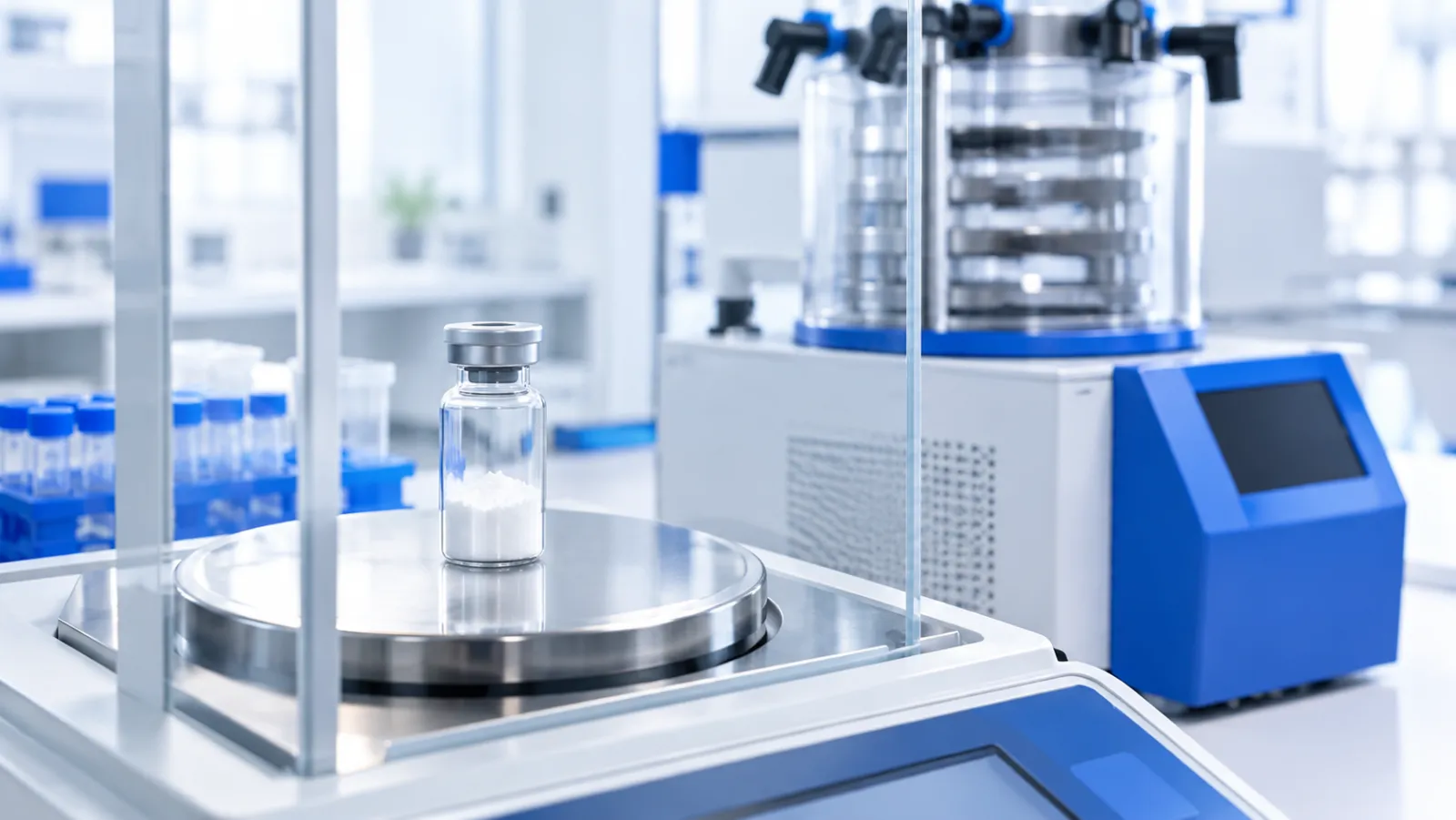
In short: Gross weight is the total mass of a lyophilised peptide powder. Net peptide content is the share of that mass that is peptide, after counter-ions such as TFA or acetate, water and other non-peptide material are excluded. In published analyses, the TFA counter-ion alone made up about 10% to nearly 25% of a powder’s mass.
This explainer is part of our guide to reading a peptide certificate of analysis. It explains the two numbers, what sits between them and how laboratories measure the gap, in general terms. Technical terms are defined in the peptide glossary.
What is the difference between gross weight and net peptide content?
Gross weight is the mass of everything in the powder, while net peptide content is the percentage of that mass that is the peptide itself. The two differ because a lyophilised (freeze-dried) synthetic peptide is rarely the peptide alone.
The terms vary between sources. The European Medicines Agency (EMA) guideline on synthetic peptides calls the measurement “assay” or “content” 1, and McCarthy et al., in a 2023 paper on peptide reference standards, call it peptide mass content 2. A 2020 review of counter-ions by Sikora et al. lists peptide concentration or mass fraction among the quality control factors for synthetic peptides, alongside identity, purity, residual solvents such as water, and counter-ions 3. Results are usually given as percent by weight (% w/w) or as milligrams per gram.
What else is in a lyophilised peptide powder?
Besides the peptide, a lyophilised powder usually holds counter-ions and water, with smaller amounts of residual solvents, inorganic residues and peptide-related impurities.
Counter-ions. Many peptides carry charged side chains, so they exist as salts with an oppositely charged counter-ion 3. Solid-phase synthesis uses trifluoroacetic acid (TFA) for cleavage and purification, so cationic peptides are mainly obtained as trifluoroacetate salts 4. Most approved peptide medicines are acetate salts 3. The EMA guideline says acetate is the usual counter-ion for synthetic peptide substances, that the counter-ion should be defined and its amount controlled with a justified upper limit, and that it may be present in a stoichiometric (fixed-ratio) or non-stoichiometric amount 1. Acetate vs TFA salts explains why the choice matters.
Water. Li et al. wrote that most peptides are very hygroscopic, which is why powdered peptide reference standards had to be weighed under controlled humidity with water content measured at the time of use 5. The EMA guideline asks for hygroscopicity to be described and for water content to be part of stability testing for hygroscopic powders 1. Both McCarthy et al. and Wang et al. measured water by Karl Fischer titration, in which water reacts with iodine and sulfur dioxide 2 6.
Residual solvents and inorganic residues. McCarthy et al. measured residual solvents by gas chromatography and inorganic impurities by residue on ignition 2. In synthetic glucagon, Wang et al. found each inorganic ion measured below 0.1% 6.
Peptide-related impurities. Shorter, modified or rearranged versions of the target sequence are peptide material too. They are measured by high-performance liquid chromatography (HPLC), covered in HPLC purity explained.
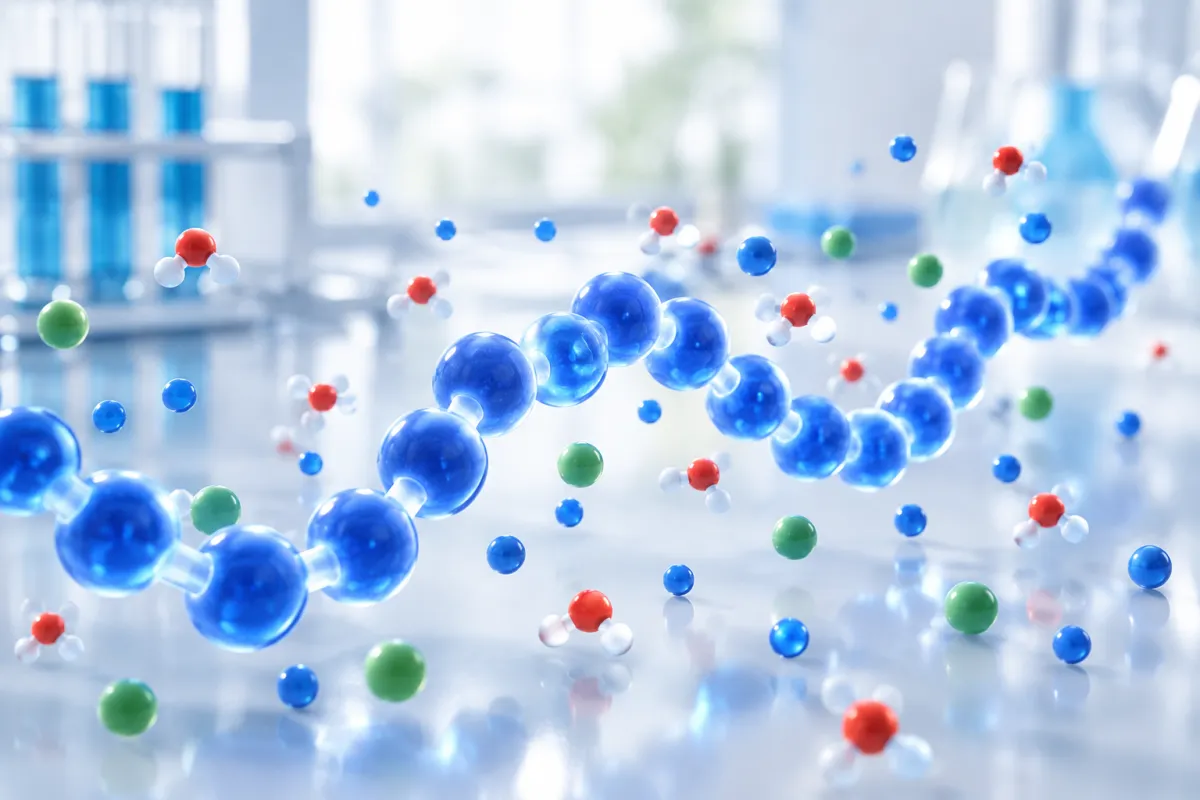 Illustration: a peptide chain with associated counter-ions and water, shown schematically rather than as any specific structure.
How large can the gap between gross weight and peptide content be?
In the published analyses below, material other than the target peptide made up from about a tenth of the mass, in synthetic glucagon, to nearly a third, in an angiotensin II reference material. It was larger still where an undeclared additive was present. These are individual materials, and Wang et al. noted that the type and content of impurities are closely related to the production method, the process and the structure of the peptide 6.
| Study | Study type | Material | What was measured | Reported finding |
|---|---|---|---|---|
| Wang, 2020 | Analytical chemistry study | Synthetic glucagon | Water by Karl Fischer titration, TFA by ion chromatography, inorganic ions and peptide impurities by mass spectrometry, all subtracted from the sample mass | Glucagon content 896.36 ± 0.68 mg/g; TFA 103.03 mg/g; manufacturer-reported purity 983.72 mg/g |
| Melanson, 2018 | Analytical chemistry study | Candidate angiotensin II certified reference material | Mass balance using fluorine nuclear magnetic resonance (NMR) for TFA, combined with quantitative proton NMR and amino acid analysis by mass spectrometry | TFA counter-ion nearly 25% by mass; final purity 691 ± 9 mg/g |
| Choules, 2020 | Analytical case study | Two commercially sourced custom peptides | Composition by quantitative proton NMR | Undeclared mannitol at 20% and 43% w/w |
| Li, 2019 | Multi-laboratory comparative study | Lyophilised oxytocin reference standard candidate | Peptide quantity by HPLC assay, quantitative NMR and amino acid analysis | HPLC assay against the same bulk material gave the lowest inter-laboratory variability |
How is net peptide content measured?
Net peptide content is measured either by quantifying the peptide directly or by measuring everything that is not the target peptide and subtracting it. The EMA guideline lists a chromatographic assay against a reference standard, elemental analysis, amino acid analysis, nitrogen analysis by the Kjeldahl method and quantitative NMR (qNMR) as options 1.
- Amino acid analysis (AAA): the peptide is broken down in acid and the released amino acids are measured. Amino acids that survive hydrolysis well, such as leucine, proline, valine and phenylalanine, serve as proxies for the parent peptide 5.
- Quantitative NMR: measures the intact peptide against an internal standard, avoiding the errors that hydrolysis can introduce 5.
- HPLC assay: compares the sample’s main peak with a characterised reference standard of the same peptide 5.
- Mass balance: every detectable impurity, including related peptides, counter-ion, water, residual solvents and non-combustible residues, is measured and subtracted from 100% 2. Wang et al. used this approach for glucagon 6.
Method choice matters. In a multi-laboratory study of oxytocin, Li et al. reported that accuracy and precision were highly dependent on the quantitation method, with the HPLC assay showing the lowest inter-laboratory variability 5.
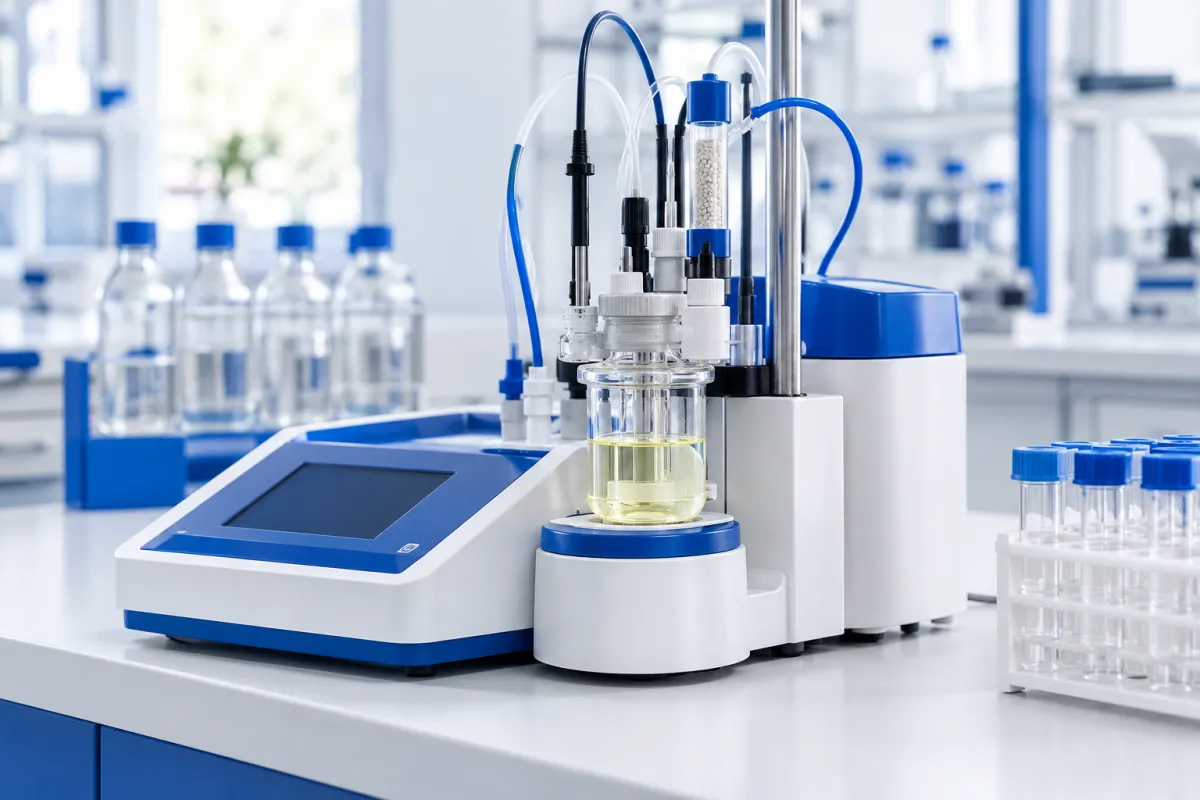 Illustration: a titration instrument of the type used to measure water in lyophilised powders.
How do net peptide content and HPLC purity fit together?
Net peptide content and HPLC purity answer different questions, and the share of a powder that is the target peptide depends on both. HPLC purity describes the peptide material; content describes the whole powder.
In the mass-balance calculation McCarthy et al. described, the HPLC impurity total is subtracted from 100, the weight percentages of counter-ion, residual solvents and inorganic residue are subtracted from 100, the two fractions are multiplied, and the result is corrected for water 2. Li et al. set out the same form of calculation for an oxytocin standard 5.
Some content methods count related peptides along with the target. Melanson et al. noted that both amino acid analysis and qNMR are susceptible to interference from related peptide impurities, which need to be measured and accounted for 7. Li et al. noted that their NMR and AAA values were not corrected for peptide-related impurities, which could in theory bias them against HPLC results 5. HPLC purity explained covers what the purity figure itself includes.
How do standards for peptide medicines express content?
Standards for peptide medicines express content on a counter-ion-free, anhydrous basis, so the figure refers to the peptide alone. The EMA guideline states that limits of assays determined by liquid chromatography are expressed in terms of the counter-ion-free, anhydrous substance unless otherwise justified, that the assay and its calculation should be clearly defined, and that the strength of a finished medicine is defined by the mass of peptide base, not including salt or counter-ion 1. Where manufacturers apply correction factors for assay, purity, moisture, residual solvent or salt content to reach a declared amount, the guideline expects those factors to be described 1.
Reference standards follow similar logic. McCarthy et al. reported that the United States Pharmacopeial Convention (USP) moved many peptide reference standards from powders to lyophilised vials with an assigned content, removing the need for users to determine counter-ions and residual moisture before use 2.
These rules govern authorised medicines. For any peptide material, the practical question when reading a label or certificate is which basis a stated amount uses: the gross mass of powder or the peptide content. A certificate that defines its assay and shows how it was calculated answers that question directly.
Frequently asked questions
What does net peptide content mean?
Net peptide content is the percentage of a peptide powder’s weight that is the peptide itself, after counter-ions, water and other non-peptide material are excluded. Regulatory documents call it assay or content 1, and USP authors describe it as peptide mass content 2. It is usually reported as percent by weight or milligrams per gram, separately from HPLC purity.
Why is net peptide content lower than 100%?
Because a lyophilised synthetic peptide also contains counter-ions, water and small amounts of other material. In a 2020 study of synthetic glucagon, Wang et al. measured TFA at 103.03 mg/g and a glucagon content of 896.36 mg/g 6. In a 2018 study of an angiotensin II reference material, Melanson et al. measured TFA at nearly 25% by mass 7.
Is net peptide content the same as HPLC purity?
No. HPLC purity is the main peak’s share of the peptide signal in a chromatogram, while net peptide content is the peptide’s share of the whole powder. In the USP mass-balance approach described by McCarthy et al., both are combined to assign the target peptide’s mass fraction 2. See HPLC purity explained for what purity includes.
What is a counter-ion in a synthetic peptide?
A counter-ion is an oppositely charged ion that pairs with charged groups on a peptide to form a salt. Solid-phase synthesis uses trifluoroacetic acid for cleavage and purification, so cationic peptides are mainly obtained as trifluoroacetate salts 4, while most approved peptide medicines are acetate salts 3. Acetate vs TFA salts covers the difference.
How is water measured in a lyophilised peptide powder?
Karl Fischer titration, in which water reacts with iodine and sulfur dioxide, is the method described in the analytical papers. McCarthy et al. used it for peptide reference standard material, and Wang et al. ran it inside a low-humidity glovebox for synthetic glucagon 2 6. Li et al. noted that most peptides are very hygroscopic, which is why humidity control matters when they are weighed 5.
References
- European Medicines Agency. Guideline on the development and manufacture of synthetic peptides (EMA/CHMP/CVMP/QWP/367182/2025; adopted December 2025, in effect from 1 June 2026). https://www.ema.europa.eu/en/development-manufacture-synthetic-peptides-scientific-guideline. Accessed 28 September 2026. [regulatory guideline]
- McCarthy D, Han Y, Carrick K, et al. Reference Standards to Support Quality of Synthetic Peptide Therapeutics. Pharm Res. 2023;40(6):1317-1328. doi:10.1007/s11095-023-03493-1. PMID: 36949371. PMCID: PMC10338602. [analytical methods paper with case studies]
- Sikora K, Jaśkiewicz M, Neubauer D, et al. The Role of Counter-Ions in Peptides: An Overview. Pharmaceuticals (Basel). 2020;13(12):442. doi:10.3390/ph13120442. PMID: 33287352. PMCID: PMC7761850. [narrative review]
- Roux S, Zékri E, Rousseau B, et al. Elimination and exchange of trifluoroacetate counter-ion from cationic peptides: a critical evaluation of different approaches. J Pept Sci. 2008;14(3):354-359. doi:10.1002/psc.951. PMID: 18035848. [analytical chemistry study]
- Li C, Bhavaraju S, Thibeault MP, et al. Survey of peptide quantification methods and comparison of their reproducibility: A case study using oxytocin. J Pharm Biomed Anal. 2019;166:105-112. doi:10.1016/j.jpba.2018.12.028. PMID: 30640042. PMCID: PMC6507411. [multi-laboratory comparative study]
- Wang X, Zhang F, Li H, et al. Purity determination of synthetic glucagon using a mass balance approach. Sci Rep. 2020;10(1):4423. doi:10.1038/s41598-020-61109-9. PMID: 32157163. PMCID: PMC7064584. [analytical chemistry study]
- Melanson JE, Thibeault MP, Stocks BB, et al. Purity assignment for peptide certified reference materials by combining qNMR and LC-MS/MS amino acid analysis results: application to angiotensin II. Anal Bioanal Chem. 2018;410(26):6719-6731. doi:10.1007/s00216-018-1272-7. PMID: 30143839. [analytical chemistry study]
- Choules MP, Bisson J, Simmler C, et al. NMR reveals an undeclared constituent in custom synthetic peptides. J Pharm Biomed Anal. 2020;178:112915. doi:10.1016/j.jpba.2019.112915. PMID: 31671336. PMCID: PMC6913887. [analytical case study]
Check the lab report
Every published certificate of analysis names its lab, lot and test date. For laboratory research use only.