

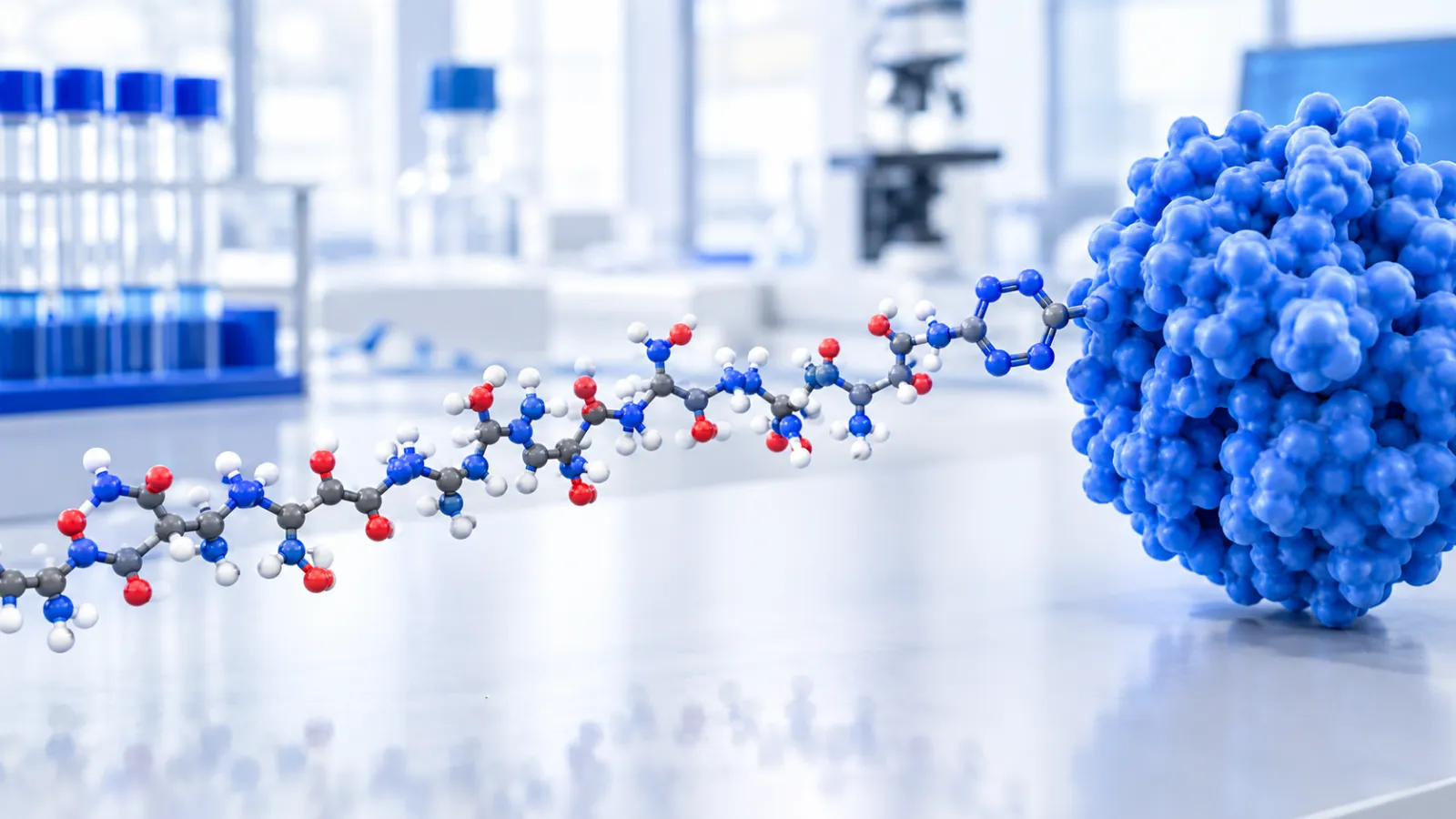
In short: Both forms of CJC-1295 share one modified 29-residue sequence from growth hormone-releasing hormone (GHRH). The DAC form adds a lysine carrying a maleimide linker designed to bond to albumin. Published pharmacology used the DAC form; the other appears in analytical papers. WADA section S2 names CJC-1295 and GHRH analogues, and the TGA names CJC-1295 as an unapproved peptide product.
This comparison covers chemistry only: the drug affinity complex (DAC), the shared sequence, which form the published studies used and how a laboratory tells the two apart. Study types are labelled as in how to read a peptide study, and the wider record is reviewed in CJC-1295 and ipamorelin: structure, receptors and the research record.
Key facts
| CJC-1295 with DAC | CJC-1295 without DAC | |
|---|---|---|
| Other names | CJC 1295, CJC1295 | Modified GRF (1-29); PubChem synonym “CJC-1295-no DAC acetate” |
| Sequence | YaDAIFTQSYRKVLAQLSARKLLQDILSRK-NH2 (a = D-alanine) | YaDAIFTQSYRKVLAQLSARKLLQDILSR-NH2 (a = D-alanine) |
| Length | 30 residues | 29 residues |
| C-terminus | Lysinamide with a 3-maleimidopropionyl group on its side chain | Argininamide |
| Molecular formula | C165H269N47O46 | C152H252N44O42 |
| Molecular weight | 3,647.2 g/mol | 3,367.9 g/mol |
| CAS number | 446262-90-4 | Listed inconsistently (see below) |
| PubChem CID | 91971820 | 56841945 |
| Thiol-reactive group | Maleimide | None |
| Published pharmacology | Cell, rodent and human studies, 2005 to 2009 | None found; analytical studies only |
| WADA status | Named in S2.2.4; prohibited at all times | S2.2.4 names “GHRH and its analogues”; prohibited at all times |
| TGA status | CJC-1295 named as an example of an unapproved peptide product | The TGA advisory does not distinguish the forms |
Identifiers are from PubChem 1, 2. Sequences use one-letter amino acid codes; “a” marks D-alanine.
What is the difference between CJC-1295 with and without DAC?
The two forms differ only at the C-terminus: the DAC form has an extra lysine at position 30 whose side chain carries a 3-maleimidopropionyl group, and the form without DAC stops at residue 29.
In 2005, Jetté et al. defined CJC-1295 as a tetrasubstituted form of human GRF(1-29) (GRF is another name for GHRH) with an added lysine at the C-terminus carrying a 3-maleimidopropionamide group 3. The “with DAC” name refers to this addition; Memdouh et al., for example, list “CJC-1295 with drug affinity complex” as an analyte 4. The PubChem structures confirm that the two forms have identical residues 1 to 29 1, 2.
The C-termini differ as a result: the form without DAC ends in argininamide (arginine 29 with its carboxyl group converted to an amide), and the DAC form ends in lysinamide at position 30 1, 2.
Where does the shared sequence come from?
Both forms are built on the first 29 residues of human GHRH, with four substitutions at positions where earlier studies documented specific breakdown routes.
Native human GHRH has 44 residues. Guillemin et al. isolated it from a pancreatic tumour and reported its sequence in 1982 5, and UniProt records the same mature peptide 6. Comparing that sequence with the PubChem structures shows four changes shared by both forms of CJC-1295 1, 6:
| Position | Native GHRH | CJC-1295 (both forms) |
|---|---|---|
| 2 | L-alanine | D-alanine |
| 8 | Asparagine | Glutamine |
| 15 | Glycine | Alanine |
| 27 | Methionine | Leucine |
Position 2. In a 1986 in vitro study with human plasma, Frohman et al. reported that GHRH was converted to a fragment missing its first two residues, with less than one-thousandth of the original activity 7. In 1989 they identified the enzyme as dipeptidyl peptidase IV (DPP-IV) and reported that a D-amino acid at position 1 or 2 prevented the cut 8.
Position 8. In a 1991 stability study, Friedman et al. reported that a GHRH analogue at pH 7.4 and 37 °C degraded mainly by deamidation (loss of the side-chain amide) of asparagine 8, giving products 25 to 500 times less potent in bovine pituitary cells 9.
Position 15. Stevenson et al. reported in 1993 that, under the solvent conditions they tested, an analogue with alanine at position 15 was more helical than one with glycine, and its asparagine 8 deamidated more slowly. They concluded that a helical environment around residue 8 makes it less prone to deamidation 10.
Position 27. Methionine is among the amino acids most susceptible to oxidation, according to a 1995 review by Li et al. 11. Both forms of CJC-1295 carry leucine here.
These papers describe the chemistry at each position; Jetté et al.’s abstract does not give reasons for each substitution 3.
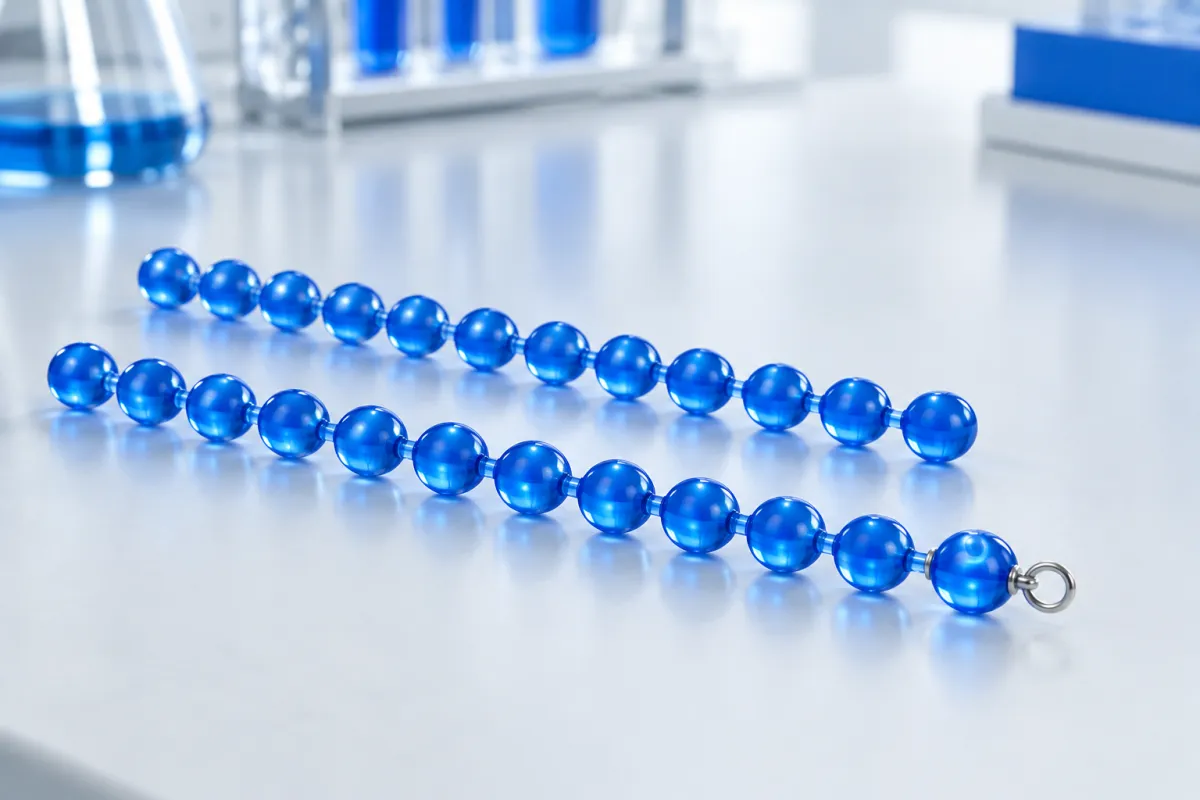 Illustration: two stylised peptide chains, one with an extra linker at its end, suggesting the difference between the two forms.
What does the drug affinity complex add?
The DAC adds a thiol-reactive maleimide group, designed to bond the peptide to albumin in the blood.
The reaction. A maleimide reacts with a thiol (a sulfur-hydrogen group) by Michael addition, forming a succinimide thioether. Fontaine et al. noted in 2015 that this reaction is widely used to join drugs to large molecules. They also reported that the resulting bond can later undergo thiol exchange or a stabilising ring-opening reaction 12.
The target. Jetté et al. designed their GHRH analogues to bond to the free thiol on cysteine 34 of serum albumin 3. A 2013 review by Sleep et al. describes albumin as the most abundant plasma protein, with a long circulatory half-life owing to its size and a recycling pathway involving the neonatal Fc receptor (FcRn), whereas molecules below the kidney’s filtration threshold are lost quickly 13.
What was measured. Jetté et al. reported that the albumin conjugates resisted DPP-IV in vitro and stayed active in rat pituitary cells, and that in rats a western blot placed CJC-1295 on the albumin band from 15 minutes onwards 3.
The form without DAC has no maleimide, no lysine 30 and no group designed to bond to albumin 2.
Which form did the published studies use?
The published pharmacology studies used the DAC form, and the form without DAC appears in analytical and anti-doping papers.
These papers describe CJC-1295 as a long-acting analogue, and Jetté, Alba and Ionescu et al. attribute this to albumin binding, which identifies the DAC form 3, 14, 15. For human studies, we give design and endpoints only.
| Study | Study type | Model | What was measured | Reported finding |
|---|---|---|---|---|
| Jetté, 2005 | Cell and rodent study (DAC form) | Rat anterior pituitary cells; rats | DPP-IV stability; GH release; plasma persistence; albumin binding | Conjugates resisted DPP-IV; CJC-1295 was present in plasma beyond 72 hours |
| Alba, 2006 | Rodent study (DAC form) | GHRH knockout mice | Growth measures; pituitary RNA and GH mRNA | Higher pituitary RNA and GH mRNA |
| Teichman, 2006 | Two randomised controlled trials (DAC form) | Healthy adults | Pharmacokinetics; GH and IGF-I | Design and endpoints only |
| Ionescu, 2006 | Human study (DAC form) | Healthy men | Overnight GH secretion pattern; IGF-I | Design and endpoints only |
| Sackmann-Sala, 2009 | Human proteomics study (DAC form) | Serum from healthy men | Serum protein profiles | Design and endpoints only |
| Henninge, 2010 | Analytical study | Unknown preparation | Sequence by tandem mass spectrometry | A 29-residue amide consistent with a peptide marketed as CJC-1295 |
| Memdouh, 2021 | Analytical study (both forms) | In vitro metabolism; fortified urine | Metabolites; detection by mass spectrometry | 19 major metabolites; detection limits generally 1 ng/mL or lower |
In Europe PMC searches on 28 September 2026, we found no primary pharmacology study of the 29-residue form under the names “CJC-1295 without DAC” or “modified GRF (1-29)”. Findings reported for the DAC form cannot be assumed to apply to it.
Why are the names confusing?
The name “CJC-1295” is used for both structures, in the literature and in chemical databases.
- In pharmacology papers, CJC-1295 is the DAC form 3.
- In some analytical papers, “CJC-1295” means the 29-residue form, listed separately from “CJC-1295 with drug affinity complex” 4.
- In seized material, Henninge et al. found the 29-residue amide in a preparation matching a peptide marketed as CJC-1295 18.
- In PubChem, the record titled “Cjc 1295” has the DAC structure and CAS number 446262-90-4 1. The record for the 29-residue amide lists CAS numbers 863288-34-0 and 446036-97-1, with synonyms that include both “CJC 1295 with DAC” and “CJC-1295-no DAC acetate” 2.
A name or CAS number is therefore not enough to establish identity; the sequence and measured mass are.
How can a laboratory tell the two forms apart?
Mass spectrometry distinguishes them directly, because the DAC form is 279.3 g/mol heavier.
The molecular weights are 3,647.2 g/mol with DAC and 3,367.9 g/mol without 1, 2; the difference, C13H17N3O4, is one lysine residue plus a maleimidopropionyl group. Mass spectrometry identity testing explains how an observed mass is matched to an expected one, and tandem mass spectrometry can confirm the sequence itself, as Henninge et al. showed 18.
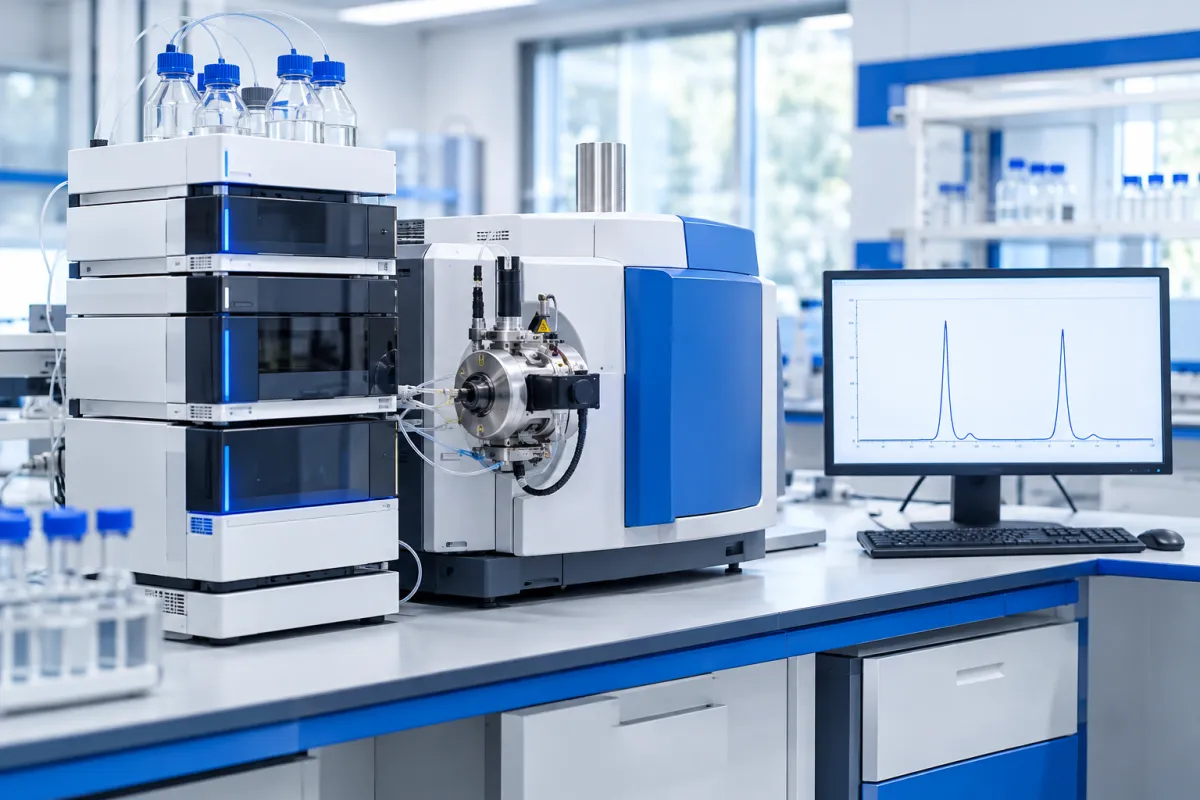 Illustration: a liquid chromatography and mass spectrometry set-up of the kind used to confirm which peptide form a sample contains.
Memdouh et al. detected the two forms as separate compounds 4. The maleimide in the DAC form is built to react with thiols 12, so it is the more chemically reactive of the two.
Purity is a separate question from identity, covered in HPLC purity explained. For how peptides of this length are assembled one residue at a time, see solid-phase peptide synthesis explained. Batch reports are on our COA page.
What is the regulatory and anti-doping status of each form?
WADA’s section S2.2.4 names CJC-1295 and covers GHRH analogues generally, and the TGA advisory names CJC-1295 without distinguishing the forms.
WADA. The 2026 Prohibited List names “growth hormone-releasing hormone (GHRH) and its analogues” in section S2.2.4, with CJC-1295 as an example. Section S2 also covers “other substances with similar chemical structure or similar biological effect(s)”. S2 substances are prohibited at all times 19. Our anti-doping status table covers other research peptides.
TGA. The TGA safety advisory of 13 April 2026 names BPC-157, GHK-Cu, TB-500, retatrutide and CJC-1295 as examples of unapproved peptide products: goods not included in the Australian Register of Therapeutic Goods (ARTG). It says they have not been evaluated by the TGA for safety, quality or effectiveness 20.
Frequently asked questions
What does DAC stand for in CJC-1295?
DAC stands for drug affinity complex, as in the analyte name “CJC-1295 with drug affinity complex” (Memdouh et al., 2021). Structurally, it is a lysine added at position 30 whose side chain carries a 3-maleimidopropionyl group. Jetté et al. (2005) designed it to bond to the free thiol on cysteine 34 of serum albumin.
Is CJC-1295 without DAC the same as modified GRF (1-29)?
Both names are used for the same structure: the first 29 residues of human GHRH with D-alanine 2, glutamine 8, alanine 15 and leucine 27, ending in an amide. PubChem records this structure as CID 56841945, with a molecular weight of 3,367.9 g/mol (PubChem). Because names vary between sellers and databases, the sequence and mass are the reliable identifiers.
Which version of CJC-1295 did the published studies use?
The pharmacology studies from 2005 to 2009 used the DAC form, which several of their authors described as binding to albumin (Jetté et al., 2005; Alba et al., 2006). We found no primary pharmacology study of the 29-residue form without DAC. It appears in analytical work, such as the 2010 identification of a preparation sold as CJC-1295 (Henninge et al., 2010).
What is the molecular weight difference between CJC-1295 with and without DAC?
About 279 g/mol. PubChem lists 3,647.2 g/mol for CJC-1295 with DAC (C165H269N47O46) and 3,367.9 g/mol for the 29-residue form without it (C152H252N44O42) (PubChem). The difference, C13H17N3O4, is one lysine residue plus the maleimidopropionyl linker. A mass spectrometer resolves a gap of this size easily, so a measured mass shows which form a sample contains.
Are both forms of CJC-1295 prohibited in sport?
Section S2.2.4 of the 2026 WADA Prohibited List names “growth hormone-releasing hormone (GHRH) and its analogues”, giving CJC-1295 as an example, and S2 substances are prohibited at all times (WADA). The list does not separate the forms with and without DAC. Athletes can check a substance with Sport Integrity Australia.
References
- PubChem. Compound summary for CID 91971820 (Cjc 1295). https://pubchem.ncbi.nlm.nih.gov/compound/91971820. Accessed 28 September 2026. [chemical database]
- PubChem. Compound summary for CID 56841945. https://pubchem.ncbi.nlm.nih.gov/compound/56841945. Accessed 28 September 2026. [chemical database]
- Jetté L, Léger R, Thibaudeau K, et al. Human growth hormone-releasing factor (hGRF)1-29-albumin bioconjugates activate the GRF receptor on the anterior pituitary in rats: identification of CJC-1295 as a long-lasting GRF analog. Endocrinology. 2005;146(7):3052-3058. doi:10.1210/en.2004-1286. PMID: 15817669. [cell study and rodent study]
- Memdouh S, Gavrilović I, Ng K, et al. Advances in the detection of growth hormone releasing hormone synthetic analogs. Drug Test Anal. 2021;13(11-12):1871-1887. doi:10.1002/dta.3183. PMID: 34665524. [analytical study (in vitro)]
- Guillemin R, Brazeau P, Böhlen P, et al. Growth hormone-releasing factor from a human pancreatic tumor that caused acromegaly. Science. 1982;218(4572):585-587. doi:10.1126/science.6812220. PMID: 6812220. [isolation and sequencing study]
- UniProt. P01286: Somatoliberin (GHRH), Homo sapiens. https://www.uniprot.org/uniprotkb/P01286/entry. Accessed 28 September 2026. [protein database]
- Frohman LA, Downs TR, Williams TC, et al. Rapid enzymatic degradation of growth hormone-releasing hormone by plasma in vitro and in vivo to a biologically inactive product cleaved at the NH2 terminus. J Clin Invest. 1986;78(4):906-913. doi:10.1172/jci112679. PMID: 3093533. PMCID: PMC423714. [in vitro plasma study and human study]
- Frohman LA, Downs TR, Heimer EP, et al. Dipeptidylpeptidase IV and trypsin-like enzymatic degradation of human growth hormone-releasing hormone in plasma. J Clin Invest. 1989;83(5):1533-1540. doi:10.1172/jci114049. PMID: 2565342. PMCID: PMC303858. [in vitro plasma study]
- Friedman AR, Ichhpurani AK, Brown DM, et al. Degradation of growth hormone releasing factor analogs in neutral aqueous solution is related to deamidation of asparagine residues. Replacement of asparagine residues by serine stabilizes. Int J Pept Protein Res. 1991;37(1):14-20. doi:10.1111/j.1399-3011.1991.tb00727.x. PMID: 1904406. [stability study and cell study]
- Stevenson CL, Friedman AR, Kubiak TM, et al. Effect of secondary structure on the rate of deamidation of several growth hormone releasing factor analogs. Int J Pept Protein Res. 1993;42(6):497-503. doi:10.1111/j.1399-3011.1993.tb00356.x. PMID: 8307680. [structural and stability study]
- Li S, Schöneich C, Borchardt RT. Chemical instability of protein pharmaceuticals: Mechanisms of oxidation and strategies for stabilization. Biotechnol Bioeng. 1995;48(5):490-500. doi:10.1002/bit.260480511. PMID: 18623513. [review]
- Fontaine SD, Reid R, Robinson L, et al. Long-term stabilization of maleimide-thiol conjugates. Bioconjug Chem. 2015;26(1):145-152. doi:10.1021/bc5005262. PMID: 25494821. [chemistry study]
- Sleep D, Cameron J, Evans LR. Albumin as a versatile platform for drug half-life extension. Biochim Biophys Acta. 2013;1830(12):5526-5534. doi:10.1016/j.bbagen.2013.04.023. PMID: 23639804. [narrative review]
- Alba M, Fintini D, Sagazio A, et al. Once-daily administration of CJC-1295, a long-acting growth hormone-releasing hormone (GHRH) analog, normalizes growth in the GHRH knockout mouse. Am J Physiol Endocrinol Metab. 2006;291(6):E1290-E1294. doi:10.1152/ajpendo.00201.2006. PMID: 16822960. [rodent study (GHRH knockout mice)]
- Ionescu M, Frohman LA. Pulsatile secretion of growth hormone (GH) persists during continuous stimulation by CJC-1295, a long-acting GH-releasing hormone analog. J Clin Endocrinol Metab. 2006;91(12):4792-4797. doi:10.1210/jc.2006-1702. PMID: 17018654. [human study (healthy men)]
- Teichman SL, Neale A, Lawrence B, et al. Prolonged stimulation of growth hormone (GH) and insulin-like growth factor I secretion by CJC-1295, a long-acting analog of GH-releasing hormone, in healthy adults. J Clin Endocrinol Metab. 2006;91(3):799-805. doi:10.1210/jc.2005-1536. PMID: 16352683. [two randomised controlled trials in healthy adults]
- Sackmann-Sala L, Ding J, Frohman LA, et al. Activation of the GH/IGF-1 axis by CJC-1295, a long-acting GHRH analog, results in serum protein profile changes in normal adult subjects. Growth Horm IGF Res. 2009;19(6):471-477. doi:10.1016/j.ghir.2009.03.001. PMID: 19386527. PMCID: PMC2787983. [human serum proteomics study]
- Henninge J, Pepaj M, Hullstein I, et al. Identification of CJC-1295, a growth-hormone-releasing peptide, in an unknown pharmaceutical preparation. Drug Test Anal. 2010;2(11-12):647-650. doi:10.1002/dta.233. PMID: 21204297. [analytical study]
- World Anti-Doping Agency. The Prohibited List (2026 List, section S2). https://www.wada-ama.org/en/prohibited-list. Accessed 28 September 2026. [anti-doping standard]
- Therapeutic Goods Administration. Understanding your responsibilities when importing, compounding and supplying unapproved peptide products. Safety advisory, 13 April 2026. https://www.tga.gov.au/safety/safety-monitoring-and-information/safety-alerts/understanding-your-responsibilities-when-importing-compounding-and-supplying-unapproved-peptide-products. Accessed 28 September 2026. [regulator publication]
Reference material. Certified Research Peptides supplies CJC-1295 With DAC for laboratory research, with a batch certificate of analysis: CJC-1295 With DAC.
Check the lab report
Every published certificate of analysis names its lab, lot and test date. For laboratory research use only.