

In short: CJC-1295 is a synthetic analogue of growth hormone-releasing hormone (GHRH). Ipamorelin is a five-residue ghrelin receptor agonist. Their record is mostly cell and animal work, with a few small human studies. Both are prohibited at all times under WADA section S2, and the TGA names CJC-1295 as an example of an unapproved peptide product.
This review covers the structure, receptors, published studies and trial record of CJC-1295 and ipamorelin. It uses the evidence labels explained in how to read a peptide study: every study is named by type and model. Human studies are described by their design and what they measured only.
Key facts
| CJC-1295 (with DAC) | CJC-1295 without DAC | Ipamorelin | |
|---|---|---|---|
| Names | CJC 1295, CJC1295 | Sold as “CJC-1295 without DAC” or modified GRF (1-29) | NNC 26-0161 |
| Sequence | YaDAIFTQSYRKVLAQLSARKLLQDILSRK-NH2, with a maleimidopropionyl group on the side chain of lysine 30 (a = D-alanine) | YaDAIFTQSYRKVLAQLSARKLLQDILSR-NH2 (a = D-alanine) | Aib-His-D-2-Nal-D-Phe-Lys-NH2 |
| Length | 30 residues | 29 residues | 5 residues |
| Molecular formula | C165H269N47O46 | C152H252N44O42 | C38H49N9O5 |
| Molecular weight | 3,647.2 g/mol | 3,367.9 g/mol | 711.9 g/mol |
| CAS number | 446262-90-4 | Listed inconsistently (see note) | 170851-70-4 |
| PubChem CID | 91971820 | 56841945 | 9831659 |
| Compound class | GHRH analogue with an albumin-reactive linker | GHRH analogue | Growth hormone secretagogue (ghrelin receptor agonist) |
| Receptor studied | GHRH receptor | No dedicated study found | Ghrelin receptor (GHS-R1a) |
| Evidence base | Cell, animal and small human studies; one terminated phase 2 trial | Analytical and anti-doping studies | Cell, animal and one human pharmacokinetic study; two phase 2 trials |
| WADA status | S2.2.4, prohibited at all times | S2.2.4 names “GHRH and its analogues”; prohibited at all times | S2.2.4, prohibited at all times |
| TGA status | Named as an example of an unapproved peptide product (TGA advisory, 13 April 2026) | The advisory names CJC-1295 without distinguishing forms | Not among the advisory’s named examples |
Identifiers are from PubChem 1, 2, 3. PubChem’s record for the 29-residue form lists two CAS numbers and both “with DAC” and “no DAC” synonyms 2; CJC-1295 with DAC vs without DAC compares the forms.
What are CJC-1295 and ipamorelin?
CJC-1295 and ipamorelin are synthetic peptides designed to act at the two pituitary receptors that trigger growth hormone (GH) release: the GHRH receptor and the ghrelin receptor.
GHRH, the hypothalamic hormone that signals GH release, was isolated in 1982 by Guillemin et al. as a 44-residue peptide from a pancreatic tumour 4; UniProt records the same mature sequence 5. In a 1989 in vitro plasma study, Frohman et al. showed that the enzyme dipeptidyl peptidase IV (DPP-IV) cuts the native hormone between residues 2 and 3, and that a D-amino acid at position 1 or 2 blocked the cut 6.
CJC-1295 was built to resist that breakdown. In a 2005 study in rat pituitary cells and rats, Jetté et al. made three versions of the first 29 residues of human GHRH, each with a group designed to bond to the blood protein albumin, and identified CJC-1295 as a long-lasting analogue 7.
Ipamorelin belongs to the other pathway. The ghrelin receptor was cloned in 1996 as the target of synthetic growth hormone secretagogues (GHSs) 8, and in 1999 Kojima et al. identified the body’s own ligand for it, ghrelin, in rat stomach 9. Raun et al. described ipamorelin in 1998 as a pentapeptide from a chemistry programme on analogues of growth hormone-releasing peptide 1 (GHRP-1) 10.
The two are often discussed together because they act at different receptors. In a Europe PMC search on 28 September 2026, we found no peer-reviewed study that tested CJC-1295 and ipamorelin together; papers naming both were reviews, surveys or analytical methods.
How are CJC-1295 and ipamorelin structured?
CJC-1295 is the first 29 residues of human GHRH with four substitutions and an extra lysine carrying an albumin-reactive group, while ipamorelin is a five-residue amide built partly from amino acids that do not occur in proteins.
Comparing the PubChem structure of CJC-1295 with the UniProt sequence of human GHRH shows four changes in the first 29 residues 1, 5:
- Position 2: L-alanine becomes D-alanine, its mirror-image form, at the site DPP-IV cuts in the native hormone 6.
- Position 8: asparagine becomes glutamine.
- Position 15: glycine becomes alanine.
- Position 27: methionine becomes leucine.
Jetté et al. described CJC-1295 as a tetrasubstituted form of human GRF(1-29), GRF being another name for GHRH, with an added C-terminal lysine whose side chain carries a 3-maleimidopropionamide group 7. This linker is called the drug affinity complex (DAC) 11. It was designed to react with the free thiol (sulfur-hydrogen) group on cysteine 34 of serum albumin 7. The version sold as “CJC-1295 without DAC” has the same 29 substituted residues, ending in an amide, with no added lysine or linker 2. The reasons documented for each substitution are covered in the DAC comparison.
 Illustration: a long and a short peptide chain, suggesting the size difference between a GHRH analogue and a pentapeptide.
Ipamorelin’s sequence is Aib-His-D-2-Nal-D-Phe-Lys-NH2 3, 10. Aib is 2-aminoisobutyric acid (2-methylalanine), D-2-Nal is 3-(2-naphthyl)-D-alanine and D-Phe is D-phenylalanine, and the chain ends in lysinamide 3. Raun et al. reported that it comes from a series lacking the central alanine-tryptophan pair of GHRP-1 10.
What mechanisms have researchers studied?
Researchers have studied CJC-1295 at the GHRH receptor and ipamorelin at the ghrelin receptor: two different G protein-coupled receptors (GPCRs) on GH-producing pituitary cells.
The GHRH receptor. In 1993, Gaylinn et al. cloned the human receptor: a 423-residue protein with seven transmembrane domains in the secretin family of GPCRs. GHRH binding raised cyclic AMP (cAMP), a signalling molecule, in cells made to express it 12. UniProt places it in GPCR family 2 13. Jetté et al. reported that their albumin conjugates were active in a GH secretion assay in cultured rat anterior pituitary cells 7. In mice lacking the GHRH gene, Alba et al. reported higher total pituitary RNA and GH messenger RNA after CJC-1295 administration, with tissue staining consistent with proliferation of GH-producing cells 14.
The ghrelin receptor. Howard et al. cloned this receptor from swine and human pituitary and hypothalamus and showed that synthetic GHSs act on it 8. UniProt places it in GPCR family 1, with ghrelin as its ligand 9, 15. Using receptor antagonists (blocking compounds), Raun et al. showed that ipamorelin, like GHRP-6, released GH through a GHRP-type receptor 10.
Two signalling routes. In a 1989 rat pituitary cell study, Cheng et al. reported that GHRH and GHRP-6, an earlier growth hormone-releasing peptide, acted through different receptors and gave a synergistic GH response together. GHRH raised cAMP about threefold, while GHRP-6 did not change cAMP but amplified the GHRH-induced rise 16.
Selectivity. In conscious swine, Raun et al. reported that GHRP-6 and GHRP-2 raised adrenocorticotropic hormone (ACTH) and cortisol, whereas ipamorelin did not raise either above the levels seen with GHRH, and none of the compounds changed FSH, LH, prolactin or TSH 10. The paper’s title calls ipamorelin “the first selective growth hormone secretagogue”. This rests on one animal study.
What does the published research include?
The published research is a small set of cell and animal studies from 1989 to 2012, five human studies and a few analytical papers. For human studies, the table gives design and endpoints only.
| Study | Study type | Model | What was measured | Reported finding |
|---|---|---|---|---|
| Cheng, 1989 | Cell study | Rat primary pituitary cells | GH release and cAMP with GHRH, GHRP-6 or both | Different receptors; a synergistic GH response when combined |
| Raun, 1998 | Cell and animal study | Rat pituitary cells; rats; swine | GH, ACTH, cortisol and other pituitary hormones | GH release similar to GHRP-6, without ACTH or cortisol rises above GHRH levels |
| Jetté, 2005 | Cell and rodent study | Rat anterior pituitary cells; rats | DPP-IV stability; GH release; plasma persistence; albumin binding | Conjugates resisted DPP-IV; CJC-1295 gave a fourfold larger GH area under the curve than hGRF(1-29) over 2 hours and was present in plasma beyond 72 hours; a western blot placed it on the albumin band |
| Alba, 2006 | Rodent study | GHRH knockout mice | Growth measures; pituitary RNA, GH mRNA and histology | Higher pituitary RNA and GH mRNA; histology consistent with GH-cell proliferation |
| Venkova, 2009 | Rodent study | Rat model of postoperative ileus | Time to first bowel movement; faecal pellet output | Single administration at the highest level tested shortened time to first bowel movement against vehicle |
| Greenwood-Van Meerveld, 2012 | Rodent and isolated tissue study | Rat postoperative ileus model; isolated stomach muscle | Gastric emptying; muscle contractility | Faster gastric emptying than vehicle; loss of contractile responses reversed |
| Gobburu, 1999 | Human pharmacokinetic and pharmacodynamic study | Healthy male volunteers | Plasma ipamorelin and GH, fitted to a model | Design and endpoints only |
| Teichman, 2006 | Two randomised, double-blind, placebo-controlled trials | Healthy adults aged 21 to 61 | Pharmacokinetics; peak and area under the curve of GH and IGF-I | Design and endpoints only |
| Ionescu, 2006 | Before-and-after human study | Healthy men aged 20 to 40 | Overnight GH secretion pattern; IGF-I | Design and endpoints only |
| Sackmann-Sala, 2009 | Human serum proteomics study | Serum from 11 healthy young men | Serum proteins by gel electrophoresis and mass spectrometry | Design and endpoints only |
| Beck, 2014 | Phase 2 randomised, double-blind, placebo-controlled trial | Adults after bowel resection | Adverse events; time to tolerance of a solid meal | Design and endpoints only |
The ipamorelin gut studies and its published trial share one research question: postoperative ileus, a temporary slowing of the bowel after surgery 17, 18, 23.
What does the clinical trial record show?
ClinicalTrials.gov lists one interventional trial of CJC-1295 and two of ipamorelin, all phase 2, and none of the three records has posted results.
- NCT00267527 (CJC-1295). A randomised, double-blind, placebo-controlled study in people with HIV infection, sponsored by ConjuChem. First posted in December 2005, it is listed as terminated with no reason given, and was last updated in October 2006 24.
- NCT00672074 (ipamorelin). A randomised, placebo-controlled study in postoperative ileus, sponsored by Helsinn Therapeutics, completed in 2009 with 117 participants and published by Beck et al. in 2014 23, 25.
- NCT01280344 (ipamorelin). A second randomised, placebo-controlled study by the same sponsor, on recovery of gut function after bowel resection, completed in May 2014 with 320 participants 26. The record links no publication, and we found no results paper in Europe PMC on 28 September 2026.
The Australian New Zealand Clinical Trials Registry returned no records for “ipamorelin” or “CJC” on the same date 27. No registered trial has tested the two compounds together.
What are the limits of the evidence?
The evidence is thin: a handful of pharmacology papers per compound, mostly in animals and cells, small and short human studies, and no study of the two together.
- Small and dated. The primary CJC-1295 pharmacology papers we found were published from 2005 to 2009 7, 14, 20, 21, 22.
- Developer-linked. Every registered trial lists a company sponsor, and one completed ipamorelin trial has no published results 24, 26.
- Animal models. Findings in knockout mice, surgical rat models and swine may not carry over to people, as why most peptide research is preclinical explains.
- The form without DAC. We found no primary pharmacology study of the 29-residue form. Results obtained with the DAC form cannot be assumed to apply to it.
What is the regulatory and anti-doping status of CJC-1295 and ipamorelin in Australia?
Both compounds are prohibited at all times in sport under section S2.2.4 of the WADA Prohibited List, and the TGA names CJC-1295 as an example of an unapproved peptide product.
TGA. The TGA safety advisory of 13 April 2026 names BPC-157, GHK-Cu, TB-500, retatrutide and CJC-1295 as examples of unapproved peptide products: goods not included in the Australian Register of Therapeutic Goods (ARTG). It says they have not been evaluated by the TGA for safety, quality or effectiveness 28. The advisory does not distinguish the forms of CJC-1295. Ipamorelin is not among its named examples, which are presented as examples rather than a complete list 28.
WADA. Section S2 of the 2026 Prohibited List covers peptide hormones, growth factors, related substances and mimetics, prohibited at all times and classed as non-Specified. Subsection S2.2.4 names “growth hormone-releasing hormone (GHRH) and its analogues”, with CJC-1295 as an example, and “growth hormone secretagogues (GHS) and their mimetics”, with ipamorelin as an example 29. Athletes in Australia can check a substance with Sport Integrity Australia 30, and our anti-doping status table covers other research peptides.
How are CJC-1295 and ipamorelin characterised in the lab?
Identity is confirmed by mass spectrometry and purity by high-performance liquid chromatography (HPLC), and the two CJC-1295 forms are told apart by their masses.
PubChem gives molecular weights of 3,647.2 g/mol for CJC-1295 with DAC, 3,367.9 g/mol for the form without DAC and 711.9 g/mol for ipamorelin 1, 2, 3. The 279.3 g/mol gap between the CJC-1295 forms matches the extra lysine and maleimidopropionyl group. See mass spectrometry identity testing and HPLC purity explained for how these checks work.
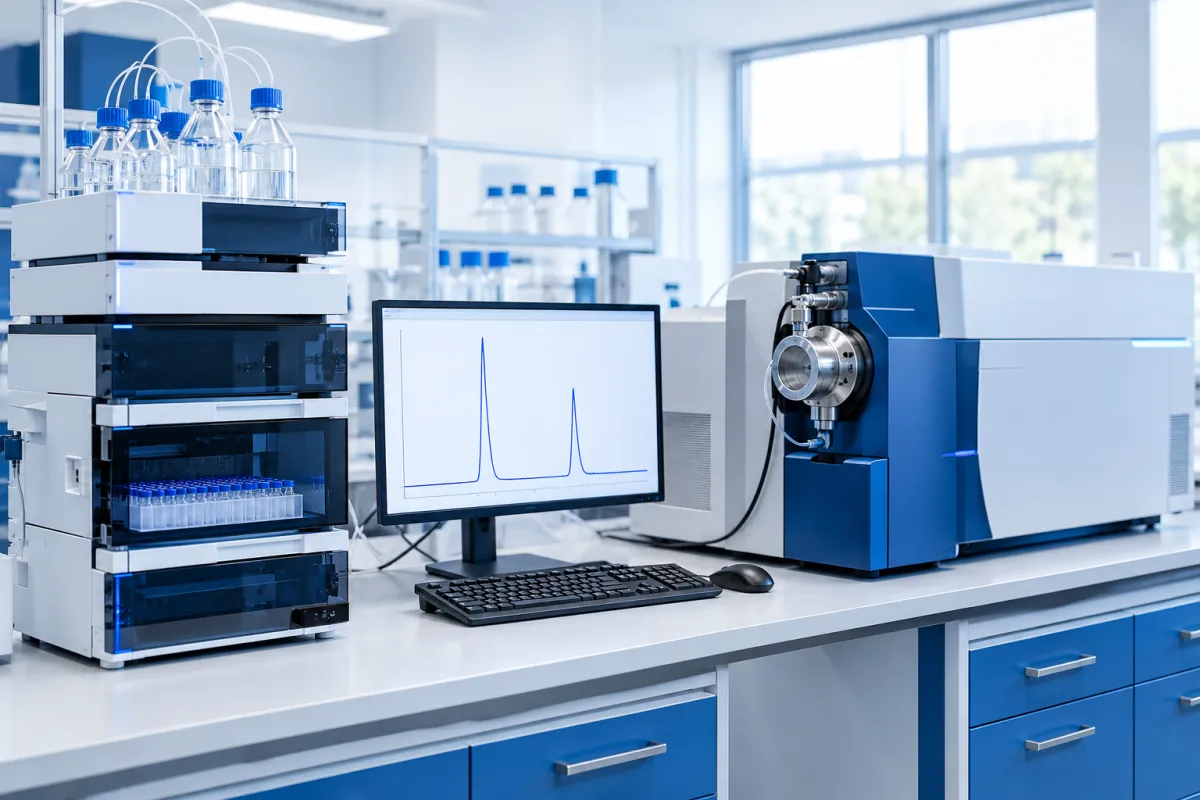 Illustration: a liquid chromatography and mass spectrometry set-up of the kind used to check peptide identity and purity.
The name alone is not enough. In 2010, Henninge et al. used liquid chromatography with high-resolution tandem mass spectrometry on an unknown preparation from Norwegian authorities and found a 29-residue peptide with a C-terminal amide, with a sequence consistent with a peptide marketed as CJC-1295 31: the form without the DAC linker. In 2021, Memdouh et al. treated CJC-1295 and CJC-1295 with DAC as separate analytes, identified 19 major in vitro metabolites and developed a mass spectrometry method to detect them in urine 11.
In a two-component vial, each peptide is identified and quantified separately, as how multi-component peptide blends are tested explains. Batch reports are on our COA page.
Frequently asked questions
What is the difference between CJC-1295 and ipamorelin?
They are different molecules that act at different receptors. CJC-1295 is a modified 29-residue fragment of growth hormone-releasing hormone, usually carrying an albumin-reactive linker, and was studied at the GHRH receptor (Jetté et al., 2005). Ipamorelin is a five-residue amide that acts at the ghrelin receptor, GHS-R1a (Raun et al., 1998). PubChem lists their molecular weights as about 3,647 and 712 g/mol.
Have CJC-1295 and ipamorelin been tested in registered clinical trials?
Yes, separately and only to phase 2. ClinicalTrials.gov lists one terminated phase 2 trial of CJC-1295 (NCT00267527) and two completed phase 2 trials of ipamorelin (NCT00672074 and NCT01280344). Only one of the three has a results paper that we could find, and no registered trial has tested the two together.
Are CJC-1295 and ipamorelin prohibited in sport?
Yes. The 2026 WADA Prohibited List names CJC-1295 as an example of a GHRH analogue and ipamorelin as an example of a growth hormone secretagogue, both under section S2.2.4. S2 substances are prohibited at all times, in and out of competition (WADA). Athletes in Australia can check a substance’s status with Sport Integrity Australia.
How can a lab tell which form of CJC-1295 is in a vial?
By measuring its mass. PubChem lists 3,647.2 g/mol for CJC-1295 with DAC and 3,367.9 g/mol for the 29-residue form without it, a difference of about 279 g/mol. Mass spectrometry separates the two easily, and tandem mass spectrometry can confirm the sequence, as Henninge et al. (2010) did with a preparation sold under the CJC-1295 name.
References
- PubChem. Compound summary for CID 91971820 (Cjc 1295). https://pubchem.ncbi.nlm.nih.gov/compound/91971820. Accessed 28 September 2026. [chemical database]
- PubChem. Compound summary for CID 56841945. https://pubchem.ncbi.nlm.nih.gov/compound/56841945. Accessed 28 September 2026. [chemical database]
- PubChem. Compound summary for CID 9831659 (Ipamorelin). https://pubchem.ncbi.nlm.nih.gov/compound/9831659. Accessed 28 September 2026. [chemical database]
- Guillemin R, Brazeau P, Böhlen P, et al. Growth hormone-releasing factor from a human pancreatic tumor that caused acromegaly. Science. 1982;218(4572):585-587. doi:10.1126/science.6812220. PMID: 6812220. [isolation and sequencing study]
- UniProt. P01286: Somatoliberin (GHRH), Homo sapiens. https://www.uniprot.org/uniprotkb/P01286/entry. Accessed 28 September 2026. [protein database]
- Frohman LA, Downs TR, Heimer EP, et al. Dipeptidylpeptidase IV and trypsin-like enzymatic degradation of human growth hormone-releasing hormone in plasma. J Clin Invest. 1989;83(5):1533-1540. doi:10.1172/jci114049. PMID: 2565342. PMCID: PMC303858. [in vitro plasma study]
- Jetté L, Léger R, Thibaudeau K, et al. Human growth hormone-releasing factor (hGRF)1-29-albumin bioconjugates activate the GRF receptor on the anterior pituitary in rats: identification of CJC-1295 as a long-lasting GRF analog. Endocrinology. 2005;146(7):3052-3058. doi:10.1210/en.2004-1286. PMID: 15817669. [cell study and rodent study]
- Howard AD, Feighner SD, Cully DF, et al. A receptor in pituitary and hypothalamus that functions in growth hormone release. Science. 1996;273(5277):974-977. doi:10.1126/science.273.5277.974. PMID: 8688086. [receptor cloning study]
- Kojima M, Hosoda H, Date Y, et al. Ghrelin is a growth-hormone-releasing acylated peptide from stomach. Nature. 1999;402(6762):656-660. doi:10.1038/45230. PMID: 10604470. [peptide isolation study (rat)]
- Raun K, Hansen BS, Johansen NL, et al. Ipamorelin, the first selective growth hormone secretagogue. Eur J Endocrinol. 1998;139(5):552-561. doi:10.1530/eje.0.1390552. PMID: 9849822. [cell study and animal study (rat, swine)]
- Memdouh S, Gavrilović I, Ng K, et al. Advances in the detection of growth hormone releasing hormone synthetic analogs. Drug Test Anal. 2021;13(11-12):1871-1887. doi:10.1002/dta.3183. PMID: 34665524. [analytical study (in vitro)]
- Gaylinn BD, Harrison JK, Zysk JR, et al. Molecular cloning and expression of a human anterior pituitary receptor for growth hormone-releasing hormone. Mol Endocrinol. 1993;7(1):77-84. doi:10.1210/mend.7.1.7680413. PMID: 7680413. [receptor cloning and cell study]
- UniProt. Q02643: Growth hormone-releasing hormone receptor, Homo sapiens. https://www.uniprot.org/uniprotkb/Q02643/entry. Accessed 28 September 2026. [protein database]
- Alba M, Fintini D, Sagazio A, et al. Once-daily administration of CJC-1295, a long-acting growth hormone-releasing hormone (GHRH) analog, normalizes growth in the GHRH knockout mouse. Am J Physiol Endocrinol Metab. 2006;291(6):E1290-E1294. doi:10.1152/ajpendo.00201.2006. PMID: 16822960. [rodent study (GHRH knockout mice)]
- UniProt. Q92847: Growth hormone secretagogue receptor type 1, Homo sapiens. https://www.uniprot.org/uniprotkb/Q92847/entry. Accessed 28 September 2026. [protein database]
- Cheng K, Chan WW, Barreto A, et al. The synergistic effects of His-D-Trp-Ala-Trp-D-Phe-Lys-NH2 on growth hormone (GH)-releasing factor-stimulated GH release and intracellular adenosine 3’,5’-monophosphate accumulation in rat primary pituitary cell culture. Endocrinology. 1989;124(6):2791-2798. doi:10.1210/endo-124-6-2791. PMID: 2541999. [cell study (rat pituitary cells)]
- Venkova K, Mann W, Nelson R, et al. Efficacy of ipamorelin, a novel ghrelin mimetic, in a rodent model of postoperative ileus. J Pharmacol Exp Ther. 2009;329(3):1110-1116. doi:10.1124/jpet.108.149211. PMID: 19289567. [rodent study]
- Greenwood-Van Meerveld B, Tyler K, Mohammadi E, et al. Efficacy of ipamorelin, a ghrelin mimetic, on gastric dysmotility in a rodent model of postoperative ileus. J Exp Pharmacol. 2012;4:149-155. doi:10.2147/jep.s35396. PMID: 27186127. PMCID: PMC4863553. [rodent study and isolated tissue study]
- Gobburu JV, Agersø H, Jusko WJ, et al. Pharmacokinetic-pharmacodynamic modeling of ipamorelin, a growth hormone releasing peptide, in human volunteers. Pharm Res. 1999;16(9):1412-1416. doi:10.1023/a:1018955126402. PMID: 10496658. [human pharmacokinetic and pharmacodynamic study]
- Teichman SL, Neale A, Lawrence B, et al. Prolonged stimulation of growth hormone (GH) and insulin-like growth factor I secretion by CJC-1295, a long-acting analog of GH-releasing hormone, in healthy adults. J Clin Endocrinol Metab. 2006;91(3):799-805. doi:10.1210/jc.2005-1536. PMID: 16352683. [two randomised controlled trials in healthy adults]
- Ionescu M, Frohman LA. Pulsatile secretion of growth hormone (GH) persists during continuous stimulation by CJC-1295, a long-acting GH-releasing hormone analog. J Clin Endocrinol Metab. 2006;91(12):4792-4797. doi:10.1210/jc.2006-1702. PMID: 17018654. [human study (healthy men)]
- Sackmann-Sala L, Ding J, Frohman LA, et al. Activation of the GH/IGF-1 axis by CJC-1295, a long-acting GHRH analog, results in serum protein profile changes in normal adult subjects. Growth Horm IGF Res. 2009;19(6):471-477. doi:10.1016/j.ghir.2009.03.001. PMID: 19386527. PMCID: PMC2787983. [human serum proteomics study]
- Beck DE, Sweeney WB, McCarter MD, et al. Prospective, randomized, controlled, proof-of-concept study of the Ghrelin mimetic ipamorelin for the management of postoperative ileus in bowel resection patients. Int J Colorectal Dis. 2014;29(12):1527-1534. doi:10.1007/s00384-014-2030-8. PMID: 25331030. [phase 2 randomised controlled trial]
- ClinicalTrials.gov. Record NCT00267527 (CJC 1295; phase 2; sponsor ConjuChem). https://clinicaltrials.gov/study/NCT00267527. Accessed 28 September 2026. [trial registry record]
- ClinicalTrials.gov. Record NCT00672074 (ipamorelin; phase 2; sponsor Helsinn Therapeutics). https://clinicaltrials.gov/study/NCT00672074. Accessed 28 September 2026. [trial registry record]
- ClinicalTrials.gov. Record NCT01280344 (ipamorelin; phase 2; sponsor Helsinn Therapeutics). https://clinicaltrials.gov/study/NCT01280344. Accessed 28 September 2026. [trial registry record]
- Australian New Zealand Clinical Trials Registry (ANZCTR). Trial search for “ipamorelin” and “CJC”. https://www.anzctr.org.au/TrialSearch.aspx. Accessed 28 September 2026. [trial registry]
- Therapeutic Goods Administration. Understanding your responsibilities when importing, compounding and supplying unapproved peptide products. Safety advisory, 13 April 2026. https://www.tga.gov.au/safety/safety-monitoring-and-information/safety-alerts/understanding-your-responsibilities-when-importing-compounding-and-supplying-unapproved-peptide-products. Accessed 28 September 2026. [regulator publication]
- World Anti-Doping Agency. The Prohibited List (2026 List, section S2). https://www.wada-ama.org/en/prohibited-list. Accessed 28 September 2026. [anti-doping standard]
- Sport Integrity Australia. Anti-doping. https://www.sportintegrity.gov.au/what-we-do/anti-doping. Accessed 28 September 2026. [anti-doping authority]
- Henninge J, Pepaj M, Hullstein I, et al. Identification of CJC-1295, a growth-hormone-releasing peptide, in an unknown pharmaceutical preparation. Drug Test Anal. 2010;2(11-12):647-650. doi:10.1002/dta.233. PMID: 21204297. [analytical study]
Reference material. Certified Research Peptides supplies CJC-1295 + Ipamorelin Blend for laboratory research, with a batch certificate of analysis: CJC-1295 + Ipamorelin Blend.
Check the lab report
Every published certificate of analysis names its lab, lot and test date. For laboratory research use only.