

In short: NAD+ (nicotinamide adenine dinucleotide) is a dinucleotide coenzyme, not a peptide. Cells use it to carry electrons in redox reactions and as a substrate for enzymes such as sirtuins and PARPs. Its literature spans biochemical, cell and animal studies, plus human measurement studies. It is not named in the TGA’s April 2026 peptide advisory or on the 2026 WADA Prohibited List.
This review covers what NAD+ is, how it is built, which enzymes use it and how researchers measure it. Each study is labelled by type; our guide to how to read a peptide study explains the labels. NAD+ is often discussed alongside mitochondria-focused peptides such as MOTS-c and SS-31 (elamipretide), but it belongs to a different class of molecule.
Key facts
| Property | Value |
|---|---|
| Name and synonyms | Nicotinamide adenine dinucleotide (oxidised form); NAD+, NAD, nadide, beta-NAD, coenzyme I, diphosphopyridine nucleotide (DPN) 1 |
| Sequence and length | Not applicable: NAD+ is a dinucleotide, not a peptide |
| Molecular formula | C21H27N7O14P2 1 |
| Molecular weight | 663.4 g/mol 1 |
| Monoisotopic mass | 663.1091 Da 1 |
| CAS number | 53-84-9 1 |
| PubChem CID | 5892 |
| Reduced form | NADH: C21H29N7O14P2, 665.4 g/mol, PubChem CID 439153 1 |
| Compound class | Dinucleotide coenzyme |
| Evidence base | Biochemical, cell and animal studies; human studies cited here are noninvasive measurement studies |
| WADA status | Not named on the 2026 WADA Prohibited List 2 |
| TGA status | Not named in the TGA safety advisory of 13 April 2026 on unapproved peptide products 3 |
What is NAD+?
NAD+ is the oxidised form of nicotinamide adenine dinucleotide, a coenzyme: a small non-protein molecule that enzymes need in order to work. Bieganowski and Brenner described NAD+ as essential for life in all organisms, both as a coenzyme for oxidoreductases (enzymes that move electrons between molecules) and as a source of ADP-ribosyl groups used in other reactions 4. Trammell and Brenner described it as a coenzyme for hydride transfer reactions and a substrate for sirtuins and other NAD+-consuming enzymes 5.
Nicotinic acid and nicotinamide were identified as its vitamin precursors in Elvehjem’s work of the 1930s 4, and older papers call it coenzyme I, cozymase or diphosphopyridine nucleotide (DPN) 1.
NAD+ contains no amino acids, so it is not a peptide in the sense described in our primer on what a peptide is.
How is NAD+ structured?
NAD+ is two nucleotides joined through their phosphate groups: one nucleotide carries nicotinamide and the other carries adenine. PubChem’s systematic name for NAD+ describes an adenine nucleoside and a nicotinamide (3-carbamoylpyridinium) nucleoside, each built on a ribose sugar, linked by a chain of two phosphates 1.
A mass check shows how the halves fit. Using PubChem values, nicotinamide mononucleotide (NMN, 334.22 g/mol) plus adenosine monophosphate (AMP, 347.22 g/mol), minus one water (18.015 g/mol), gives C21H27N7O14P2 at about 663.4 g/mol, matching NAD+ 1. In cells the joining step is done by NMN adenylyltransferases (NMNATs), which use NMN and ATP; Nikiforov et al. placed one of them, NMNAT3, inside the mitochondrial matrix of human cells 6.
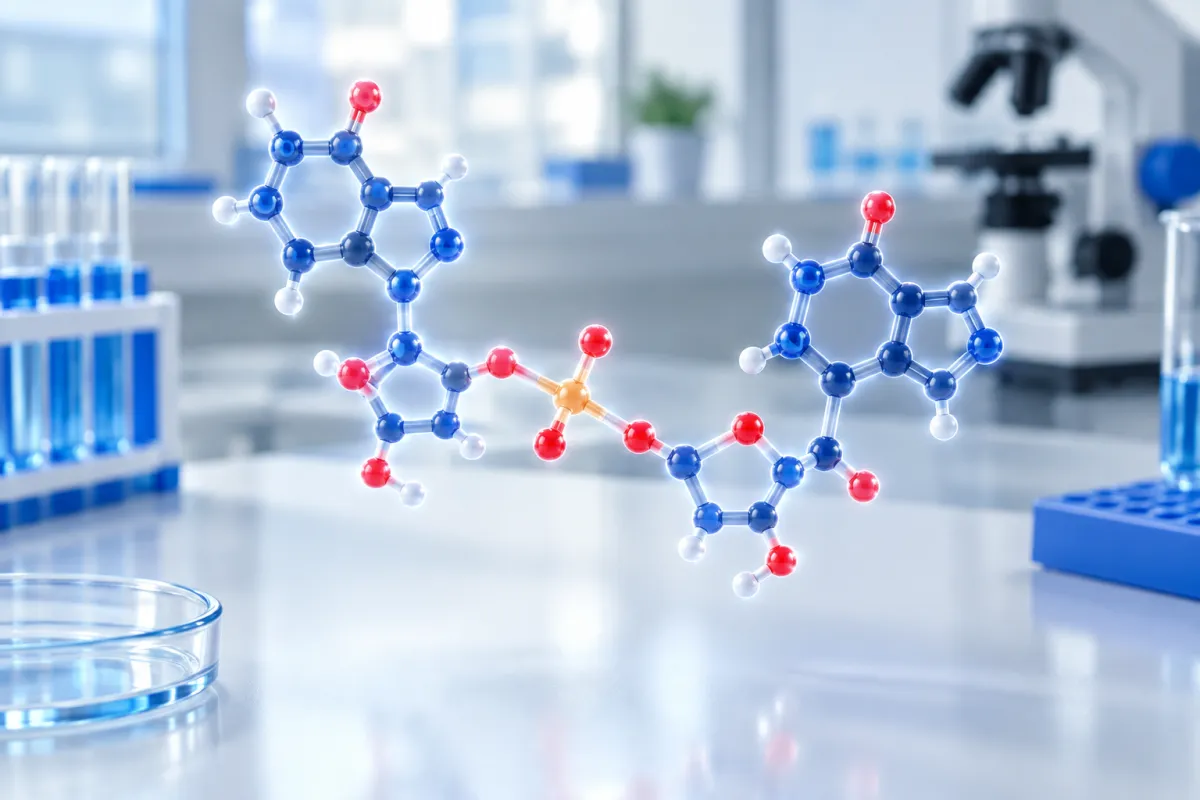 Illustration: an abstract dinucleotide model, not the exact structure of NAD+.
The chemistry happens on the nicotinamide ring. In NAD+ the ring nitrogen carries a positive charge, which is why the “+” appears in the name. When NAD+ accepts a hydride (two electrons and a proton) it becomes NADH, and PubChem’s name for NADH shows the ring as a 4H-pyridine, with an extra hydrogen at position 4 and no charge. PubChem lists NADH as C21H29N7O14P2 at 665.4 g/mol 1. A close relative, NADP+, carries one more phosphate group (C21H28N7O17P3, 743.4 g/mol) 1; Lu et al. measured all four forms, NAD+, NADH, NADP+ and NADPH, in one method 7.
How does NAD+ differ from its precursors?
NAD+ is the finished coenzyme; nicotinamide, nicotinic acid, nicotinamide riboside (NR) and NMN are smaller building blocks that cells convert into it, each entering metabolism at a different point. Formulas and weights below are from PubChem 1.
| Compound | Formula | Molecular weight (g/mol) | PubChem CID | Relation to NAD+ |
|---|---|---|---|---|
| NAD+ | C21H27N7O14P2 | 663.4 | 5892 | The coenzyme itself |
| NMN | C11H15N2O8P | 334.22 | 14180 | Joined to an adenosine unit from ATP by NMNAT enzymes 6 |
| NR | C11H15N2O5+ | 255.25 | 439924 | Phosphorylated to NMN by NR kinases 4 |
| Nicotinamide | C6H6N2O | 122.12 | 936 | Converted towards NAD+ by NAMPT in the salvage pathway 8; also released when NAD+ is consumed 9 |
| Nicotinic acid | C6H5NO2 | 123.11 | 938 | Vitamin precursor 4 |
Two points matter when reading experiments:
- What reaches the cell may differ from what was added. In human cells, Nikiforov et al. reported that, besides nicotinamide and nicotinic acid, only the corresponding nucleosides readily entered; NAD+ and NMN were broken down outside the cell first 6. Using isotope-labelled compounds, Ratajczak et al. reported that NMN was converted to NR outside mammalian cells before uptake, and that the kinase NRK1 was rate-limiting for using external NR and NMN 10.
- Tissues differ. In a cell and mouse isotope-tracer study, Liu et al. reported that cell lines made NAD+ from nicotinamide, while in mice the liver made NAD+ from the amino acid tryptophan and released nicotinamide 11.
Mitochondria add another layer. Luongo et al. reported that mammalian mitochondria can take up intact NAD+ and identified SLC25A51 as a mitochondrial NAD+ transporter 12.
What mechanisms have researchers studied?
Researchers study NAD+ in two roles: as a reusable electron carrier, and as a substrate that some enzymes consume.
- Electron carrier. NAD+ and NADH shuttle between oxidised and reduced forms without being used up. In rat liver, Williamson, Lund and Krebs calculated free NAD+/NADH ratios of about 725 in the cytoplasm and about 8 in mitochondria, and noted that much more NADH than NAD+ is bound to protein 13.
- Sirtuins. Landry et al. reported that SIR2-family enzymes (sirtuins) remove acetyl groups from histone proteins in a reaction that absolutely requires NAD 14.
- PARPs. Poly(ADP-ribose) polymerases (PARPs) use NAD+ as a substrate to build poly(ADP-ribose) 15, 6. Liu et al. reported that NAD+ in cell lines was consumed largely by PARPs and sirtuins 11.
- NADases. Essuman et al. reported that the TIR domain of the protein SARM1 cleaves NAD+ into ADP-ribose, cyclic ADP-ribose and nicotinamide, with nicotinamide acting as a feedback inhibitor 9.
- Synthesis. In mouse fibroblasts, Revollo et al. reported that the enzyme NAMPT was the rate-limiting step of the salvage pathway, and that raising NAMPT, but not NMNAT, increased total cellular NAD 8.
- Compartments. Using a fluorescent biosensor in human HEK293T cells, Cambronne et al. measured free NAD+ at about 106 µM in the cytoplasm, 109 µM in the nucleus and 230 µM in mitochondria, values close to the Michaelis constants (a measure of enzyme affinity) of sirtuins and PARPs in those compartments 15.
What does the published research include?
The NAD+ literature is large; the studies below each reported a mechanism or measurement approach discussed in this article.
| Study | Study type | Model | What was measured | Reported finding |
|---|---|---|---|---|
| Williamson, 1967 | Rodent study | Freeze-clamped rat liver | Free NAD+/NADH ratios, calculated from dehydrogenase substrates | Cytoplasmic ratio about 725 and mitochondrial ratio about 8 in well-fed rats |
| Landry, 2000 | Biochemical study | SIR2-family enzymes with acetylated histones | Deacetylase activity | Deacetylation absolutely required NAD |
| Revollo, 2004 | Cell study | Mouse fibroblasts | NAD synthesis via NAMPT and NMNAT | NAMPT was rate-limiting |
| Nikiforov, 2011 | Cell study | Human cell lines | Precursor entry and mitochondrial NAD synthesis | NAD+ and NMN were degraded outside cells before uptake |
| Cambronne, 2016 | Cell study | HEK293T cells with a biosensor | Free NAD+ by compartment | About 106, 109 and 230 µM in cytoplasm, nucleus and mitochondria |
| Ratajczak, 2016 | Cell and genetic model study | Mammalian cells | Use of external NR and NMN | NMN converted to NR outside cells; NRK1 rate-limiting |
| Essuman, 2017 | Biochemical and cell study | Purified proteins; cultured neurons | NAD+ cleavage | SARM1 TIR domain cleaved NAD+ |
| de Graaf, 2017 | Human measurement study | Human brain, 7 tesla MRS | NAD+ signal by 1H and 31P MRS | 107 ± 28 µM by 1H MRS; 312 to 367 µM by 31P MRS |
| Liu, 2018 | Isotope-tracer study | Cell lines; mice | NAD synthesis and breakdown fluxes | Fluxes varied widely between tissues |
| Luongo, 2020 | Cell and organelle study | Mammalian cells; isolated mitochondria | Mitochondrial NAD+ uptake | SLC25A51 imported NAD+ into mitochondria |
What are the limits of the evidence?
Most mechanistic evidence on NAD+ comes from purified enzymes, yeast, cultured cells and rodents, and the numbers depend heavily on how they were measured.
- Model systems. Ratios from rat liver and concentrations from one human cell line may not hold in other cells, tissues or species 13, 15. The only human data cited here are noninvasive brain measurements 16; human intervention studies are outside this article’s scope.
- Free versus total. Extraction methods report total NAD+, while sensors report the free pool 15, and much NADH is protein-bound 13.
- Extraction artefacts. Lu et al. found substantial interconversion between oxidised and reduced forms with several common extraction solvents 7. Trammell and Brenner noted that if enzymes are not inactivated when cells are broken open, cellular NAD+ can fall to about 1% of the expected value 5.
- Specificity. Trammell and Brenner argued that HPLC with UV detection lacks the specificity and sensitivity needed for complex samples, because other metabolites can share a peak 5.
- Concentration versus flux. Liu et al. described reliance on concentration measurements as a limitation; their tracer work found NAD turnover in mice high in the small intestine and spleen and low in skeletal muscle 11.
- Contested findings. Grozio et al. reported in a mouse study that Slc12a8 transports NMN 17. Schmidt and Brenner disputed that conclusion in a published comment 18, and the original authors replied 19. This sits alongside cell studies reporting that NMN is converted to NR before entry 10, 6.
This article cites a selection of primary studies and is not a systematic review.
What is NAD+’s regulatory and anti-doping status in Australia?
NAD+ is not named in the TGA’s April 2026 advisory on unapproved peptide products, and it is not named on the 2026 WADA Prohibited List.
- TGA. The TGA’s safety advisory of 13 April 2026 names BPC-157, GHK-Cu, TB-500, retatrutide and CJC-1295 as examples of unapproved peptide products, meaning goods not included in the Australian Register of Therapeutic Goods (ARTG). NAD+ is not among the compounds it names 3.
- WADA. NAD+ is not named on the 2026 Prohibited List, which came into effect on 1 January 2026 2. Check the current WADA Prohibited List, and see Sport Integrity Australia’s anti-doping information 20. Our overview of research peptides and anti-doping status compares compounds.
How is NAD+ characterised in the lab?
NAD+ material is characterised by chromatography and mass spectrometry, while NAD+ in biological samples is measured by several methods that each report a slightly different quantity.
For the material itself, reversed-phase HPLC separates NAD+ from related compounds (see what an HPLC purity figure tells you), and mass spectrometry checks identity against the expected monoisotopic mass of 663.1091 Da for neutral NAD+ 1. Our explainer on mass spectrometry for peptides covers principles that apply to small molecules too.
For biological samples, the main approaches are:
| Method | What it reports | Example |
|---|---|---|
| Reversed-phase HPLC with UV detection | Total NAD+ in an acid extract, detected by absorbance at 261 nm | Yoshino and Imai 21 |
| Liquid chromatography-mass spectrometry (LC-MS) | NAD+ and related metabolites, identified by mass | Trammell and Brenner 5; Lu et al. 7 |
| Isotope tracing with LC-MS | Rates of synthesis and breakdown | Liu et al. 11 |
| Genetically encoded fluorescent sensors | Free NAD+ in one compartment, or the NAD+/NADH ratio in living cells | Cambronne et al. 15; Zhao et al. 22 |
| Magnetic resonance spectroscopy (MRS) | NAD+ and NADH in intact brain, without taking a sample | Lu et al. 23; de Graaf et al. 16 |
| Dehydrogenase equilibrium calculations | Free NAD+/NADH ratio | Williamson et al. 13 |
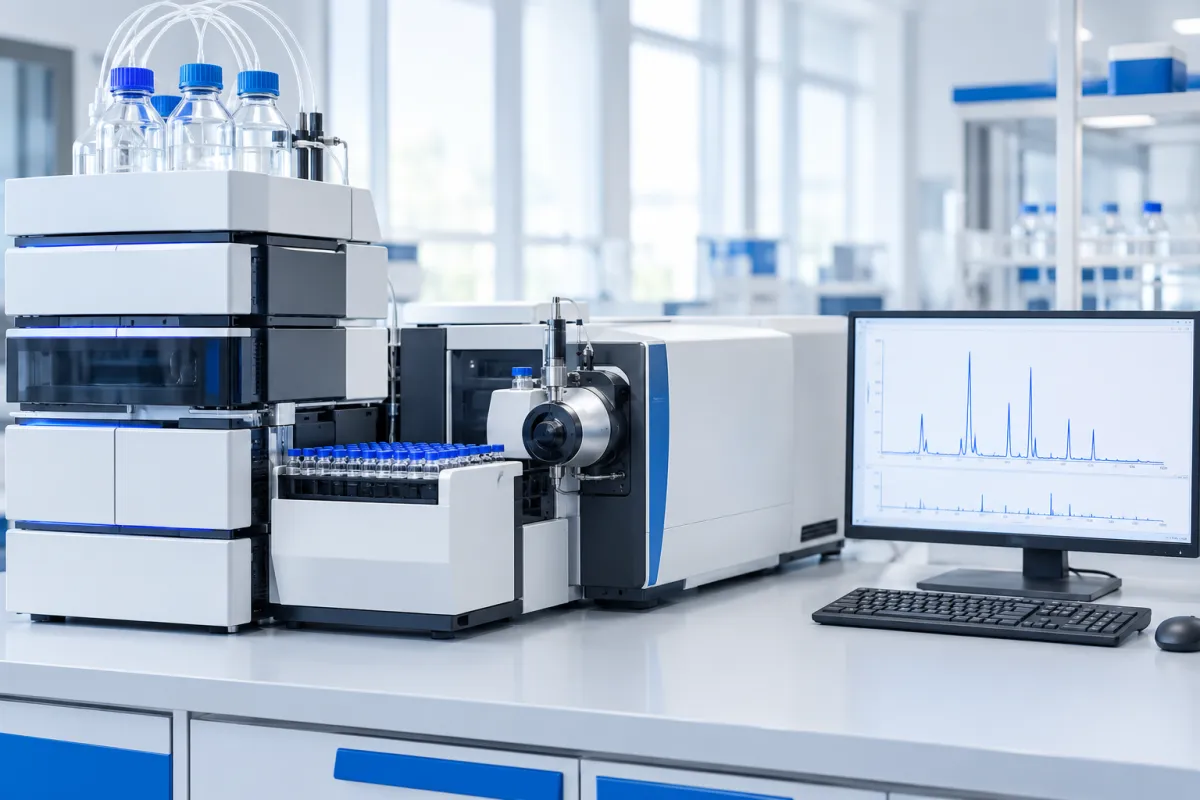 Illustration: an LC-MS system of the kind used to measure NAD+ and related metabolites.
Sample handling matters as much as the instrument. Yoshino and Imai extracted NAD+ with perchloric acid, validated their HPLC method with tandem mass spectrometry and stressed collecting tissue quickly to avoid NAD+ degradation 21. Lu et al. recommended an acidic 40:40:20 mix of acetonitrile, methanol and water with 0.1 M formic acid for LC-MS, neutralised immediately after extraction, with spiked standards to monitor interconversion 7. For MRS, which Lu et al. developed and tested in cat brain 23, de Graaf et al. reported that 1H detection is simpler but sees less of the NAD+ signal, while 31P detection sees nearly all of it but overlaps with NADH and UDP-glucose 16.
Frequently asked questions
Is NAD+ a peptide?
No. NAD+ is a dinucleotide: two nucleotides, one carrying nicotinamide and one carrying adenine, joined through a pair of phosphate groups. It contains no amino acids or peptide bonds. PubChem lists it as nadide (CID 5892), C21H27N7O14P2, 663.4 g/mol 1. Our primer on what a peptide is explains the difference.
What is the difference between NAD+ and NADH?
NAD+ is the oxidised form and NADH the reduced form of the same coenzyme. NADH carries an extra hydrogen at position 4 of the nicotinamide ring and has lost the ring’s positive charge; PubChem lists NAD+ as C21H27N7O14P2 and NADH as C21H29N7O14P2 1. In rat liver, Williamson et al. calculated free NAD+/NADH ratios of about 725 in the cytoplasm and about 8 in mitochondria 13.
What is the difference between NAD+, NMN and NR?
NMN (nicotinamide mononucleotide) and NR (nicotinamide riboside) are smaller precursors that cells convert into NAD+. NR kinases phosphorylate NR to NMN 4, and NMNAT enzymes join NMN to an adenosine unit from ATP to form NAD+ 6. In mammalian cell studies, NMN added outside cells was converted to NR before uptake 10, although a mouse study proposed a dedicated NMN transporter 17.
How is NAD+ measured in research samples?
Common methods are reversed-phase HPLC with UV detection, liquid chromatography-mass spectrometry, genetically encoded fluorescent sensors and magnetic resonance spectroscopy. The choice matters: Lu et al. found substantial interconversion of oxidised and reduced forms with several common extraction solvents 7, and sensors report free NAD+ while extraction methods report total NAD+ 15.
Is NAD+ on the WADA Prohibited List?
NAD+ is not named on the 2026 WADA Prohibited List, which came into effect on 1 January 2026 2. Check the current WADA Prohibited List before relying on this, and see Sport Integrity Australia’s anti-doping information. Our anti-doping overview covers other compounds.
References
- PubChem. Compound summaries for nadide (NAD+, CID 5892), NADH (CID 439153), NADP+ (CID 5885), nicotinamide mononucleotide (CID 14180), nicotinamide riboside (CID 439924), nicotinamide (CID 936), nicotinic acid (CID 938), adenosine monophosphate (CID 6083) and water (CID 962). National Center for Biotechnology Information. Accessed 28 September 2026. [chemical database]
- World Anti-Doping Agency. World Anti-Doping Code International Standard: Prohibited List 2026 (in effect from 1 January 2026). https://www.wada-ama.org/en/prohibited-list. Accessed 28 September 2026. [anti-doping standard]
- Therapeutic Goods Administration. Understanding your responsibilities when importing, compounding and supplying unapproved peptide products. Safety advisory, published 13 April 2026. https://www.tga.gov.au/safety/safety-monitoring-and-information/safety-alerts/understanding-your-responsibilities-when-importing-compounding-and-supplying-unapproved-peptide-products. Accessed 28 September 2026. [regulator advisory]
- Bieganowski P, Brenner C. Discoveries of nicotinamide riboside as a nutrient and conserved NRK genes establish a Preiss-Handler independent route to NAD+ in fungi and humans. Cell. 2004;117(4):495-502. doi:10.1016/s0092-8674(04)00416-7. PMID: 15137942. [yeast genetics and enzyme study]
- Trammell SA, Brenner C. Targeted, LCMS-based Metabolomics for Quantitative Measurement of NAD(+) Metabolites. Comput Struct Biotechnol J. 2013;4:e201301012. doi:10.5936/csbj.201301012. PMID: 24688693. PMCID: PMC3962138. [methods review]
- Nikiforov A, Dölle C, Niere M, et al. Pathways and subcellular compartmentation of NAD biosynthesis in human cells: from entry of extracellular precursors to mitochondrial NAD generation. J Biol Chem. 2011;286(24):21767-21778. doi:10.1074/jbc.m110.213298. PMID: 21504897. PMCID: PMC3122232. [cell study]
- Lu W, Wang L, Chen L, et al. Extraction and Quantitation of Nicotinamide Adenine Dinucleotide Redox Cofactors. Antioxid Redox Signal. 2018;28(3):167-179. doi:10.1089/ars.2017.7014. PMID: 28497978. PMCID: PMC5737638. [methods study]
- Revollo JR, Grimm AA, Imai S. The NAD biosynthesis pathway mediated by nicotinamide phosphoribosyltransferase regulates Sir2 activity in mammalian cells. J Biol Chem. 2004;279(49):50754-50763. doi:10.1074/jbc.m408388200. PMID: 15381699. [cell study]
- Essuman K, Summers DW, Sasaki Y, et al. The SARM1 Toll/Interleukin-1 Receptor Domain Possesses Intrinsic NAD+ Cleavage Activity that Promotes Pathological Axonal Degeneration. Neuron. 2017;93(6):1334-1343.e5. doi:10.1016/j.neuron.2017.02.022. PMID: 28334607. PMCID: PMC6284238. [biochemical and cell study]
- Ratajczak J, Joffraud M, Trammell SA, et al. NRK1 controls nicotinamide mononucleotide and nicotinamide riboside metabolism in mammalian cells. Nat Commun. 2016;7:13103. doi:10.1038/ncomms13103. PMID: 27725675. PMCID: PMC5476803. [cell and genetic model study]
- Liu L, Su X, Quinn WJ 3rd, et al. Quantitative Analysis of NAD Synthesis-Breakdown Fluxes. Cell Metab. 2018;27(5):1067-1080.e5. doi:10.1016/j.cmet.2018.03.018. PMID: 29685734. PMCID: PMC5932087. [cell and mouse isotope-tracer study]
- Luongo TS, Eller JM, Lu MJ, et al. SLC25A51 is a mammalian mitochondrial NAD+ transporter. Nature. 2020;588(7836):174-179. doi:10.1038/s41586-020-2741-7. PMID: 32906142. PMCID: PMC7718333. [cell and isolated mitochondria study]
- Williamson DH, Lund P, Krebs HA. The redox state of free nicotinamide-adenine dinucleotide in the cytoplasm and mitochondria of rat liver. Biochem J. 1967;103(2):514-527. doi:10.1042/bj1030514. PMID: 4291787. PMCID: PMC1270436. [rodent study]
- Landry J, Sutton A, Tafrov ST, et al. The silencing protein SIR2 and its homologs are NAD-dependent protein deacetylases. Proc Natl Acad Sci U S A. 2000;97(11):5807-5811. doi:10.1073/pnas.110148297. PMID: 10811920. PMCID: PMC18515. [biochemical study]
- Cambronne XA, Stewart ML, Kim D, et al. Biosensor reveals multiple sources for mitochondrial NAD+. Science. 2016;352(6292):1474-1477. doi:10.1126/science.aad5168. PMID: 27313049. PMCID: PMC6530784. [cell study]
- de Graaf RA, De Feyter HM, Brown PB, et al. Detection of cerebral NAD+ in humans at 7T. Magn Reson Med. 2017;78(3):828-835. doi:10.1002/mrm.26465. PMID: 27670385. PMCID: PMC5366282. [human measurement study]
- Grozio A, Mills KF, Yoshino J, et al. Slc12a8 is a nicotinamide mononucleotide transporter. Nat Metab. 2019;1(1):47-57. doi:10.1038/s42255-018-0009-4. PMID: 31131364. PMCID: PMC6530925. [mouse and cell study; an author correction was published, PMID 32694647]
- Schmidt MS, Brenner C. Absence of evidence that Slc12a8 encodes a nicotinamide mononucleotide transporter. Nat Metab. 2019;1(7):660-661. doi:10.1038/s42255-019-0085-0. PMID: 32694648. [published comment]
- Grozio A, Mills K, Yoshino J, et al. Reply to: Absence of evidence that Slc12a8 encodes a nicotinamide mononucleotide transporter. Nat Metab. 2019;1(7):662-665. doi:10.1038/s42255-019-0086-z. PMID: 32694650. [published reply]
- Sport Integrity Australia. Anti-doping. https://www.sportintegrity.gov.au/what-we-do/anti-doping. Accessed 28 September 2026. [national anti-doping body]
- Yoshino J, Imai S. Accurate measurement of nicotinamide adenine dinucleotide (NAD+) with high-performance liquid chromatography. Methods Mol Biol. 2013;1077:203-215. doi:10.1007/978-1-62703-637-5_14. PMID: 24014409. PMCID: PMC3935825. [methods chapter]
- Zhao Y, Hu Q, Cheng F, et al. SoNar, a Highly Responsive NAD+/NADH Sensor, Allows High-Throughput Metabolic Screening of Anti-tumor Agents. Cell Metab. 2015;21(5):777-789. doi:10.1016/j.cmet.2015.04.009. PMID: 25955212. PMCID: PMC4427571. [cell and animal methods study]
- Lu M, Zhu XH, Zhang Y, et al. Intracellular redox state revealed by in vivo (31) P MRS measurement of NAD(+) and NADH contents in brains. Magn Reson Med. 2014;71(6):1959-1972. doi:10.1002/mrm.24859. PMID: 23843330. PMCID: PMC4384818. [animal methods study]
Reference material. Certified Research Peptides supplies NAD+ for laboratory research, with a batch certificate of analysis: NAD+.
Check the lab report
Every published certificate of analysis names its lab, lot and test date. For laboratory research use only.