

In short: GHK-Cu is the copper(II) complex of glycyl-L-histidyl-L-lysine (GHK), a tripeptide first reported in human serum in 1973. Its published record is mostly chemistry, cell culture and rodent studies. The TGA’s April 2026 safety advisory names GHK-Cu as an example of an unapproved peptide product in Australia.
This review covers where GHK-Cu came from, how it binds copper, which mechanisms laboratories have studied and where the evidence stops. Each study is labelled by type, using the categories explained in how to read a peptide study. A tripeptide is a chain of three amino acids. GHK-Cu is also one of the four components of the KLOW peptide blend.
Key facts
| Property | Value |
|---|---|
| Name and synonyms | GHK-Cu; glycyl-L-histidyl-L-lysine copper(II) complex; Cu(II)-GHK; prezatide copper (PubChem’s name for the 1:1 complex). The peptide alone is GHK or Gly-His-Lys |
| Sequence and length | Gly-His-Lys, 3 amino acid residues, bound to one copper(II) ion |
| Molecular formula | GHK peptide: C14H24N6O4 1. 1:1 copper complex (prezatide copper): C14H23CuN6O4+ 2 |
| Molecular weight | GHK peptide: 340.38 g/mol 1. Prezatide copper: 402.92 g/mol 2 |
| CAS number | GHK peptide: 49557-75-7 1. Prezatide copper: 89030-95-5 2 |
| PubChem CID | 73587 (GHK peptide); 71587328 (prezatide copper); 133697840 (a record titled GHK-Cu, drawn as two peptides per copper ion) 3 |
| Compound class | Metal-peptide complex (chelate) of a tripeptide |
| Evidence base | Chemistry, cell and animal studies. Registered human studies are few and are outside the scope of this review |
| WADA status | Not named in the 2026 WADA Prohibited List 4 |
| TGA status | Named in the TGA’s 13 April 2026 safety advisory as an example of an unapproved peptide product, meaning goods not included in the ARTG 5 |
What is GHK-Cu?
GHK-Cu is the tripeptide glycyl-L-histidyl-L-lysine (GHK) with a copper(II) ion bound to it. The peptide was reported first; its link with copper came later.
In 1973, Pickart and Thaler reported a tripeptide in human serum that, in the words of their title, prolonged the survival of normal liver cells and stimulated growth in neoplastic (tumour-derived) liver 6. In 1977, Schlesinger, Pickart and Thaler identified it as glycyl-histidyl-lysine 7.
In 1980, Pickart and colleagues reported that the peptide co-purified from plasma with roughly equimolar copper and a smaller amount of iron. They also reported that the tripeptide readily formed complexes with copper(II) and increased copper uptake into cultured hepatoma (liver tumour) cells 8. Early papers abbreviated the peptide as GHL; GHK, built from one-letter amino acid codes, is the usual name today.
The same three-residue sequence occurs inside a larger protein: the alpha-2 chain of human type I collagen contains a Gly-His-Lys triplet 9. Maquart and colleagues noted this in 1988 and suggested that the tripeptide might be released from collagen by proteases, the enzymes that cut proteins 10.
How is GHK-Cu structured?
GHK-Cu is a small metal-peptide complex, or chelate: in solution at neutral pH, one copper(II) ion is held mainly by three nitrogen atoms from one GHK molecule.
Glycine sits at the N-terminus with a free amino group. Histidine, in the middle, carries an imidazole ring (a five-membered ring containing two nitrogen atoms). Lysine sits at the C-terminus and carries a second amino group on its side chain.
Solution spectroscopy. In a 1982 chemistry study, Freedman and colleagues used electron paramagnetic resonance (EPR) and related spectroscopies, which probe the surroundings of the copper ion. They reported a 1:1 copper(II) complex at neutral pH, with copper held by two or three nitrogen atoms, one of them in the histidine ring. The oxygen-bridged polymeric structure seen in crystals did not exist in solution 11.
Crystal and solution structures. In a 2011 chemistry study, Hureau and colleagues combined X-ray crystallography with EPR, X-ray absorption and nuclear magnetic resonance (NMR) spectroscopy. They reported that Cu(II)-GHK is dimeric in the solid state but monomeric in solution, with three nitrogen ligands: the glycine amino group, a deprotonated backbone amide nitrogen and a histidine imidazole nitrogen. They also reported fast copper exchange, which they attributed to a complex with two GHK molecules per copper ion 12.
Binding strength. Using isothermal titration calorimetry, which measures the heat released as a metal binds, Trapaidze and colleagues reported mainly 1:1 binding and a conditional dissociation constant of 7.0 × 10⁻¹⁴ M at pH 7.4 13. The smaller the constant, the more tightly the metal is held.
Competition with albumin. Albumin, the most abundant plasma protein, also binds copper. In a 1981 equilibrium study, Lau and Sarkar reported that with equal amounts of albumin and GHK, about 42% of the copper was bound to the peptide 14. In 2021, Bossak-Ahmad and colleagues reported two ternary complexes in which Cu(II)-GHK was also bound to histidine side chains of human serum albumin 15.
Why the formula differs between records. PubChem’s prezatide copper record describes one peptide per copper ion (C14H23CuN6O4+, 402.92 g/mol) 2, while a record titled GHK-Cu describes two (C28H48CuN12O8, 744.3 g/mol) 3. When a certificate of analysis gives a molecular formula or molecular weight, it shows which form the batch is described as.
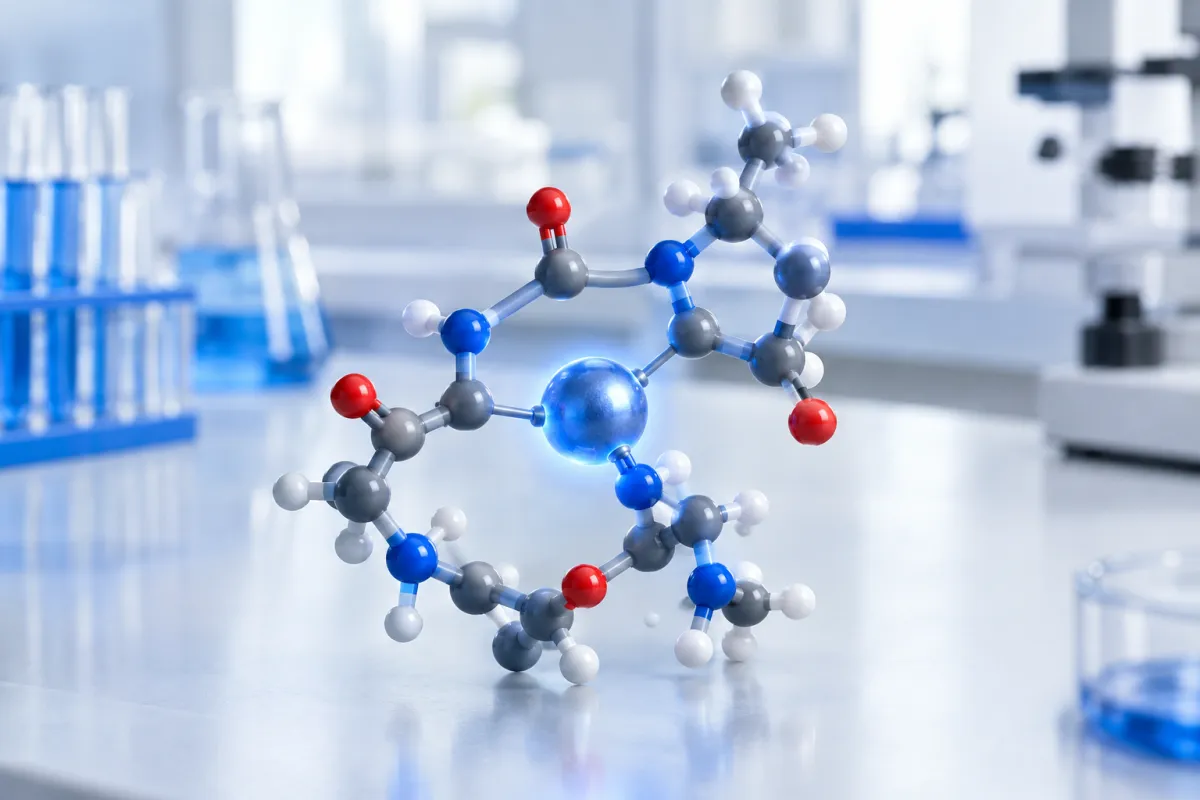 Illustration: a short peptide chain binding a metal ion. It does not show the exact structure of GHK-Cu.
What mechanisms have researchers studied?
Mechanism work on GHK and GHK-Cu falls into four groups: copper transport, gene expression, inflammatory signalling in cell and rodent models, and interactions with metals and reactive molecules.
Copper transport. The 1980 paper proposed that GHK acts as a copper transport factor, based on its co-isolation with copper, its resemblance to copper-binding sites on albumin and the increased copper uptake the authors measured in hepatoma cells 8. The albumin studies above approach the same question through chemistry 14, 15.
Gene expression. Gene expression is the copying of a gene’s information into RNA; profiling measures thousands of RNA levels at once. In 2012, Campbell and colleagues profiled 64 lung tissue samples from smokers with chronic obstructive pulmonary disease (COPD) and identified 127 genes whose expression tracked regional emphysema severity. A search of the Connectivity Map, a public database of gene-expression profiles from cultured cells exposed to many compounds, identified GHK as a compound whose profile ran opposite to that signature. In human lung fibroblasts (connective tissue cells), GHK reproduced patterns associated with TGF-beta signalling, and GHK or TGF-beta restored collagen I contraction and remodelling by fibroblasts from COPD lungs 16. A 2018 review by Pickart and Margolina discusses gene-expression data of this kind 17.
Inflammatory signalling. In a 2016 study, Park and colleagues exposed RAW 264.7 macrophages (a mouse immune cell line) and mice to lipopolysaccharide (LPS), a bacterial cell-wall component used to trigger inflammation. They reported that GHK-Cu reduced reactive oxygen species and the cytokines TNF-alpha and IL-6 (immune signalling proteins), increased superoxide dismutase activity and suppressed NF-kappaB p65 and p38 MAPK signalling 18.
Metals and reactive molecules. In a 2024 cell study, Min and colleagues reported that GHK bound copper, reduced its redox activity and prevented copper- and zinc-induced death of central nervous system cells in culture, as well as metal-induced aggregation of bovine serum albumin 19. In a 2008 chemistry study, Beretta and colleagues reported that GHK reacted with acrolein, a reactive aldehyde formed when fats oxidise 20.
What does the published research include?
The published research on GHK-Cu is mainly chemistry, cell culture and rodent studies, with lung injury and lung fibrosis among the most studied animal models.
A Europe PMC title search on 28 September 2026 returned 148 PubMed-indexed papers with GHK or its chemical name in the title 21. The table summarises representative primary studies. Findings are in each study’s own terms and apply only to the model tested.
| Study | Study type | Model | What was measured | Reported finding |
|---|---|---|---|---|
| Maquart 1988 | Cell study | Fibroblast cultures | Collagen synthesis; cell number | GHK-Cu increased collagen synthesis, independent of any change in cell number |
| Campbell 2012 | Human tissue gene-expression study with cell experiments | Lung tissue from smokers with COPD; human lung fibroblasts | Genes linked to emphysema severity; Connectivity Map; collagen gel contraction | GHK was identified as reversing the severity signature and restored contraction by COPD-derived fibroblasts |
| Park 2016 | Cell and mouse study | RAW 264.7 macrophages; mice with LPS-induced acute lung injury | Oxidative and inflammatory markers; lung histology | Lower TNF-alpha and IL-6 and less inflammatory cell infiltration into lung tissue |
| Zhou 2017 | Mouse study (GHK without copper) | Mice with bleomycin-induced lung fibrosis | Histology; collagen; TGF-beta1 and Smad signalling | Less inflammatory infiltration and fibrosis; reversal of increases in TGF-beta1 and phosphorylated Smad2 and Smad3 |
| Ma 2020 | Mouse study | Mice with bleomycin-induced lung fibrosis | Histology; TNF-alpha, IL-6, myeloperoxidase; collagen | Inhibition of inflammatory and fibrotic changes and less collagen deposition |
| Fu 2015 | Rat study | 72 rats after anterior cruciate ligament reconstruction, GHK-Cu or saline | Knee laxity; graft stiffness and strength; gait; histology | Smaller laxity difference at 6 weeks; no significant differences at 12 weeks or in ultimate load, gait or histology |
| Mao 2025 | Mouse and cell study | Mice with dextran sulfate sodium colitis; mouse macrophages and colonic epithelial cells | Disease activity index; cytokines; tight junction proteins; SIRT1 and STAT3 | Lower disease activity index and cytokines; higher ZO-1, occludin and SIRT1 |
 Illustration: cell-culture work, the setting for much of the published GHK-Cu research.
What are the limits of the evidence?
The evidence reviewed here is preclinical: chemistry, cell culture and animal models, with no human efficacy data among these studies.
- Human data. A ClinicalTrials.gov search on 28 September 2026 returned three registered studies that mention GHK-Cu 26; they are outside the scope of this review. Apart from the donated lung tissue analysed by Campbell and colleagues 16, none of the studies above involved people. See why most peptide research is preclinical.
- Concentration of authorship. Loren Pickart, who co-authored the 1973 report, is an author on 15 of the 148 papers in the title search, including 4 of the 10 most cited 21. The 2018 review lists a commercial research and development department as the authors’ affiliation 17. Two of the lung fibrosis studies share authors 22, 23.
- Different forms. Some studies used GHK alone and others GHK-Cu. Because GHK exchanges copper quickly 12 and competes with albumin for it 14, the form present in a culture or an animal may not match the form added.
- Computational matches. The Connectivity Map result is a match between gene-expression profiles from cultured cells, not an outcome measured in people 16.
- Transient results. In the rat ligament study, differences seen at 6 weeks were absent at 12 weeks 24.
- Model limits. Chemically induced injury models reproduce selected features of a human disease in an animal, not the disease itself.
What is GHK-Cu’s regulatory and anti-doping status in Australia?
The TGA names GHK-Cu as an example of an unapproved peptide product, and GHK-Cu is not named on the 2026 WADA Prohibited List.
The TGA’s safety advisory of 13 April 2026 names BPC-157, GHK-Cu, TB-500, retatrutide and CJC-1295 as examples of unapproved peptide products, meaning goods not included in the Australian Register of Therapeutic Goods (ARTG). It says these products have not been evaluated by the TGA for safety, quality or effectiveness 5.
GHK-Cu is not named in the 2026 WADA Prohibited List, in effect from 1 January 2026 4. The list’s section S0 (non-approved substances) is not limited to named examples: it covers any pharmacological substance not addressed by other sections and with no current approval by any governmental regulatory health authority for human therapeutic use. Check the current WADA Prohibited List and Sport Integrity Australia, and see our anti-doping status table for research peptides.
How is GHK-Cu characterised in the lab?
Laboratories use the same tools as for other synthetic peptides, plus methods that examine the copper.
- Identity. Mass spectrometry measures molecular mass and so confirms whether the peptide is Gly-His-Lys. Beretta and colleagues used electrospray ionisation tandem mass spectrometry to characterise GHK and its reaction products 20. See how mass spectrometry confirms peptide identity.
- Purity. Reversed-phase HPLC separates a peptide from synthesis by-products. See what an HPLC purity percentage does and does not tell you.
- Copper binding. Research groups have characterised the complex with potentiometric titration and visible absorption spectroscopy 14, EPR 11, X-ray crystallography and NMR 12, and calorimetry 13.
- Form stated. Because the 1:1 and 2:1 PubChem records differ in formula and weight 2, 3, the values on a certificate of analysis show which form a batch is described as. Our guide to reading a peptide certificate of analysis explains each section, and our published batch certificates are listed separately.
Frequently asked questions
Is GHK-Cu the same as GHK?
No. GHK is the tripeptide glycyl-L-histidyl-L-lysine on its own (C14H24N6O4, PubChem CID 73587) 1. GHK-Cu is that peptide bound to a copper(II) ion. PubChem lists the 1:1 complex as prezatide copper (CID 71587328) 2 and holds a separate GHK-Cu record drawn with two peptides per copper ion (CID 133697840) 3. Published studies used either GHK alone or the copper complex.
Who discovered GHK?
Pickart and Thaler reported the tripeptide in human serum in 1973 6. In 1977, Schlesinger, Pickart and Thaler identified it as glycyl-histidyl-lysine 7. In 1980, Pickart and colleagues reported that it forms complexes with copper(II) and increases copper uptake into cultured hepatoma cells 8. Pickart is an author on all three papers, and on several later reviews of the peptide.
Has GHK-Cu been tested in human clinical trials?
The published literature on GHK-Cu is mainly chemistry, cell and animal research. A ClinicalTrials.gov search on 28 September 2026 returned three registered studies that mention GHK-Cu 26; they are outside the scope of this review. Our guide to how to read a peptide study explains why cell and animal findings cannot be read as results in people.
Is GHK-Cu approved by the TGA?
The TGA’s safety advisory of 13 April 2026 names GHK-Cu, with BPC-157, TB-500, retatrutide and CJC-1295, as examples of unapproved peptide products: goods not included in the Australian Register of Therapeutic Goods. The advisory says these products have not been evaluated by the TGA for safety, quality or effectiveness 5.
Is GHK-Cu on the WADA Prohibited List?
GHK-Cu is not named in the 2026 WADA Prohibited List 4. Section S0 of the list (non-approved substances) covers any pharmacological substance not addressed elsewhere in the list and with no current approval by any governmental regulatory health authority for human therapeutic use. Check the current list, Sport Integrity Australia and our anti-doping status table.
How is the identity of GHK-Cu confirmed?
Mass spectrometry confirms identity by measuring molecular mass, and HPLC measures purity. Research groups studying the copper complex have also used EPR spectroscopy, X-ray crystallography and calorimetry 11, 12, 13. The molecular formula on a certificate of analysis shows whether a batch is described as the 1:1 or the 2:1 peptide-to-copper form. See our guide to peptide mass spectrometry.
References
- PubChem. Glycyl-L-histidyl-L-lysine (CID 73587). https://pubchem.ncbi.nlm.nih.gov/compound/73587. Accessed 28 September 2026. [compound database]
- PubChem. Prezatide copper (CID 71587328). https://pubchem.ncbi.nlm.nih.gov/compound/71587328. Accessed 28 September 2026. [compound database]
- PubChem. GHK-Cu (CID 133697840). https://pubchem.ncbi.nlm.nih.gov/compound/133697840. Accessed 28 September 2026. [compound database]
- World Anti-Doping Agency. World Anti-Doping Code International Standard: Prohibited List 2026. https://www.wada-ama.org/en/prohibited-list. Accessed 28 September 2026. [anti-doping regulator]
- Therapeutic Goods Administration. Understanding your responsibilities when importing, compounding and supplying unapproved peptide products (safety advisory, 13 April 2026). https://www.tga.gov.au/safety/safety-monitoring-and-information/safety-alerts/understanding-your-responsibilities-when-importing-compounding-and-supplying-unapproved-peptide-products. Accessed 28 September 2026. [regulator]
- Pickart L, Thaler MM. Tripeptide in human serum which prolongs survival of normal liver cells and stimulates growth in neoplastic liver. Nature: New Biology. 1973;243(124):85-87. PMID: 4349963. [cell study]
- Schlesinger DH, Pickart L, Thaler MM. Growth-modulating serum tripeptide is glycyl-histidyl-lysine. Experientia. 1977;33(3):324-325. doi:10.1007/bf02002806. PMID: 858356. [analytical chemistry study]
- Pickart L, Freedman JH, Loker WJ, et al. Growth-modulating plasma tripeptide may function by facilitating copper uptake into cells. Nature. 1980;288(5792):715-717. doi:10.1038/288715a0. PMID: 7453802. [cell and chemistry study]
- UniProt. Collagen alpha-2(I) chain, human (P08123). https://www.uniprot.org/uniprotkb/P08123/entry. Accessed 28 September 2026. [protein database]
- Maquart FX, Pickart L, Laurent M, et al. Stimulation of collagen synthesis in fibroblast cultures by the tripeptide-copper complex glycyl-L-histidyl-L-lysine-Cu2+. FEBS Letters. 1988;238(2):343-346. doi:10.1016/0014-5793(88)80509-x. PMID: 3169264. [cell study]
- Freedman JH, Pickart L, Weinstein B, et al. Structure of the glycyl-L-histidyl-L-lysine-copper(II) complex in solution. Biochemistry. 1982;21(19):4540-4544. doi:10.1021/bi00262a004. PMID: 6291585. [chemistry study]
- Hureau C, Eury H, Guillot R, et al. X-ray and solution structures of Cu(II) GHK and Cu(II) DAHK complexes: influence on their redox properties. Chemistry: A European Journal. 2011;17(36):10151-10160. doi:10.1002/chem.201100751. PMID: 21780203. [chemistry study]
- Trapaidze A, Hureau C, Bal W, et al. Thermodynamic study of Cu2+ binding to the DAHK and GHK peptides by isothermal titration calorimetry (ITC) with the weaker competitor glycine. Journal of Biological Inorganic Chemistry. 2012;17(1):37-47. doi:10.1007/s00775-011-0824-5. PMID: 21898044. [chemistry study]
- Lau SJ, Sarkar B. The interaction of copper(II) and glycyl-L-histidyl-L-lysine, a growth-modulating tripeptide from plasma. Biochemical Journal. 1981;199(3):649-656. doi:10.1042/bj1990649. PMID: 7340824. PMCID: PMC1163421. [chemistry study]
- Bossak-Ahmad K, Bal W, Frączyk T, et al. Ternary Cu2+ complexes of human serum albumin and glycyl-L-histidyl-L-lysine. Inorganic Chemistry. 2021;60(22):16927-16931. doi:10.1021/acs.inorgchem.1c03084. PMID: 34730942. [chemistry study]
- Campbell JD, McDonough JE, Zeskind JE, et al. A gene expression signature of emphysema-related lung destruction and its reversal by the tripeptide GHK. Genome Medicine. 2012;4(8):67. doi:10.1186/gm367. PMID: 22937864. PMCID: PMC4064320. [human tissue gene-expression study with cell experiments]
- Pickart L, Margolina A. Regenerative and protective actions of the GHK-Cu peptide in the light of the new gene data. International Journal of Molecular Sciences. 2018;19(7):1987. doi:10.3390/ijms19071987. PMID: 29986520. PMCID: PMC6073405. [narrative review]
- Park JR, Lee H, Kim SI, et al. The tri-peptide GHK-Cu complex ameliorates lipopolysaccharide-induced acute lung injury in mice. Oncotarget. 2016;7(36):58405-58417. doi:10.18632/oncotarget.11168. PMID: 27517151. PMCID: PMC5295439. [cell and mouse study]
- Min JH, Sarlus H, Harris RA. Glycyl-L-histidyl-L-lysine prevents copper- and zinc-induced protein aggregation and central nervous system cell death in vitro. Metallomics. 2024;16(5):mfae019. doi:10.1093/mtomcs/mfae019. PMID: 38599632. PMCID: PMC11135135. [cell study]
- Beretta G, Arlandini E, Artali R, et al. Acrolein sequestering ability of the endogenous tripeptide glycyl-histidyl-lysine (GHK): characterization of conjugation products by ESI-MSn and theoretical calculations. Journal of Pharmaceutical and Biomedical Analysis. 2008;47(3):596-602. doi:10.1016/j.jpba.2008.02.012. PMID: 18378108. [analytical chemistry study]
- Europe PMC. Title search for GHK, glycyl-histidyl-lysine, glycyl-L-histidyl-L-lysine, Gly-His-Lys, glycylhistidyllysine or copper tripeptide, PubMed-indexed records, sorted by citation count. https://europepmc.org/. Accessed 28 September 2026. [literature search]
- Zhou XM, Wang GL, Wang XB, et al. GHK peptide inhibits bleomycin-induced pulmonary fibrosis in mice by suppressing TGFβ1/Smad-mediated epithelial-to-mesenchymal transition. Frontiers in Pharmacology. 2017;8:904. doi:10.3389/fphar.2017.00904. PMID: 29311918. PMCID: PMC5733019. [mouse study]
- Ma WH, Li M, Ma HF, et al. Protective effects of GHK-Cu in bleomycin-induced pulmonary fibrosis via anti-oxidative stress and anti-inflammation pathways. Life Sciences. 2020;241:117139. doi:10.1016/j.lfs.2019.117139. PMID: 31809714. [mouse study]
- Fu SC, Cheuk YC, Chiu WY, et al. Tripeptide-copper complex GHK-Cu (II) transiently improved healing outcome in a rat model of ACL reconstruction. Journal of Orthopaedic Research. 2015;33(7):1024-1033. doi:10.1002/jor.22831. PMID: 25731775. [rat study]
- Mao S, Huang J, Li J, et al. Exploring the beneficial effects of GHK-Cu on an experimental model of colitis and the underlying mechanisms. Frontiers in Pharmacology. 2025;16:1551843. doi:10.3389/fphar.2025.1551843. PMID: 40672369. PMCID: PMC12263609. [mouse and cell study]
- ClinicalTrials.gov. Search for the term GHK-Cu. https://clinicaltrials.gov/search?term=GHK-Cu. Accessed 28 September 2026. [trial registry]
Reference material. Certified Research Peptides supplies GHK-Cu for laboratory research, with a batch certificate of analysis: GHK-Cu.
Check the lab report
Every published certificate of analysis names its lab, lot and test date. For laboratory research use only.